9 minutes ago
Women and Their Power in New Institutions
Periskopi(6 years ago)
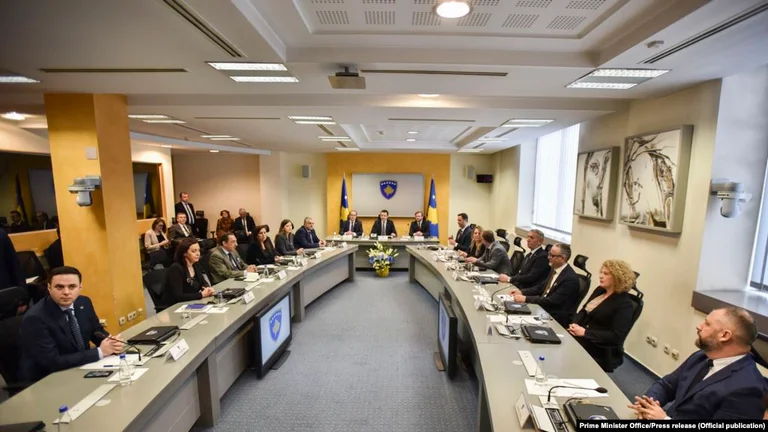
(6 years ago)For the first time since the formation of institutions of the Republic of Kosovo, in the new government headed by Albin Kurti, comprised of 15 ministries, five of them will be led by women. Meanwhile, at the helm of the Kosovo Assembly, a woman has also been chosen, Vjosa Osmani, who first vice has yes [...]
For the first time since the formation of institutions of the Republic of Kosovo, in the new government headed by Albin Kurti, comprised of 15 ministries, five of them will be led by women. Meanwhile, at the helm of the Kosovo Assembly, a woman, Vjosa Osmani, who first deputy also has a wife, MP Arberie Nagavci.
The women's ministers voted in the Kosovo Assembly on Monday are Albulen Haxhiu, Justice Minister Roseta Hajdari, Economy, Trade and Finance Minister and Finance alike from the Vetevendosje Movement. Meanwhile, by the Democratic League of Kosovo, Hykmete Bajrami has been named Minister of Education and Vlora Doshumi Minister of Culture, Youth and Sports. In contrast, from non-Serb communities, Emilia Rexhepi will be Minister of Local Power Management.
Nongovernmental organisations dealing with women's rights and empowering their role in politics and society assess the appointment of six women in decision-making positions as a positive step, as they have sometimes expressed concerns that women are under-represented in most governing positions.
Luljeta Demolli, executive director of the Centre for Investigative and Gender Studies, in a proposal for Radio Free Europe, says that in the new government, 30 percent quota has been reached, which, according to her, implies that the quota system has produced positive effects.
Serbian Prime Minister Albin Kurti (Vojsa Osmani) has come from younger generations. Therefore, it is normal to have a better representation of gender representation. And we have a very quality representation of women. We hope that this government will be more willing to increase the number of women in employment”, Demolli said.
Even Life Krasniqi, analyst from the Kosovo Democratic Institute, told Radio Free Europe, increasing women's representation in the new government, testifies that political will is in line with the requirements of nongovernmental organisations and the need for all members of society to take their obligations as equal members.
I think the awareness of society for the role of women in general, such as society, decisionmaking, and every aspect of life will increase. In addition to increasing awareness, gender prejudice” will be fought, Krasniqi said.
In addition to appointments to the government, in the 6 October parliamentary elections, women secured 38 out of 120 seats in Kosovo's Assembly. Most of the women MPs secured seats in the assembly through winning votes, without needing gender quotas.
The quota system in Kosovo for the first time applied to the United Nations Mission in Kosovo (UNMIK) in 2000. Under one regulation, at least 30 percent of candidates on party lists were required to be female.
But representatives from civil society say the Law on Gender Equality should be implemented, in which it says that “the uneven representation of a gender is when participation or representation is lower than 50 percent in any organ and decision-making level in political and public life”.
In the government led by Ramush Haradinaj, formed in 2017 and numbering 21 ministries, only two women were originally appointed to ministerial posts -- gifts Hoxha and Albena Resiti. The latter had resigned a year later.
During the mandate of the same government, following several changes to the ministry, Adrijana Hodzic had headed the Ministry of Management of Local Power, while earlier last year Dijana Zivic had been appointed Minister of Agriculture.
Another issue that is constantly raised as concern, in terms of representation and participation of women in decision-making, is related to local government, as all 38 Kosovo municipalities are led by men.
The highest position ever held by any woman in Kosovo is that of Kosovo President Atifete Jahjaga from 2011 to 2016.
Unlike a statistical report for 2019 by the Institute for Advanced GAP Studies published last week, women's employment rate, especially in high leadership positions, is said to remain very low in comparison with men. These differences are especially expressed at the central level.
According to this report, until the day of Prime Minister Haradinaj's resignation, only ten per cent of senior management positions (the ministers, deputy ministers, secretary-general) were managed by women. Even in leadership positions in municipal administration, the GAP report notes, women's representation remains quite low, with only 20 percent.
In addition to leading positions, the degree of employed women remains lower than men. Since the rate of unemployment among men in 2019 was 22.8 percent, the unemployment rate among women was 32.7 percent. On the other hand, the report says, women's interest in finding a job is nearly the same level as that of men.