12 minutes ago
Political rivalry for primat in dialogue
Periskopi(6 years ago)
(6 years ago)In the process of Kosovo-Serbia dialogue, which aims to resume in the future in order to reach an agreement that would resolve the dispute between the two countries, the role of representatives of Kosovo's highest political institutions will be discussed on the basis of a new political context, in which it is currently [...]
In the process of Kosovo-Serbia dialogue, which is intended to resume in the future in order to reach an agreement that would resolve the dispute between the two countries, the role of representatives of Kosovo's highest political institutions will be discussed on the basis of a new political context, in which it is currently the country, assessing connoisseurs of political developments.
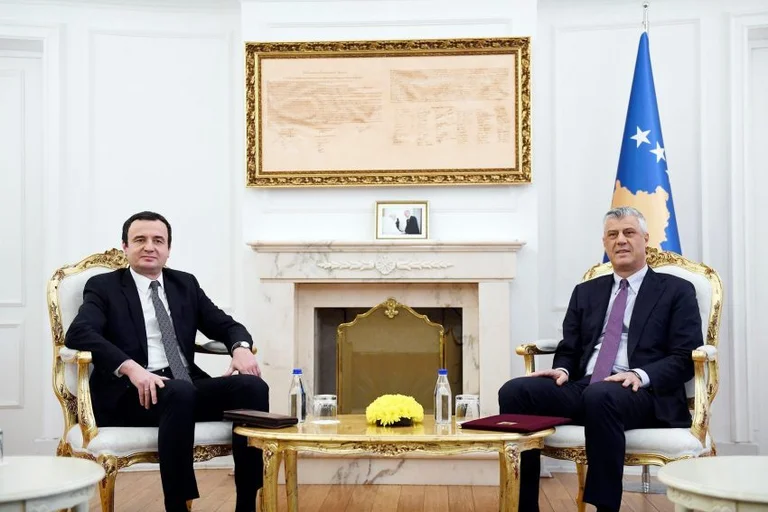
In recent years, the leading role in dialogue with Serbia has been held by the country's president, Hashim Thaci, but, Kosovo's new prime minister, Albin Kurti, has already warned that the Kosovo government will have the leading role in the process.
Kosovo Prime Minister Albin Kurti has stated in an interview for Radio Free Europe that he does not believe there could be a “team that is both prime minister and President”, as he says it is not in the nature of international negotiations such a situation.
According to political development connoisseurs, there is already an assessment of the country's Constitutional Court, which defines the roles of institutions in the dialogue process with Serbia.
The Kryeziu Progress by the Committee for Jury and Political Studies tells Radio Free Europe that the Presidency and Prime Minister have institutional responsibility to co-ordinate their positions and represent with a voice Kosovo's position in the dialogue process with Serbia.
There is an act of Constitutional Court of the Republic of Kosovo that has confirmed the responsibility and constitutional competencies to the Government to lead with the process of dialogue, clarifying that it has such role and responsibility and that no other institution can be carried. The second “, this bias, has confirmed that the country's president has only a consultative role in the middle. Although he recognises the president's role, he considers that his role in relation to the prime minister could only be developed in the margins of co-operation between the” institutions, Kryeziu points out.
Political affairs analyst Imer Mushkolaj, speaking of Radio Free Europe, says that based on the Constitutional Court's assessment, the main burden in the dialogue process with Serbia will fall on the Government of Kosovo. According to him, the president has constitutional competencies for representing Kosovo abroad, and he, in the process of dialogue, must be brought in line with these competencies.
“I don't see that there may be problems in the approach that institutions will have in front of talks with Serbia, if the president and prime minister simply exploit their competencies. Of course, none of these, such as positions, rule out each other, so this should not be the case. More important than who could have more responsibility, which would be imposed, conditionally, more, is to reach a kind of general consensus in terms of talks with Serbia, but also opposition support”, says Mushkolaj.
He adds that the European Union and the United States of America are not interested in proper names, as a guarantee of continuing dialogue and reaching an agreement, because the related positions and competencies have clarified the Constitutional Court.