8 hours ago
Details from the meeting in Munich: How the Vuchy Kurt crashed
Periskopi(6 years ago)
(6 years ago)In Munich, a debate on the Western Balkans took place on Friday. The panel of discussion has been closed, but the DW has learned some details from its sources. The European Union and the US have not turned their backs on the Western Balkans. That was the message the organizers of [...]
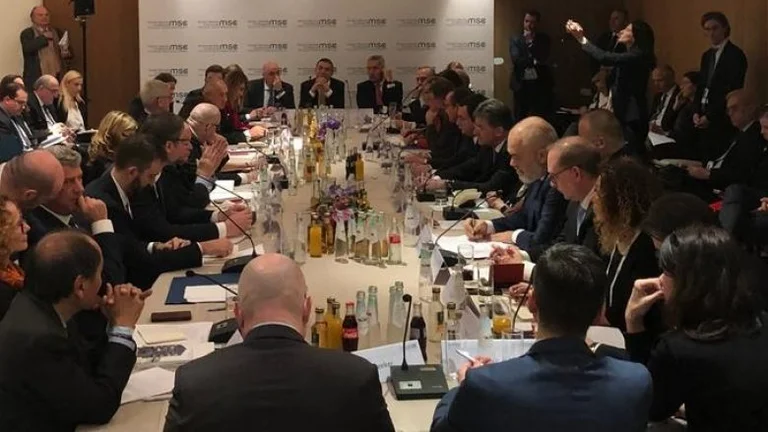
The European Union and the US have not turned their backs on the Western Balkans. That was the message the summit organisers gave for the Western Balkans, as learned from well-informed sources. The debate, organised on Friday evening in Munich, has sparked tremendous interest.
The rally was host of Munich Wolfgang Ischinger's Conference, chief of European diplomacy Josep Borelli, Kosovo President Hashim Thaci, Serbia's Aleksandar Vuciq, Montenegrin state head Milo Djukanovic, North Macedonia Pendarovski, Albanian Prime Minister Edi Rama, Bulgarian leader Boiko Borisov and many other personalities. With great interest at this meeting, however, the presentation of Kosovo Prime Minister Albin Kurti, who was for the first time part of these meetings has been expected.
Close-door appointment
The meeting was held on closed doors according to principle “Chatam Haus”, which means that participants do not have the right to publish details from the meeting. However, a video of Prime Minister Kurti's speech, which has been declared against the current idea of Minisenen, is published on social networks, demanding that this idea be converted into the Berlin Process framework.
Kurti has presented three principles for talks with Serbia. There is no agreement without dialogue. The second sʹka dialogue with maps and the third without presidents on maps”. In this way he directly criticised President Thaci and Prime Minister Vuciq, but also Prime Minister Rama, of whom rumours were spread in the media, that he has been involved in the issue of possible change of Kosovo and Serbia's borders.
From DW sources it has been learned that Serbia's president, Vuciq, was mostly concerned after Kurti's claims that “bota has helped Kosovo break free from Serbia, now must help Serbia break free from Kosovo”, because it presents only burdens to Serbia.
From well-informed sources it is also taught that Vucic has rejected these claims, in words that “Kosovo is still part of Serbia according to Resolution 1244 and that Kosovo has not yet recognised half of UN member states and more than half of the world population”.
Kurt was at this meeting the only one who has asked the six countries of the Western Balkans to join the European Union simultaneously. “If one or two states enter the EU before others, there will be even more problems”, said Kurti, who has rejected the idea of the Minisen and added that Balkan countries now need a éMini-Marill Plany.
Mycengen Protectors
The countries, which have launched the initiative for Minisensis, have defended the idea in words that it offers free movement of people and goods. Representatives of these countries have confirmed that this idea also stems from the Berlin Process. It is learned that one of them has rejected all claims that it protects any ideas for the creation of a third Yugoslavia and has even used words like those over and over again of this <x0).
One of the most addressed topics has been the necessity of opening a clearer perspective of Western Balkan countries for EU membership. There have been differences between speakers for procedures that must be followed up to membership and the way membership is done. But all speakers agreed that the perspective of BP countries for EU membership should be kept open.
One of the speakers has also criticised non-European trends in the Balkans, suggesting that there are countries and states in the Balkans which curb and undermine this path. He has not clearly appointed what countries these are, but is thought to be the closest countries to Russia.
From well-informed sources we learn that Kosovo President Hashim Thaci has called for a stronger EU commitment to solving problems, primarily for visa liberalisation for Kosovars. The EU has been criticised for its inaction and negligence, while Kosovars feel deceived by the EU because Kosovo has met all the conditions required.
More unity is required by the EU in resolving similar problems, but also in the enlargement process. Sometimes the necessity of opening negotiations for the membership of Albania and Northern Macedonia in the EU has also been mentioned. This will also be one of the topics to be addressed at the upcoming EU meetings in Brussels, and in particular at the Zagreb summit in May.