7 hours ago
Von Croamon: Kosovo awaits major challenges in 2021, not held elections every year
Periskopi(5 years ago)
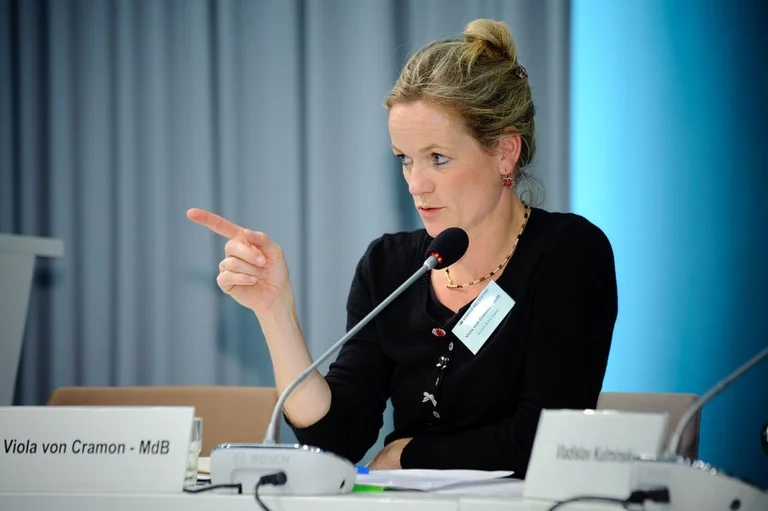
(5 years ago)German Eurodeput Violet von Cremon sees Kosovo ahead of major challenges next year. The upcoming elections must bring political stability to begin working with the long list of reforms. I believe it was a big mistake, which the government collapsed on March 25th. Many in the West then commented on it, and we [...]
I believe it was a big mistake, which the government collapsed on March 25th. Many in the West then commented on it, and we all criticized it as not a good idea to bring down a government that had done a good job until then, and many people were happy. It appeared early on that it would become difficult to find a majority for changing the government or electing the new prime minister. The Constitutional Court confirmed what many people said from the outset, that this election was not constitutional, even under the circumstances allowed in the vote, persons who had been convicted. I had not made that statement before because it was good first to say their word to the courts. To me, it's a shame that the Constitutional Court took a long time for this” has been expressed.
Below in full interviews:
Deutsche Welle: The Constitutional Court in Kosovo wasted the election of the government Hoti, which means new elections. Let's sum up the country's multiple crisis -- two governments in pandemic time -- a retired president, failure to adopt needed laws, as the government had no majority in parliament, integration impasses, long deadlock of dialogue, deep economic problems, without forgetting unresolved political problems. Is Kosovo heading towards a failed state?
Violet von Croamon: I wouldn't say that. Of course what you count remains and the actual situation remains a challenge, but let's start from the beginning. I believe it was a big mistake that the government collapsed on March 25th. Many in the West then commented on it, and we all criticized it as not a good idea to bring down a government that had done a good job until then, and many people were happy. It appeared early on that it would become difficult to find a majority for changing the government or electing the new prime minister. The Constitutional Court confirmed what many people said from the outset, that this election was not constitutional, even under the circumstances allowed in the vote, persons who had been convicted. I had not made that statement before because it was good first to say their word to the courts. To me, it's a shame the Constitutional Court took a long time for this.
So everyone knew and waited until when this government would fail?
So it is a problem when the decision is postponed for six months and it does not help anyone. On the other hand, holding elections in time is certainly not an easy thing. Now the decision is out, but I haven't spoken to Mrs. Osman yet and I haven't seen press reports of when the elections will be held. So we need a date for the parliamentary elections and of course before the end of April, the new president or president will have to be elected. You do all of this in pandemic times, at the time when the economic situation has been difficult, and in a situation, when everyone expects Kosovo results in terms of dialogue, in turn, is not easy, that is clear.
It is the most difficult weeks for Kosovo currently, both in terms of pandemic and policy developments, but what can the EU provide specifically for the situation not to deteriorate?
Kosovo is receiving great support, meanwhile, as far as the effects of pandemic are concerned, but of course the question remains, has the government taken all the necessary measures so that the infection figures will not increase. We've heard that the collection devices have arrived, but partly it's hard to find doctors, doctors, or specialised nurses to use them - techniques alone are not enough. Certainly in Economic Direction The EU will help, even in terms of the election body. This is how it will be. The EU will help, but as in what form this will be long defined.
What do you expect from early elections?
I hope that these elections will bring so much stability, that we don't have new elections every year, and that long-awaited reforms will begin; reform in terms of electoral law, reform in justice, that about fighting corruption. So all this list of reforms to be carried out, that's what's urgent. We need stable relations, we don't need authoritarian situations like in Serbia, not this, but relations, where people understand, that it is being governed. For them to feel represented in foreign policy and understand, that reforms in the country have begun.
These will be elections without the two old politicians in politics, Thaci and Veselin, as they are in The Hague following the raising of war crimes charges. Will that have any effect?
These are the staff issues of certain parties, I think that the PDK will be reformed in the direction of personnel, that is expected. I think the PDK has leading politicians in its ranks to present in the upcoming elections. But this is an internal party issue itself.
Dialogue with Serbia resumed this autumn, but reaching an agreement seems distant, if you remember Vucic's statements as recently, that Serbia will not recognise Kosovo as long as it is president. What, then, will stand at the end of the normalisation of relations agreement with Serbia, which the EU is also engaged in, if not the recognition of Kosovo?
Yes, of course that will happen, but of course the question of what form will have a mutual recognition, what will be within the general package, how this should be shaped in order for Serbia to agree, and this will naturally have to be negotiated properly when we have a new government in Kosovo. But I do not believe this will be the last word of Serbian government representatives. At this point I would remain optimistic, because even the Serbian president knows, only with mutual recognition and recognition of Kosovo has an EU path. He has great interest in having Serbia integrated into the EU.
In addition to current problems, there is an unresolved problem that has isolated Kosovo, non-liberalisation of visas, Kosovars are tired of waiting for liberalisation. Is something new expected next year?
Sadly, during the German EU presidency, nothing happened in this direction, and I have often raised my voice, that visa liberalisation is too late. There are reservations for this, but they are not in Berlin, but in Paris, partly in Holland. And here is the question, what the Kosovo government can do to remove these concerns. It was a wise move, which is now under way in bilateral talks with the French government, to show that what is important to the French government, Macro is being recorded by the Kosovo government and concerns are being addressed for one, with reforms, which will be shown by evidence. And at this point we hope that the French will also provide green light and that if everything goes well to approve visa liberalisation next year.