 4 hours ago
Russian Weapons in Serbia, Through NATO, EU Countries
Periskopi(6 years ago)
(6 years ago)For permission to transport Russian weapons to Serbia, through the countries of the European Union and NATO states, it has been left to each member state to decide on its own, but green light -- especially in the case of certain countries -- may be a signal of disagreement. Over the past two years, Russia has been brought in and delivered [...]
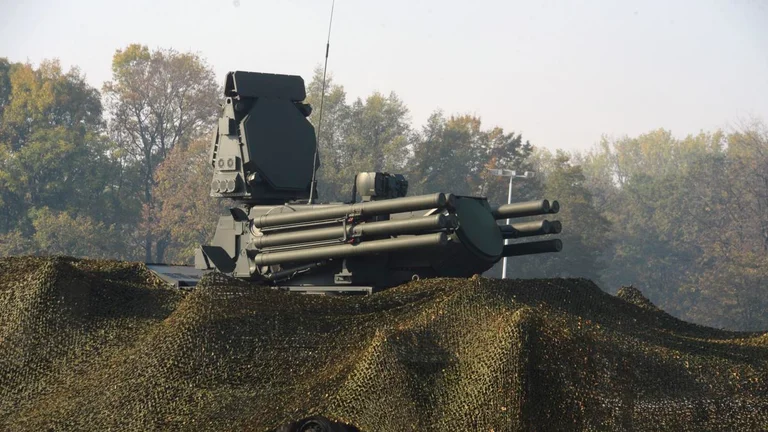
Over the past two years, Russia has been brought and delivered to Serbia, as a purchase or as a donation, the Russian anti-aircraft missile system “Partir S1”, T-72 combat tanks and the BRDM-2 armoured vehicles.
According to data and statements by officials, military weapons and equipment were brought to Serbia by the Russian Federation via air routes and rivers. Data on flights and transportation shows that Russian weapons arrived in Serbia, in part through the territories of European Union member states (BE) and NATO.
The only reaction, so far, has been achieved by Romania, which in 2019 blocked sending Russian tanks and armoured carriers along the Danube.
While the European Commission says the decisions for issuing transfer permits are taken by the European bloc's member states independently and in line with their competencies. Meanwhile, NATO has refrained from commenting on what Russian weapons destined for Serbia are transported through Alliance member states.
However, according to Ted Galen Carpenter, senior associate for defence and foreign policy studies at the Cato Institute in Washington, reports on Bulgaria's co-operation in facilitating Russian arms shipments to Serbia could cause significant disagreements within NATO.
“Theoretically, all Alliance members have the sovereign right to make such decisions. But the reality is that members are under pressure not to engage in unusual conduct on key political or military issues”, Carpenter said, adding that this is especially true if the United States (SHBA), as NATO leaders, has a strong stance on the issue.
All details concerning the transport of Russian weapons and military equipment from Russia to Serbia have been marked as secret by the Ministry of Defence. The REL has filed a complaint with the commissioner because the Defence Ministry has refused to provide the required information in line with the Law for Free Access to information of public importance.
Romania's “
The transport of Russian weapons from Russia to Serbia attracted public attention in July 2019, when Romania's Foreign Affairs Ministry, which is also a member of the EU and NATO, refused to issue a Transit permit for 10 Russian armoured vehicles, which Russia donated to Serbia, arguing that the sanctions the European Union imposed on Russia in 2014, due to the annexation of the Ukrainian Crime Peninsula, are still in force.
Serbia's president, Aleksandar Vuciq, had then declared that vehicles were brought through the airway „against the objections of some“, giving no more details about how transport has been implemented.
I don't want to talk about this. We have respected the norms of international public law and everything has been in line with the deal with Russia. We made it. As they came in, this is our case”, Vucinic told reporters on July 29th, in Nis, after the vehicle was admitted.
Romania's Ministry of Foreign Affairs, in a response, has stressed that only one Romanian operator can be issued for granting the transfer for transport of military equipment.
“One of these conditions says that the service offered by the Romanian operator, under a transitary permit, should not serve directly or indirectly the interests of an individual, the judicial person, entity or organisation by the Russian Federation and should not be destined for use in the Russian Federation”, Romania's Ministry of Foreign Affairs has said, calling in response to the EU Council's 2014 decision to impose sanctions on Russia because of the Crimea annexation.
This condition, in the concrete case, was not met, so it was not possible to issue permission on the part of Romania's competent body“, the Romanian Ministry of Foreign Affairs said.
How were Russian armoured vehicles delivered?
Hungary's government, in September 2019, has confirmed that this country, despite EU sanctions, has allowed transportation of armoured vehicles from Russia to Serbia, because this transport was carried out by civilian aircraft, for which permission is not necessary, has broadcast Hungarian media.
Serbia's Civil Aviation Directorate has said it does not possess information about civilian aircraft from the Russian Federation, which has landed on Serbia's territory in the period between July 26th and July 29th 2019.
FlightRadar24, specialised in tracking flights, based on available data, presented flight photos from July 26th 2019, which they said corresponded to required parameters, or data for a civilian aircraft from the Russian Federation that delivered armoured vehicles to Serbia.
Photos obtained by the Flightdar24 civil aircraft from the Russian Federation, which reportedly transported armoured vehicles BRD-2 to Serbia.
Photos obtained by the Flightdar24 civil aircraft from the Russian Federation, which reportedly transported armoured vehicles BRD-2 to Serbia.
In the photos sent out, it is evident that the plane from Russia, in Serbia's direction, has crossed Bulgaria's Black Sea and airspace, while to return it used Hungary, Slovakia, Poland and Belarus's airspace.
On July 26th, the Ilyusin IL-76 plane landed in Belgrade, about 3 p.m. (at local time) from a destination in Russia. He left for Moscow around 17:40“, declared on FlightRadar 24, warning that they do not access the complete route and all flight data.
Free Europe Radio has been addressed to competent institutions in Slovakia and Poland.
In a written reply by Poland's Civil Aviation Directorate, they have stressed that they cannot confirm that any Russian military carrier for Serbia has entered / passed through Poland's airspace in July 2019.
The directorship of Poland's civil aviation has not been informed of such flight and cargo, while the data that competent institutions possess does not indicate that such flight has been realised”, have been declared by this institution.
On the other hand, the Slovak Transport Ministry, in a response to Radio Free Europe's question, said they had received a call for a flight from a Russian civil aviation operator who regularly uses Slovakia's airspace, in line with the rules of the International Civil Aviation Organisation (ICAO).
“Operator has informed us of the sender and the receiver, from whom none have been marked as a military organisation. The shipment is described in the general expression „autodes “and the aviation operator has stated that (the charge) does not contain weapons and ammunition“, the Transport and Slovakia Ministry stressed.
Also, this minister has stressed that he has reviewed the request and given permission for flight, considering that all valid required documents have been submitted, as well as that „had no legal reason to refuse permission to fly”.
Opinion is still deprived of information about whose ownership the civilian plane was, which Russian armoured vehicles were brought to Serbia, and whether it cost transportation or who covered their delivery expenses in Serbia.
Bulgaria's “
In early March 2020, with the fourth shipment of parts of the Russian antiaircraft system „Pancir“completed the missile system, which Serbia purchased from Russia.
According to data from Moscow's specially-based website flight flight „, Russian plane Antonov 24 „Ruslan“has started flying from Moscow Airport „Vnuovo“, on March 3rd and 12:59 in the Middle Europe, to land at the Batajnica military airport, after more than four hours of flight. As in the case of armoured vehicles, the route again passed through Bulgaria's territory.
On this subject, REL addressed Bulgaria's Ministry of Foreign Affairs, which has refused to provide answers to the question of why Bulgaria, as a member of the EU and NATO, has made the decision to allow Russian weapons and military equipment to be transported through its territory.
Because of receiving the Russian missile system, Brussels and official Washington have also reacted.
In a statement for Voice of America on February 25th, EU High Representative for Foreign Policy and Security spokesman Peter Stano has stated that it is necessary for Serbia to harmonise its foreign policy with European Union policy.
Serbia's „government has marked integration into the European Union as a strategic priority of the state. We expect Serbia to behave in line with the obligations it has taken on“, Stano said then.
The US State Department has called on Serbia to give up buying weapons from Russia, as well as that it could result in sanctions against Serbia.
“We called on all our allies and partners to give up transactions with Russia, which could lead to the establishment of sanctions under the Law for opposing the opponents of America through sanctions (CAATSA)”, the State Department said in a written response to the Voice of America, on February 24th, commenting on the delivery of the first part of the Russian system “184> in Serbia, three days earlier.
Serbia's president, Aleksandar Vuciq, in a statement in December 2019, has said Serbia “would slow down buying new weapons”.
EU: Transmission permits, competence of member states
The control of export and transfer of weapons from European Union member states submits to national legislation, the EU Council's joint stance on the control of the export of technology and military equipment, as well as to the Agreement on Weapons Trade, the European Commission says in a written response to the REL question.
These rules are legally binding for all member states and apply under their responsibility and under the supervision of national institutions“, the EU says.
The EU's common position, as explained, among its fundamental provisions, sets out eight criteria for risk assessment for an application for arms export and transfer, including respect for human rights and international humanitarian law from the country of last destination, as well as preserving regional peace, security and stability.
The decision on whether export or transitation will be approved or rejected remains the right to discretion of member states. National institutions are left to implement the “control, the EU's response says.
The European Commission says member states, once a year, report on their export permits, as well as on the true export of conventional weapons, and that the EU's annual report on arms export is accessible through databases, but that specific data on transmitting permits are not included in the database.
NATO: This is a question for Romania, Bulgaria
In NATO, they have not wanted to comment on the transport of Russian weapons and military equipment from Russia to Serbia, a part of which is developed even through the territories of NATO members. In response to Radios Free Europe, this organisation has directed that we turn to the competent organs of Romania and Bulgaria.
Regarding intensifying Serbia's co-operation with Russia in the field of defence and arms purchase, NATO says purchases in the defence field are nationally decided.
“NATO and Serbia are close partners and we are committed to strengthening our partnership with Serbia, while fully respecting its neutrality policy”, it has said NATO, adding that Serbia has the right to freely choose its political and security allegations.
<x0) NATO.
Carpenter: “Standard Objection” can create problems
However, Ted Galen Carpenter from the Cato Institute in Washington, explains that “objecting to standard” NATO has fuelled major problems for Turkey, especially in light of the purchase of the S-400 anti-aircraft missile system, which Ankara purchased from Russia in 2019.
When it comes to Russia's influence in the Western Balkans by strengthening military and military-technical co-operation, Carpenter points out that Washington has made it quite clear that it wants to exclude Russia's influence in the region.
The American “Liders will certainly be very unhappy with Sofia's apparent co-operation. Although some NATO members (e.g. Hungary, Chekhia, Turkey, Greece, Italy) favour a softer policy in general towards Russia, it is a little bit reliable that in terms of this issue will support Bulgaria, or any other state that helps Russia”, considers Carpenter.
Galeon: First of all, EU issues
The issue of the transport of Russian weapons to Serbia through the territories of EU and NATO members, as Mark Galeotti of the Royal Institute in London, says of Radio Free Europe, is primarily issues for the EU.
“NATO, as such, has not imposed sanctions, but the EU has. It is sanctions (on Russia) that Romania has cited as the reason for its failure to obtain a transfer of”, Galletti said.
He stresses that NATO member states are fully sovereign in the sense of bringing decisions on granting gun transfer permits.
“They are expected to review sanctions, but states themselves make decisions. Considering that Hungary, as it claims, has also allowed such shipments, as well as that the EU has its own much bigger problems, I don't believe this will be an important matter”, Galletti stressed.
When it comes to the impact Russia accomplishes in the Western Balkans through the equivalent of military and military-technical co-operation with Serbia, Galeotti says most of the weapons brought in is from the Soviet Union, such as the BRD-2 armoured vehicles, which were introduced into operational use in 1962.
“Serbs eagerly receive Russian gifts and are grateful to them for that, but the real priority for Belgrade is the closest ties to the EU, because there is money”, Galletti praised.
Serbia also hosts Russian tanks
Serbia's Defence Minister Nebojsa Stefanovic has confirmed that T-72 tanks will arrive in Serbia and estimated they would strengthen Serbia's Army combat preparation.
The “should reach 30 contemporary T-72 tanks, as part of the ʹWucciq-Putinı agreement in Sochi. They will significantly strengthen our military capabilities”, Stefanovic told Serbian Pink television on November 1st.
The media have reported that the first tank, out of a total of 30 Russian T-72 tanks that are within Russia's donation to Serbia's Army, has been brought to Serbia on October 28th.
It's part of the Russian donation, which consists of 6 MiG-29 jets, 30 armoured automobiles for surveillance. BRD-2 and 30 T-72 tanks under the agreement of Serbian President Allexandander Vuciq with Russian Defence Minister Sergey Shoigu of 2016.
Serbia's Defence Ministry in 2019 rejected Radio Free Europe's request to submit copies of the donation agreement. Serbia's Defence Ministry, then highlighted as a rationale that the required “contracts contain classified foreign data, either data entrusted to the Republic of Serbia by another state, with the obligation to keep it as a secret”.
In terms of this shipment, the opinion has still been deprived of information about who will pay transportation expenses and how total the expenses will be.











