3 hours ago
Holliday: At Kizevac are the remains of between 7 and 20 people.
Periskopi(6 years ago)
(6 years ago)Based on estimates, the mortary remains of between 7 and 20 people have been found at a location in Kizhevac near Raska in Serbia, says International Commission for Undiscovered Persons Programme for Free Europe chief for International Persons Matthew Holliday in an interview for Radio Free Europe. Government of Serbia Media Office [...]
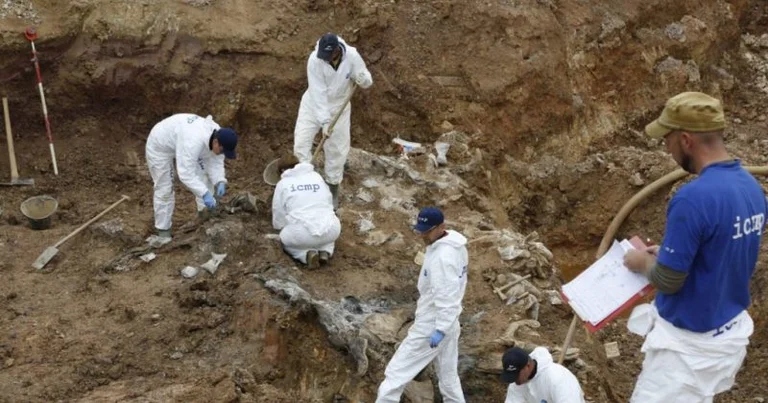
Based on estimates, the mortary remains of between 7 and 20 people have been found at a location in Kizhevac near Raska in Serbia, says International Commission for Undiscovered Persons Programme for Free Europe chief for International Persons Matthew Holliday in an interview for Radio Free Europe.
The Government of Serbia's Media Office has announced on November 30th that the exhumation of these mortories, allegedly Kosovo Albanians, has begun during the war.
ICMP experts are offering forensic assistance for exhumation, at the location located about 250km south of Belgrade, and according to Hollyday, the team was deployed there earlier this week.
Radio Free Europe: Mr. Holliday, experts from the International Commission on Undiscovered Persons (ICMP) are providing technical support to forensics in the current exhumation of mortore remains in Kizevac in the vicinity of Raska in Serbia. So far, what is known about this suspected mass cemetery?
Matthew Hollieday: Our team went there on Sunday. They were there when exhumations began Monday. It's been a long process. Serbia's Commission for Unemployed Persons actually launched an assessment of the location in Kizhevac, I believe in November 2015.
They've been performing these estimates since then and early this month, they found mortor remains. There has been a long process, but bone parts have been found by Serbia's Commission and then this Commission contacted I CMP and asked for help from our forensic teams to help process exhumation.
Not judging what can be found in the site where the mass cemetery is located, but it is understood to be a massive secondary cemetery and may be related to excavations in Raska and Rudnica that were performed several years ago. I think it is believed that the victims found in Kizevac also come from the same incidents in Kosovo in 1999.
Radio Free Europe: In this location, it is believed that the mortore remains of Kosovo Albanians are found. Do you know how many people this is about?
Matthew Hollieday: I've talked to colleagues and there's an assessment that 7 to 20 cases of mortar waste can be removed from this location. But I can't cut down until we've discovered the whole grave. Today I've been in touch with the team, and I've been told that the upper layer was removed from this location. They have made a series of measurements, and there are indicators that they will enter the site where the mass grave is located on Wednesday. So we will know how many times it is when the mass grave is fully discovered.
Radio Free Europe: How long do you expect the process of exhumation to last based on previous experiences?
Matthew Hollieday: It's hard to say, but I think estimates are that within 10 to 15 days of this specific location. But everything depends on the number of cases that will be located and will have to be removed from this location. If there is more, it will last longer, if there is less (mortal support), the process of exhumation will be carried out more quickly.
Radio Free Europe: When do you think the results of these excavations will be published? When will you know who was buried in Kizevac?
Matthew Hollieday: This depends heavily on the Belgrade District Court's War Crimes Chambers, since this location is under the jurisdiction of the Court and Prosecutor. As far as I understand, a tent has been set up near this location for forensic and anthropological examination of mortore waste and to receive autopsy samples, which will then be sent to the ICMP lab for DNA testing, for profile and other tests.
It's complicated and difficult to say how long it takes to analyze a sample because there's a lot of variations. First it depends on when a sample has been sent to us, depending on how much DNA is in these samples, and it depends on whether we can extract a profile from them. We've developed a series of techniques to increase the chances that samples can extract a profile, but when samples are accepted they must be amplified and the process of comparing DNA with reference samples sent by families should be made. And then there must be rigorous verifications to make sure that we have DNA compliance that has met the minimum criterion of 99.95 percent, which is the criterion that we have to meet to report that we have found DNA compliance.
So there's a lot of variables, but I think we can expect that the results will be given to authorities in the sense of identity if we have DNA compliance with the data we have on our database, by the end of the first quarter of next year. I say this with reservations, with all these variables in mind.
Radio Free Europe: What will now be the role of The ICMP in Kizhevac and who will be involved in further examinations of the mortore remains to be found?
Matthew Hollieday: The ICMP has sent a team to its location in Kizhevac: two forensic archaeologists, a forensic anthropologist. Our team is not leading the process of exhumation, this process is being led by an archaeologist from Serbia's Commission for Undiscovered Persons. We are assisting the Serbian Commission and it is in the hands of this commission to make all decisions on this process.
As far as our team is going to do in the future at this location, they actually have the sleeves and they're working on this location. I said even earlier, today they have worked to clean up the top layer and expect to reach the site of the mass grave on Wednesday and find skeleton remains. They should then be revealed, examined and obtained samples, and I believe the ICMP will have a role in all of these elements, in the sense of assisting the Serbian Commission on this issue.
Radio Free Europe: Do you have information that new excavations will be conducted in the future, whether in Kosovo or Serbia, in search of potential mass cemetery?
Matthew Hollieday: There are a number of locations that are in Kosovo's interest in Serbia's territory and in Serbia's interest that are on Kosovo territory. I believe a plan for exhumation is being made to occur in the spring of 2021. But beyond that, I can't give you more details. I believe this question should be addressed to the Kosovo Commission for the Undiscovered Persons and the Commission of Serbia.
“formatation fades, witness memories fade”
Radio Free Europe: How did you comment that 21 years after the war ended, over 1,400 people continue to be found?
Matthew Hollieday: Of course, for families, the fact that they still have homeless families I think is a painful legacy of conflict, without question. On the other hand, at least 2,500 of the approximately 4,500 persons found by the Kosovo conflict have been found and identified through DNA analysis. And it's important that we remember that great achievement has been made in the last 20 years and we can see the exhumations that have been done on Serbia's territory in Batajnica, in Petrovo Selo, Bajina Basta, Raska, Rudnica and now Kizevac.
If we remove Chizevac from this equation, almost 97 percent of the almost 900 cases that have been exhumed by Batajnica, Petrovo Selo, Bajina Basta, Raska and Rudnica have been identified through DNA tests conducted by us. So I think there are some important achievements.
I believe both sides, Kosovo and Serbia continue to be committed to solving this issue as a priority. Both sides have established commissions dedicated to this issue, which work and co-ordinate the research process. We would like this to intensify because it's been a long time and information is fading, witness memories fade and it can become more to find locations of other mass graves.
I think that one of the main issues in work in the future is not only about tracking new cemeterys, but about how to address the issue of unidentified persons at the Pristina morgue. There are at least 350 cases there. I The CMP is working closely with the Kosovo Commission regarding the process of evaluating all unidentified persons to see how many of these cases are out of the mandate, which means they are not the result of the Kosovo conflict and what can be done to solve the other cases that should be within the commission's mandate.
We will support the Kosovo Commission for this, and I believe it is important to stress that it should be done in the context of the group of people found unsurgeons, which is a regional multilateral mechanism, including the Commission from Serbia, the one of Kosovo, but also by the commissions from Croatia, Montenegro, Bosnia and Herzegovina because they all face the problem of unidentified mortor remains, which have been found in their territories but have not been able to identify through DNA analysis.
Radio Free Europe: What are the challenges that are making that some of the mortore remains have not been identified through DNA analysis?
Matthew Hollieday: There are three reasons why such mortar remains cannot be identified through DNA. First, they can be historical, so they don't date from the conflict even though we have collected over 14,000 reference samples from family members looking for their homeless family members from the Kosovo conflict. If they are historical, they will not match the samples we have collected from family members. This is one reason why some cases continue to be unidentified. Another reason is that members of the family have potentially refused to give DNA samples or that all family members were killed during the conflict and that there are no reference samples. This too should be considered.
But, I think the main reason that you cannot match through the DNA of unidentified people found in Pristina's morgue, is the fact that about 2,000 cases were identified in 1999, 2,000 others in 2001 without DNA analysis, through traditional identification methods through anthropomoric data, of items found near mortar waste, which unfortunately leads to the possibility of error.
It is important that the Kosovo Commission make the assessment of these unidentified cases, which means that all documentation of countries, where troops have been found, where they have been exhumed, potentially new samples gathered in order to provide accurate information and offer answers to the families of the found, but also to offer answers to their counterparts in Belgrade. This would help depoliticise the issue of unidentified mortar remains.
“There are still persons who committed crimes running free”
Radio Free Europe: Let's get back to the Chizevac case. This is the fifth mass cemetery discovered in Serbia since the end of the war. How much evidence has been used to bring about justice, since every case of the missing is linked to a crime?
Matthew Hollieday: I cannot comment on the number of war crimes cases from the Kosovo conflict that have been brought to justice in Belgrade. We can point to Vlastimir Djordjevic's case before the International War Crimes Tribunal in the former Yugoslavia in the case of Djordjevic and three other generals. I think the Tribunal at The Hague did the job in terms of high profile cases in terms of the Kosovo conflict.
But, of course, there are still persons who have committed crimes that walk free and I am talking not only about them Serbia, but also about the perpetrators in Kosovo. Regardless of nationality or ethnicity, all perpetrators must face justice for the sake of victims, but also for the sake of normalising relations between states in the region.
Radio Free Europe: In 2018, Western Balkan representatives signed the framework of a plan in The Hague through which they pledged to do more in terms of more than 12,000 people found in the Western Balkans. At that world, you have said it was a major achievement in terms of strengthening regional co-operation. What has since improved as to the issue of found persons?
Matthew Hollieday: I think the signing of the framework of this plan as well as the creation of a group of undiscovered persons, who I believe is unique, is a multilateral mechanism, where Kosovo is represented in equal shape with Serbia, but also in front of Bosnia, Croatia and Montenegro. This offers a multilateral forum for co-operation, sharing information about the cases of missing persons. Members of this group of undiscovered persons, local institutions, the commissions have built a regional database for cases of missing persons and they use this data on daily bases, to share and exchange information with each other on the issue.
This is very important that over 2,500 cases from that database appear in two or more local institutions, so they all have interest in that specific case. For example, Kosovo closes a case, identifies a person, and if the same case has been in Serbia or Montenegro, then immediately their counterparts are informed of it. I believe this has brought greater transparency and increased confidence in the process of undiscovered persons. I believe this is very important. Likewise, the group of missing persons has formed an operational group to address the issue of mortar waste that has not yet been identified.
I believe this has greatly helped depoliticise this issue, but we cannot say that this issue is not politicised as we hear statements in the media of various politicians. But I believe this group has depoliticized the issue of unidentified mortar remains. Each member of this group has information about what their counterparts are doing to resolve these cases and are actually working together, sharing information with each other to resolve some of these cases. We've had some IDs, thanks to this co-operation through the group for the missing persons and through the implementation of the plan-pronosis. I believe that this is the future of cooperation on the issue of the dead.
Radio Free Europe: The issue of the unknown is also the subject of discussions in the dialogue in Brussels between Kosovo and Serbia. It is also part of the agreement reached in Washington on 4 September. Do you have contact with Washington and Brussels and what specifically can be expected of these agreements when it comes to the fate of the missing?
Matthew Hollieday: The ICMP has not been a party to the Brussels dialogue, but we expect to see what results will come out of the dialogue in Brussels when the comprehensive agreement is reached, if achieved. We hope that this will stress the importance of state responsibility for the issue of the missing and rule of law, which is essential to the process in the future.
As for the Washington deal, The ICMP has worked closely with the American embassies in Pristina and Belgrade, and we have worked with colleagues from these embassies to help determine a range of indicators that can demonstrate progress in the issue of missing persons from Pristina and Belgrade. As you know, in Washington's agreement, Pristina and Belgrade have pledged to advance the issue of missing persons and report every year what has been done and what has been achieved.