5 hours ago
Out of 55 thousand students in 144 Kosovo schools, only 2% of those disabled
Periskopi(6 years ago)
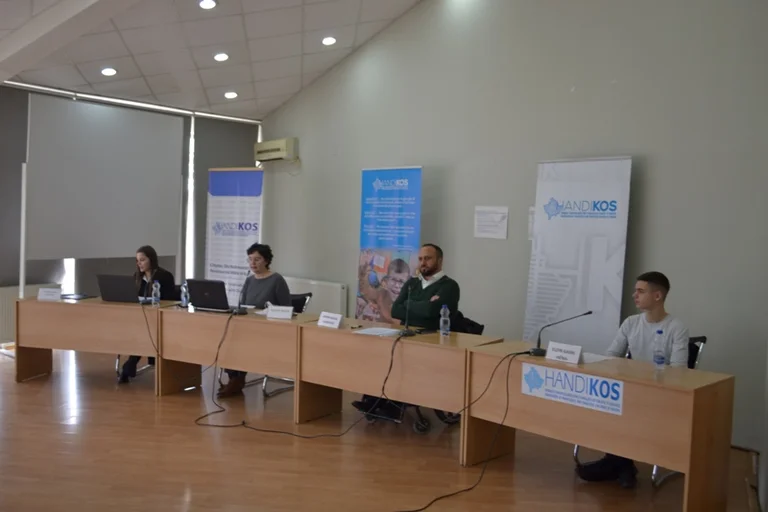
(6 years ago)HANDICOS with the support of the UNICEF Office in Kosovo today has launched the research report “The quality of primary and lower-level schools for disabled children in Kosovo, which shows the level of access they offer for disabled children, realised under the “Avancing project [...]
HANDICOS with the support of the UNICEF Office in Kosovo today has launched the research report “The quality of primary and lower-level schools for disabled children in Kosovo, which shows the level of approach they offer for disabled children, realised under the “Avancing situation of disabled children in Kosovo.
Monthly assessment in 144 schools of seven Kosovo regions reflects an extremely problematic situation in terms of access to physical access to all groups of disabled communities, with only 2 percent of them disabled.
HANDICOS Director, Mr. Africa Maliqi has stressed three types of discrimination that are committed to disabled persons in Kosovo. While he says the state is not giving the necessary support to these people.
Among the three types of discrimination facing disabled persons are the discrimination of a circle or an environment where buildings, roads and sidewalks and transport are not designed according to the needs of even institutional discrimination where laws or administrative services are not implemented or take into account the needs of disabled. Kosovo's government has not included people with limited capacity in drafting plans, this is because disabled persons are estimated to be the poorest even in health risks, and we have info that they too have been affected by the plan. We address these approaches every December 3rd, but we have no support from the governments we've had, he said.
Education Minister Rame Likaj says they are working for the children's inclusion in regular education in Kosovo.
We're trying to secure inclusion on all marginalized persons. As for the education system, you know we've inherited educational buildings that are from different times, especially those that were before the war are built with different specifics that haven't offered limited access, that's happened until after the war and so far have not satisfied the needs of this category of children. While the new buildings that are built by STAT in multiple co-operation have been infrastructured for disabled people where other needs, such as doors, have been met, he said.
The chief of the UNICEF Office in Kosovo, Murat Sahin, has said that of great importance they have great involvement.
)To UNICEF is important that all children have equal access. We all know there's a lot of difficulties that disabled children face, especially in the time of Coddy-19 I hope everyone is healthy. We all know that physical access is very important, we all know that having no assistant is a big barrier, he stressed.
The disabled children's rights provider Eldin Gashi has called for equal access with all children.
Many children in Kosovo are forced to leave school and those children remain behind. So in order to raise our voices for these people, on behalf of the group, I am calling on relevant institutions for equal access to all children in Kosovo, Eldini said.
The report shows that immediate access, classroom spaces, toilets, markings, tactical fields, elevators and parking lots, do not stand by standards and Administrative Guide 33/2007.
- Rampas do not exist at 18 % of the estimated objects, while 55% of them are not built by standards.
- In 72, there are no available toilets.
- 89 %s of schools have no elevator.
- Of the 144 schools, in only a few cases have been faced with approaching signs.
- 21 o'clock schools, they don't offer enough space in classrooms, until parking lots are 100% elusive!
HANDICOS and U NICEF calls on local institutions to enable inclusion for all children in Kosovo and to fulfill their basic right, which is approach in any environment that surrounds them.