8 minutes ago
Zaev: Common history should be seen as history that connects us, not as history that separates us
Periskopi(6 years ago)
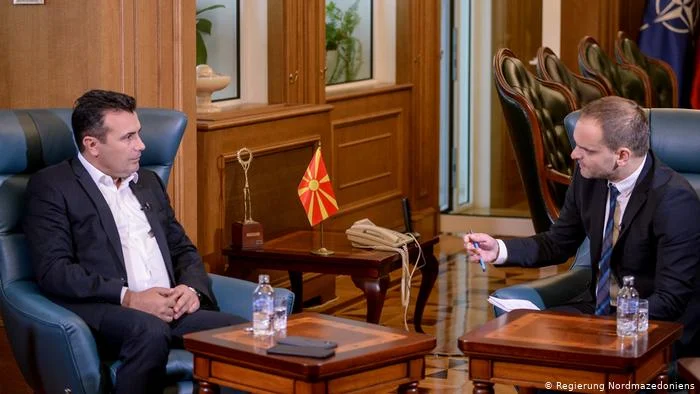
(6 years ago)Regarding Bulgaria's deadlock due to a row over Skopje-based negotiations opening- The EU for membership, North Macedonia Prime Minister Zoran Zaev talks about the DW. Deutsche Welle: Mr Zaev, Bulgaria blocked the earlier day of talks on North Macedonia's EU accession. Many who do not live in [...]
Regarding Bulgaria's deadlock due to a row over Skopje-based negotiations opening- The EU for membership, North Macedonia Prime Minister Zoran Zaev talks about the DW.
Deutsche Welle: Mr Zaev, Bulgaria blocked the earlier day of talks on North Macedonia's EU accession. Many people who do not live in the Balkans find it difficult to understand the reasons for Sofia's veto. Can you explain what Bulgaria wants and why these requirements are unacceptable to Northern Macedonia?
Zoran Zaev: This is the historical part. First they're trying with us to protect history. No one can defend history. History is very flexible, and it is very kind because it offers both the sources for friendship and the resources for conflict creation. I think that efforts to find the origin of our identity and the origin of our Macedonian language are completely unreasonable and normally unacceptable, because we have the right to identify ourselves, the right to sovereignty, the right of every nation and every country. We have been recognised by Bulgaria. Bulgaria has been the first country to recognise our sovereignty, our country in 1990, when we became an independent country. With that in mind, the idea is that we can confirm that we share common stories and through agreement with Bulgaria on good friendship, neighboring and good relations, the 2017 agreement, we accept that parts of past history are common history, but from this story both nations and both languages have been created. And we need to see this story as history that connects us, not as history that separates us. That's the idea. But the definition that our origins are Bulgarian and our language is Macedonian-veral language is humiliating and unacceptable because the truth is that we are very close nations, we call each other brothers, precisely because of this common history. Our language is just like the Bulgarian language, part of the South Slavic languages and they've developed together, they're close, we understand each other, when we speak Macedonian they understand me, when they speak Bulgarian I understand them completely. This is not just for me and Boikon (Bulgarian Prime Minister St.red), but for both our nations, for our citizens, and certainly if we are to be smart, we don't need to be completely European. If we were to be smart, we would take this common story that connects us, to raise bridges of cooperation, to create brotherhood, together in the future European Union, for us, because Bulgaria is a member of the EU.
Deutsche Welle: The European Union has 27 member states. You are in contact with many other leaders or politicians from other countries. Does Bulgaria have support from other countries on this issue? What do other countries say?
Zoran Zaev: It is very difficult for them to understand the problem. They're not giving support, because they have no explanation how they can look for these things. They ask you to accept something that is contrary to self-identification, to who we are, what language we speak. It's actually very hard to understand. Therefore, the other 26 countries are surprised and diplomatically are trying to find ways to make both countries reasonable. Because the official position of Sofia and Bulgaria, Bulgaria's goal and strategic goal, is to one day be part of the European Union. Why? Because this guarantees greater cooperation. Better friendship. More help for each other. With that in mind, I believe that we, the countries here, will be smart. Because we're dealing with historical decisions. We can decide to bring our countries into conflict, into barren conflicts, or take our countries and nations into brotherhood. We have a few days, I really hope we use these days to understand each other. I must understand the Bulgarian position, they must understand our position. Just so we can reach out to each other. Because we have an agreement of great value available, this agreement offers many solutions for the future, for improving relationships in different ways. We just have to be smart and dedicate ourselves to full implementation of this agreement. We've achieved much so far. Over the last 20 months we've created the Committee of History and Education, they've had 10 sessions, they've succeeded in 5 historical persons, three historical periods. We've summed up in protocol that these dots connect us to each other, that we will celebrate them together. That's been going really well by now. We will continue with persons and other historical periods.
Deutsche Welle: You've had to compromise with another neighbor. You signed with Greece in 2018 You changed the country's name from the Republic of Macedonia to the Republic of Northern Macedonia. Now, apparently another historic conflict is blocking the path towards the EU. Are you and your government looking for options, are you giving up this goal?
Zorav Zaev: First, we have been a very good example for the European Union and European customs. A candidate country -- a country intended to become one day, after five or ten years of EU member states -- lectured in this regard. Not just the Ohrid Agreement. The Ohrid Agreement has been the tip of diplomacy and Europipan-type dialogue on how solutions between different ethnic groups can be found, how to recognise each other, how to place geographical differences on the name, to separate northern Macedonia from Macedonia and Greece, very friendlyly. This is a method that can be used worldwide.
But the agreement with Bulgaria has very valuable values in itself, very creative. Our common history creates ties between nations and countries. Through this common story we have created our brotherhood with Bulgaria. This is the Europine, the pursuit of European principles and values. All over her unit. We have linked various ethnic groups. We are multiethnic countries, just as the EU is multiethnic. We've solved all open issues between different ethnic groups in our country. Now we're talking about citizens, we've shown European behaviour. We are consistent with European values and principles. And when it comes to Europeans showing European values, they don't. This is the European Union's big mistake. There are no other options for us. Other political forces from the world have great interests. The Western Balkans and Southeast Europe is a country where major political, economic, energy interests cross. There's a great presence in the United States, Russia. They're all present. And our country is friendly. We cooperate with everyone. If you would ask me, I would like to be the leader of a country that cooperates with everyone. But with no alternative from full membership in the EU, and full NATO dedication.