7 hours ago
Vjosa Osmani joins the AAK choir: Needs to Stop Dialogue
Periskopi(6 years ago)
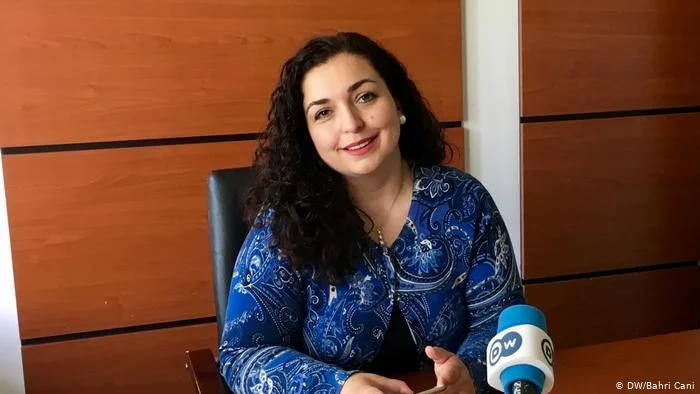
(6 years ago)In an interview for DW, Vjosa Osmani of Kosovo in office speaks of the process at the Special Court, dialogue with Serbia, the role of Germany and the president-elect American Beden in the process. Osman estimates that it is not the time to continue dialogue with Serbia, the AAK has had this request on the day [...]
Osmani estimates that it is not the moment to continue dialogue with Serbia, there has been an AAK request on the day the indictment was confirmed against Thaci, Veselin, Selimiqi.
Total interview:
The incumbent Lady President and Speaker of the Parliament, a few days ago you were taken over as Kosovo President, as the constitution predicts, following President Hashim Thaci's resignation because he was charged by Kosovo's Specialised War Crimes Chambers. Along with him was the chairman of a major party in Kosovo, and the head of a parliamentary group of a large party in the Kosovo Assembly as well. Can it be said that in Kosovo there is institutional instability or endangering state functionality?
Vjosa Osmani
Let me mention from the beginning that it is not an easy time, the less common for Kosovo as a state, for all our citizens, but also for our institutions. Of course, despite these developments we should not have any reluctance to repeat the truth that has happened in Kosovo. The truth is that terrible crimes committed by Serbia have occurred in Kosovo, ranging from attempted genocide to crimes against humanity and war crimes, which have been the continuation of a regime that has been similar to Apartid from 1989 to the end of the war. It is these actions, which Serbia, unfortunately, has not yet been brought to justice, despite several ICTY cases at The Hague Tribunal, which now does not function, as you know. But the vast majority of perpetrators have not yet been brought to justice, which we have to say aloud all the time, every angle even in Kosovo, in front of every forum, in any institutions, because we are telling the truth and as Albanians we have no need to make the truth out of it, because the truth we have already experienced is extremely terrible, and we must raise our voices every day to seek justice.
We never asked for revenge. But justice for victims, justice for children killed during the war, justice for women and men raped during the war, justice for all these victims. And also reparations for the damage Serbia has created in Kosovo. But on the other side. Kosovo has been a state for more than 12 years, and during these years, despite the many furnaces we've been through constantly has been maintaining institutional stability. We have a constitution, which clearly stipulates that in the case of the president's lack of a task force, it is the Speaker of the Parliament, which has also been confirmed by the Constitutional Court's ruling. We have a constitution that determines who replaces the prime minister in case of a lack, who replaces the Speaker of the Parliament. I have five other vice heads who can replace me. So there are issues that are built that way to ensure institutional stability. So, at the moment, our institutions are working without a problem. But that does not mean that the situation in Kosovo is not a difficult situation and, above all, because for citizens, for the civilian victims of the recent war in Kosovo there has still been no justice, and that means that as institutions we have a multiple obligation now to raise the voice to seek this justice so far.
The Special Court will try war crimes claims for former KLA members. In Kosovo there are many voices that say the Court is unilateral, a ethnicity judges. And it's a precedent in justice. I'm interested in a lawyer's point of view, you're a very good connoisseur of these things, do you agree with this conclusion?
Vjosa Osmani
By the time the Specialised Chambers, as the Special Court is being called, with a slightly easier terminology, have been discussed in the Kosovo Assembly, all of this has been discussed, so there have been arguments that would be an ethnicity. There have been arguments that you judge one party, as mentioned earlier, there is no justice for crimes committed by Serbia. All these arguments have been placed at the Kosovo Assembly hearings, but in the end it was the government's then-instance that was composed of the LDK and the PDK, or more clearly there was a coalition between Mr. Thaci and Mr. Mustafa, and have both been as coalition carriers insisting that the Special Court be formed at any cost. Because, as we are told as deputies at the time, the other option would be much more terrible, and that would be the formation of a special Court by the United Nations, where the laws of Kosovo would not be recognised, we would go back to the time of UNMIK, where additional competencies would be given even in the field of justice and foreign policy of the United Nations.
So the powers that we took after declaring independence. It was somehow an attack on the citizenship of Kosovo if we went that way. And that was pretty much the fundamental argument why the vast majority of MPs decided, or at least talk about myself, don't overreact, we supported him at the time. But it was as I said, the burden that that coalition was at the time, which was two-thirds of the coalition. And through that political support that the coalicion had, it managed to do two-thirds in the Kosovo Assembly to change the Constitution even, and to introduce the Special Court as part of our judicial system. Despite the arguments now stated, the Court is an international obligation Kosovo has received through ratification of an international agreement, at the time between President Jahjaga and the European Union.
Second, that agreement has been transformed into a constitutional amendment, which the two then coalition leaders have taken over. And third, it's turned into additional law, which then determines procedures. Now I even on the day the Special Court was adopted I've shown the arguments for and contradicted, remarks I've had. I don't believe that now is the time to go back there, but I would like to mention a fact that special officials themselves have stated, or former prosecutors who have worked there and participated in investigations have given public statements that nowhere in the documentation, through which the Special has been created, are not said to be dealing with one ethnicity or the other, but only determine the timeline, that they will investigate crimes from one period to another period, so time jurisdiction is determined, that territorial, etc., but that they will not deal with only one ethnicity.
We'll now see what we can expect in the future by the Specialised Chambers, but I wouldn't want to go in and comment on the cases that have ended as the court has voted. Because by its own will, Kosovo has, by its own will, formed part of the Constitution, by its own will, made it part of the judicial system. So all these details have been known since then.
Let's talk about internal policy developments. The election of the new president is the task of parliamentary political parties, according to Kosovo's parliamentary election system. You also exercise the office of Speaker of the Parliament. Are you willing to complete the President's duty for a five-year term if offered?
Vjosa Osmani: No, I don't believe that now I will be among the people who will become part of political calculations in the current parliament. I don't want to give recognitions about where political parties stand from this office, but I believe you already know my political position that I previously expressed as the Speaker of the Parliament, as the elected representative of Kosovo citizens, as I have with the popular legitimacy given on the 6th of October, and which, of course, has elected the current Parliament. However, I personally will not become part of such calculations.
We're at the stage of the dialogue. You say there is institutional stability in Kosovo. How do you think dialogue should be developed? There are voices that say dialogue must be interrupted...
Vjosa Osmani: I think that because of current developments now it is not the time to continue dialogue immediately. And it takes Kosovo's institutions to take little time, sit down, consult among ourselves, create a much more unified stance about dialogue, because it is necessary that whoever negotiates in the name of Kosovo, for the fate of Kosovo, have a much more unified position of the political spectrum than just the coalition it represents. I will give my maximum contribution to this direction, to discuss together with everyone, about what Kosovo's positions should be.
But now I don't believe it's the right time for Kosovo to continue as if nothing has happened. Not that it doesn't have institutions. The institutions are. But because the situation is not the same as it was a few days ago. This should be considered. There must be a re-evaluation of the process so far, what has been negotiated, how it has been negotiated, what has been achieved, however little it may have been achieved. But all together, we build our steps further. And let's not have cases when something is negotiated in Brussels, and we as other institutions know it then whether through Brussels or officials there, either through the media. But be these a kind of preliminary consultation, a kind of preliminary communication of the position that then whoever negotiates on behalf of Kosovo will have more clearly what Kosovo expects of him or her.
On the other hand, like the Kosovo Assembly, now to speak from the quality of the Speaker of the Parliament, at one point we have made clear to each government which weeks of red lines, regarding topics that should not be discussed, and they have to do not only with the country's sovereignty and territorial integrity, but also with Kosovo's internal regulation, that's how they work. No one is allowed to negotiate the creation of a third power. And it should be extremely careful not to fall into such traps, which Serbia builds by opening these topics in Brussels, as if only formally, but then turning into new compromises for the Republic of Kosovo. We who've been tracking the dialogue for a long time have seen how they got here. But mistakes should not be repeated.
Your relations with the prime minister don't look very good. I take into account that his government didn't vote, though you came from the same party. You are now no longer LDK deputy chairman at this time. Are you willing to be part of the dialogue, in this position in which you speak, as acting president, if you should eventually sign a comprehensive agreement if I speak about creating national unity?
Vjosa Osmani
I said unity would have to be built to determine what Kosovo's positions are and to have preliminary unification. But no rational person would have to go to Brussels just for signatures and formalities. I would be part of a process, where I myself am part of negotiations from the beginning, and not just giving it that kind of formalism. And to be part of signing agreements I didn't negotiate with myself. Unity is necessary, but we must take a step back in the process of dialogue, especially after Mr. Lajcak's recent statements, which have called for Kosovo to push ahead with changing the Constitution on the issue of association. So the political and institutional leaders of Kosovo must sit down to reconfirm their positions on these topics in detail and not generally speak of leadership as the Constitution. The constitution has always been the guide. But we have 33 agreements signed so far, many of which have gone beyond the Constitution, especially the 2015 document signed in Brussels for association.
So it should not be enough for anyone to mention the Constitution of Kosovo, while on the other hand, agreement must be signed that exceeds the frameworks that are determined with the Constitution. We must all sit together, redefine attitudes, decide how to move forward and then discuss the issues of formalities. But just go and sign the deal someone else negotiated would be absurd for each institutional host. Because you can't take over signing an agreement when you haven't been negotiating it. I am not there as a figure, I represent, I am the second most voted leader in the Republic of Kosovo, so I represent the citizens of Kosovo and I can speak in the name of the people of Kosovo, I am not there a formal figure that would have to wait on foot while someone else is signing agreements. But I will give support to any document that is in Kosovo's best, any document that advances Kosovo's international subjectivity, but documents that cut both our citizenship and our internal regulation.
If we enter the concession list that Kosovo has made so far since Ahtisaari's time until now, we will all need to discuss, I'm not getting in now. The concessions made by Serbia, however, are too small, if not unmovable. We'll talk about what we did. It's not time or time for us to make additional concessions that make our country even more dysfunctional. It is time for Serbia to make its own concessions. And then let's see if it can move forward. But we do continuous concessions in the hope that they will recognize us and eventually act as they did in 2007, 2008, and now in these last agreements, I believe it is the wrong approach. Serbia simply cannot be trusted. He can't be trusted. Whoever has conveyed the way they behave in foreign policy a little historically, with the signing of agreements, regardless of who they sign them, should know that Serbia as the main feature has treachery. They're disloyal, as institutions I'm speaking, as political leaders, they don't keep their word and they don't respect their signatures. Therefore, we should not expect anything else from Serbia in this case.
Your relations with the prime minister don't look very good. I take into account that his government didn't vote, though you came from the same party. You are now no longer LDK deputy chairman at this time. Are you willing to be part of the dialogue, in this position in which you speak, as acting president, if you should eventually sign a comprehensive agreement if I speak about creating national unity?
Vjosa Osmani: I said unity would have to be built to determine what Kosovo's positions are and to have preliminary unification. But no rational person would have to go to Brussels just for signatures and formalities. I would be part of a process, where I myself am part of negotiations from the beginning, and not just giving it that kind of formalism. And to be part of signing agreements I didn't negotiate with myself. Unity is necessary, but we must take a step back in the process of dialogue, especially after Mr. Lajcak's recent statements, which have called for Kosovo to push ahead with changing the Constitution on the issue of association. So the political and institutional leaders of Kosovo must sit down to reconfirm their positions on these topics in detail and not generally speak of leadership as the Constitution. The constitution has always been the guide. But we have 33 agreements signed so far, many of which have gone beyond the Constitution, especially the 2015 document signed in Brussels for association.
So it should not be enough for anyone to mention the Constitution of Kosovo, while on the other hand, agreement must be signed that exceeds the frameworks that are determined with the Constitution. We must all sit together, redefine attitudes, decide how to move forward and then discuss the issues of formalities. But just go and sign the deal someone else negotiated would be absurd for each institutional host. Because you can't take over signing an agreement when you haven't been negotiating it. I am not there as a figure, I represent, I am the second most voted leader in the Republic of Kosovo, so I represent the citizens of Kosovo and I can speak in the name of the people of Kosovo, I am not there a formal figure that would have to wait on foot while someone else is signing agreements. But I will give support to any document that is in Kosovo's best, any document that advances Kosovo's international subjectivity, but documents that cut both our citizenship and our internal regulation.
If we enter the concession list that Kosovo has made so far since Ahtisaari's time until now, we will all need to discuss, I'm not getting in now. The concessions made by Serbia, however, are too small, if not unmovable. We'll talk about what we did. It's not time or time for us to make additional concessions that make our country even more dysfunctional. It is time for Serbia to make its own concessions. And then let's see if it can move forward. But we do continuous concessions in the hope that they will recognize us and eventually act as they did in 2007, 2008, and now in these last agreements, I believe it is the wrong approach. Serbia simply cannot be trusted. He can't be trusted. Whoever has conveyed the way they behave in foreign policy a little historically, with the signing of agreements, regardless of who they sign them, should know that Serbia as the main feature has treachery. They're disloyal, as institutions I'm speaking, as political leaders, they don't keep their word and they don't respect their signatures. Therefore, we should not expect anything else from Serbia in this case.