 4 hours ago
Thaci's Resign Effects
Periskopi(6 years ago)
(6 years ago)Hashim Thaci's resignation from the position of Kosovo's president creates a new situation and a challenge for Kosovo in the internal political context, as well as for its image in the international arena, estimates the connoisseur of political developments, Ilir Ibrahimi. According to him, Kosovo at the moment needs a unity of the political scene. Unity of [...]
Hashim Thaci's resignation from the position of Kosovo's president creates a new situation and a challenge for Kosovo in the internal political context, as well as for its image in the international arena, estimates the connoisseur of political developments, Ilir Ibrahimi. According to him, Kosovo at the moment needs a unity of the political scene.
The wide unity of the political scene is necessary not to allow institutional vacuums to develop, but also to enable state and institutional processes to push forward, analyst Life Krasniqi estimates.
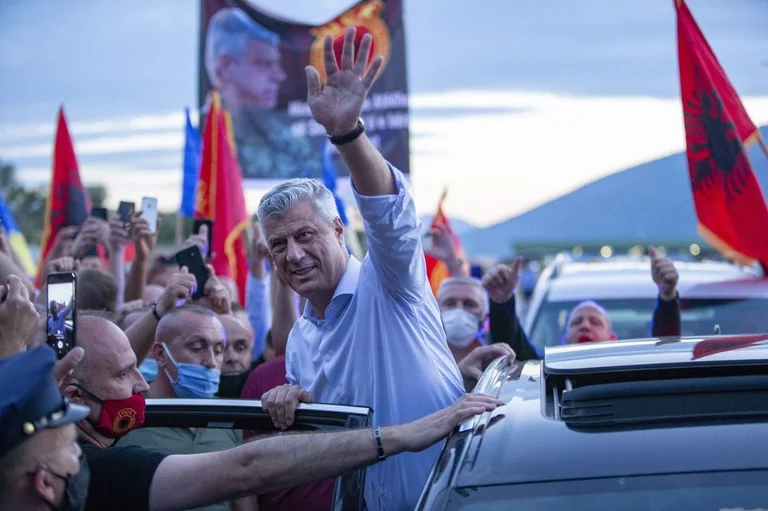
Hashim Thaci has resigned from the country's presidential position on November 5th, following confirmation of the indictment against him for war crimes and crimes against humanity from the Specialised Chambers in The Hague.
Political development director Ilir Ibrahimi, speaking of Radio Free Europe, stresses that following Thaci's resignation, political spectrum requires caution to deal with the created situation and manage domestic politics. According to him, a major political vacuum can currently be created, and political parties, for the time being, must avoid fighting among themselves to preserve the country's interests. As he says, in the current situation, it would be political amateurism if some kind of benefit is targeted by separate parties.
This would go against any political party. No political party has the capacity to manage this situation on its own. We need to put daily interests aside and find a kind of consensus that makes the political spectrum together and not just that, because the challenge is so big that it would take everyone's contribution to overcoming it. Will political parties have the opportunity and strength to achieve such a thing, the current experience does not give us that hope. However, if this is not some kind of alarm to wake up from hibernation, then I don't know what it could be”, Ibahimi stressed.
Life Krasniqi, analyst from the Kosovo Democratic Institute, tells Radio Free Europe that Thaci's resignation from the president's position, but also confirming the indictment against him and other representatives, both institutional and political parties, will certainly affect the political scene in the country. But initially, according to her, the country's institutions must live up to orders given by Thaci, who has extended the invitation to citizens for calm and restraint from any kind of protest.
The country's <x0) institutions should make sure there are no reactions or riots in the country. All of this, however, has troubled the political scene and may have implications for changes in government, there may be implications for the election of the new president, there may be implications for new elections, bans on certain processes we are in. So it creates political effects, which directly affect the functioning of the state”, Krasniqi stressed.
Effects on Kosovo- Serbia
Meanwhile, Ilir Ibrahmi estimates that early parliamentary elections, at the moment, are not a solution to the current situation. According to him, they cannot change political reality very much, and political parties will again have to sit down together to make it a government that will face the challenges that await the country.
He added that the charges confirmed against senior state officials, former senior officials, but also high figures within the framework of Kosovo's political parties, which had once led the war, will also affect internationally. As he points out, the political spectrum in Kosovo, should be aware that in the external plan, Kosovo will no longer be seen as so far and will need much hard work to overcome the challenge.
According to him, the challenge will also be dialogue with Serbia, which, as he says, Kosovo should not give up.
“Dialog must continue because Kosovo, however, must continue to carry out its duties as a state. The state cannot depend on individuals themselves, because in this case, even though there are persons who are key to the liberation and establishment of the state, we must find the strength to move our state responsibilities forward for the obligations we have taken. But they can only be brought forward if we are united and that we are not only part of the process but to reach the maximum in this process”, Ibrahim stressed.
Even Life Krasniqi expresses the opinion that an internal political unity should be created in the country, either to create an internal political stability, or to push forward the dialogue process (between Kosovo and Serbia).
This process of dialogue should also serve in the direction that Kosovo has always been ready to face international and local justice. Through this process of dialogue, too, it is required on Serbia's part to do the same. We know that Serbia has not done so and has consistently hidden persons who have committed war crimes or refused to co-operate. It remains to be seen how this process of dialogue” will be affected, Krasniqi stressed.
From the Specialised Chambers in The Hague, the charges of five persons for which the indictment has been announced have been confirmed. The indictment has been filed against former Kosovo Liberation Army chief Salih Mustafa. On Thursday, November 5th, it became known that the indictment against Hashim Thaci and former head of the Kosovo Parliament, Democratic Party of Kosovo leader Kadri Veselini, has been confirmed. Meanwhile, on Wednesday (November 4th) an indictment was reportedly confirmed against Vetevendosje Movement Parliamentary Group chief Rexhep Selimi, as well as former Kosovo Assembly Speaker Jakup Krasniqi.
For Thaci, Veselin, Selimin and Krasniqi, the indictment was made public on November 5th, where the Specialised Chambers said it was confirmed on October 26th.
The Kosovo court, composed of the Specialised Chambers and the Specialised Prosecutor's Office in The Hague, was formed in 2015 after the constitutional changes, with the international community insisting. It is financed mainly by the European Union.
The specialised prosecutor at The Hague investigates the alleged crimes of members of the former Kosovo Liberation Army committed against ethnic minorities and political rivals from January 1998 until December 2000.
These alleged crimes are mentioned in a 2011 Council of Europe report, author of which is Swiss senator Dick Marty. / REL











