 4 hours ago
The current legislature's sentence
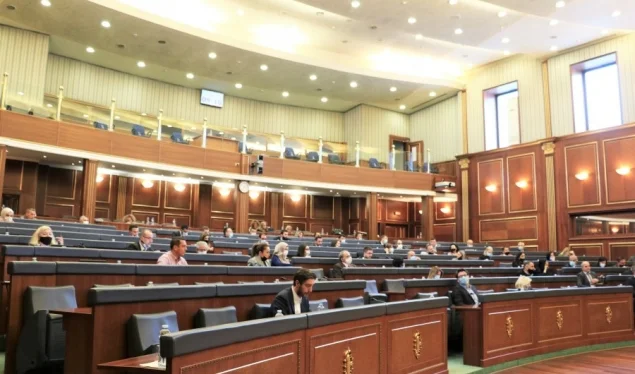
Periskopi(6 years ago)
(6 years ago)Fourteen August is the last date when Kosovo's Assembly has managed to pass a law. The Law is about preventing and fighting pandemic, which was supported by opposition MPs. The assembly's agenda includes the Law on Economic Recovery, adopted in principle after six attempts but not [...]
Fourteen August is the last date when Kosovo's Assembly has managed to pass a law. The Law is about preventing and fighting pandemic, which was supported by opposition MPs.
The assembly's agenda includes the Law on Economic Recovery, adopted in principle after six attempts but unable to pass on the second reading because of a lack of quorum.
Even during Friday's session, many bills did not pass.
Organisations dealing with monitoring the work of the assembly require the government coalition to offer quick solutions to unlock the situation, as currently only 9 percent of the legislative agenda has been realised.
“Only 13 bills, out of 143, have been adopted in the assembly, 11 of them have to do with financial issues: either they are international borrowing or interrelated agreements with foreign investment”.
“The largest share of them were approved after June, when Government Hoti was voted in, and most of them were voted on the support of the opposition”, confirmed for Radio Free Europe Eugen Cakoli, researcher at the Kosovo Democratic Institute (KDI).
He estimates that the current legislature is weaker, both in terms of lawmakers and those representatives.
During this legislature, the assembly has held 36 sessions, with 9 of them being different interventions.
It's not that we're against interference, but the assembly isn't adopting a draft law”, said Medjide Demolli- Nimani from the organisation “Enter”.
She, however, considers that the main burden on this absence of functioning of the assembly falls on the ruling coalition.
I don't want to impose the opposition, but as long as this coalition managed to create the majority, the main burden falls on them. Currently unknown, little is likely to have the same number (of votes). But even opposition deputies have their legal obligations and should be present at the” sessions, Demolli-Niman told Radio Free Europe.
Organisations monitoring the work of the assembly require change in the assembly order and MPs be punished for their inactivity.
Eugen Cakoli from KDI refers to the Constitutional Court's decisions, which, according to him, force MPs to vote during the hearings.
“On two occasions, the Constitutional Court has been demanding that MPs participate in the vote and vote according to their conviction, for, against or abstention, as participation in the session, without taking part in the vote, is completely meaningless and not logical”, Calcol says.
Even the Demolli-Niman Medjid wants MPs to be more constructive.
“Deputies must be more constructive. Let them vote against and not fail sessions due to quorum”, she said.
As long as the government coalition is failing to push ahead with the legislative agenda, monitors demand that this issue of emergency solutions, as the pandemic has burdened the lives of citizens and businesses.
“urgently, or it must reshape the government, or the opposition manages to dismiss this government. Government officials, but MPs, are getting paid, but citizens have big problems that need to be addressed urgently, as the situation has also been made difficult due to pandemic”, considers Demolli-Niman from “contos”.
She adds that the absence of the Serbian List and the disappearance of the 6+ parliamentary group makes normal functioning of the assembly even more impossible.
The Serbian List has its own parliamentary group and officially its 10 MPs have backed the ruling coalition, along with the 6+ group gathering around the MPs of other minority communities.
Avdullah Hoti's government was voted on 3 June with 61 deputies' votes, as much as needed for the government's vote. Meanwhile, one of the deputies, who has supported the government's vote, Etem Arifi, has been handed over to authorities in Kosovo for serving a one-year-three-month prison sentence for subsidies fraud.
The Assembly faces the challenge of electing the country's new president. If the parties disagree over a common name, then the assembly will be dissolved and transferred to new elections.











