 4 hours ago
COVID-19: Why is Germany less death? Three “Secrets” of the Merkel model
Periskopi(6 years ago)
(6 years ago)Tampons, large health care expenses, hospital beds doubled. That's what makes German healthcare on others. “The situation is serious, but we're not weak” There were about 250,000 young people infected by Coved-19 and over 200 people who died in Germany in the last 24 hours. [...]
Tampons, large health care expenses, hospital beds doubled. That's what makes German healthcare on others. “The situation is serious, but we're not weak”
There were about 250,000 young people infected by Coved-19 and over 200 people who died in Germany in the last 24 hours. This is an average of about 140 new infections per 100,000 people in a week (in the previous one was 125).
The infection rate, which is the number of people that each patient infects on its part, remains about 0.9. Despite the mild deadlock in force since early November, the “number of cases and even that of deaths are destined to increase, says Institute Director “Robert Koch”, Lothar Wieller, who warns of the concrete possibility that in certain areas the virus spreads uncontrollably.
Something has changed in Germany, which stood face - to - face from the first wave of pandemic and showed around the world that it was a model of a very thought and effective strategy against David-19. A good combination of massive tests, strong hospital equipment and government flexibility thanks to federalism had enabled in late May to limit the spread of pandemic to 180,000 cases and slightly more than 8,500 deaths.
But as elsewhere in Europe and the world, illusion lasted only one summer. And the Germans, who returned to Germany from vacation, proved to be the main cause of the new wave, which at first caught both Landet, health system holders and the Berlin government by surprise.
In some weeks, the exponential increase in infections caused fear to the worst - a system in trouble, especially in its monitoring capacity, discontent with spread, unexpected explosions.
Already on October 15th, the beginning of cases in April was passed by 6,294 infected young people on a single day, which grew to 14,700, ten days later and for the first time exceeded 20,000 on November 6th. The death toll has also increased to over 200 a day.
Since the beginning of the pandemic, there have been 71,000 cases of choreography in Germany, equal to about 8,600 per million inhabitants, which puts it more or less in the middle of the ranking of 217 countries in the world. Deaths were 12,200, meaning about 140 per million, and in this case Germany is much lower in rank between 65 and 70.
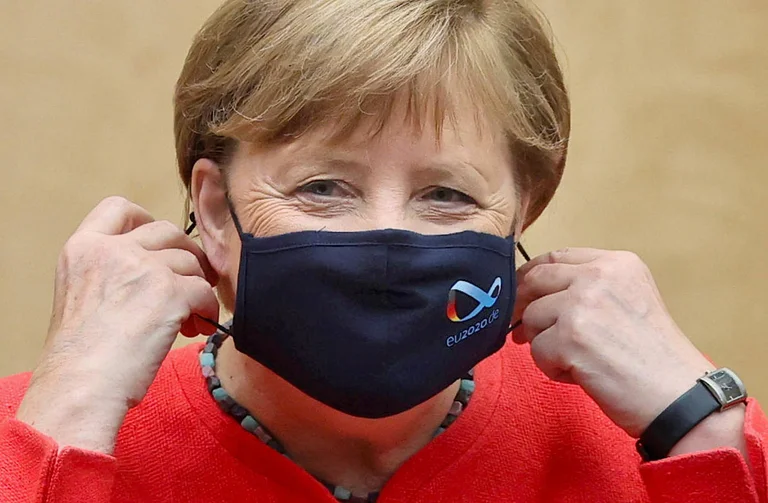
“Site is serious”. Chancellor Angela Merkel never tires of repeating, again in her role as the mother of the Nation, who has never stopped reminding Germans of the dangers of losing control of the pandemic, calling science as a compass of her action.
However, Lothar Wieler says he is a careful “optimist”: “The situation is serious, but we're not powerless”.
In fact, in the last few days there has been a slowdown in the tide. But the most interesting data, which makes Germany a special case, is that of death: at least according to official figures, fewer people die in the Federal Republic with Ovid 19 than elsewhere. Why? What, if it does, is Germany's secret to pandemic? Let's start and see the essential short- and long-term components of the German strategy and its results in the year of Covid-19.
Tests
Germany was lucky to be hit by the pandemic with a month-long delay compared to other European countries, mainly Italy. Which allowed him to prepare and limit his mistakes. From the start, the early investigation was crucial -- the buffers, which were conducted with 160,000 per week in March, had grown to 400,000 in May. This enabled the identification of the infected at a still advanced stage of the disease and their treatment in time. This ability to try became impressive after summer - in early October, the tampons were over a million a week, today 1.6 million. Only below 7% have they been positive.
Hospital care and intensive care
It's the real pillar of model. There are 1,925 hospitals in Germany, which are not always efficient because of a semi-public system based on hundreds of competitive health insurance funds. But with its approximately 500,000 beds, it is a popular network that has made a change in case of emergency.
Intensive care sites, which at the beginning of the pandemic counted 28,000, now number around 40,000, out of which 30,000 with respiratory equipment. Currently there are 3,30,000 patients with Coved in intensive care on 16 Lande, and more than 1,800 need breathing support.
In view of those occupied by people with other pathology, there are almost 6,700 beds for free care intensively for every new case of Coddy. However, there is a shortage of personnel, especially in some Landes, such as Berlin, where many hospitals that have been forced to postpone less urgent operations and attract retired personnel.
Trackers
The core axis of the system is almost 380 “Gesundheitsämter”, contact trackers, considered by some to be the secret weapon of war against pandemic, the first line of population protection. A widespread presence in the area, which serves to collect data and above all to track infections: in May, 17,000 people worked there in August 22,900, and almost all new employment is done exclusively with tracking. Corona - Warn-App, the government app that has so far been downloaded by nearly 23 million Germans, or 28% of the population, has also had some success. However, the second wave explosion caught “Gesundheitsämter”, who in October were no longer able to track the infections. The Chancellor himself sounded the alarm: “Numrat are too high”.
Second Block
On 14 October, at the summit between the government and the Landes, regional leaders submitted to a specific order, and no real measures were adopted. It was Merkel who put them in line, making earlier a warm call to the population: “We're not doing enough to keep evil away”. Then, two weeks later, setting up a soft lock. In force by the end of the month, it envisions closing bars, restaurants, gyms, pools, theatres, cinemas, beauty centres and brothels throughout the country. The ban on private meetings with more than 10 people who should be of the maximum of 2 families. The ban on mass events and the ban on travel within the country for tourist reasons. The obligation to wear a street mask in situations filled with people. On the other hand, with a choice of courage and great civilization, schools and nests remain open.
Economic Measures
In addition to the double hit (353 billion euros, plus over 800 billion loan guarantees -- launched several times between March and June -- to deal with the economic consequences of the pandemic, the federal government accompanied the new deadlock with an amortising 10 billion euros, which could reach 15 and go to companies affected by the closures.
Those with fewer than 50 employees will receive 75% of their revenue in November, the same month in 2019. Furthermore, self-employed artists and performers will have access to emergency loans without interest. The benefits of unemployment were also extended until January, which is paid for hours without working due to the closures or production cuts and which compensates up to 80% of each employee's salary. Economic miners are a key factor in accepting restrictive measures from German society, where demonstrations of denial remain marginal.
Factor Meerkel
Angela Merkel's quiet force was essential. Regenerationd literally by urgency, she gave her maximum without ever hesitation or being exposed to demagogy. Its northern star was the scientific community. Even when the worst appeared behind her, the Chancellor did not relax. Even now, it warns: “There are no conditions to reopen restaurants on December 1st”. 75% of Germans approve of her work. The culture of consensus in a country that sees law enforcement as the antidote to chaos has done the rest. Merkel won't, but if she decides to run for the fifth time, it will probably be re-elected by the people's assessment.
Everything Is Golden What Is Bright
At the beginning of the pandemic, Germany had a unfortunate nationalist reflection, with border jams and the ban on the export of masks and medical equipment to other European countries, which was fortunately corrected. Within it she faced a disturbing lack of masks during the spring. The federal system has not always functioned properly, and often the heads of Lands have each separately, with different results from the region to the region.
There have been cases, such as mega-thertore outbursts where meat is processed, which have revealed the reality of exploitation and total lack of compliance with the most basic rules of hygiene.
Finally, from 1993 to 2017, German health spending has doubled and today is equal to 230 billion euros annually, 12% GDP. But money isn't all spent in the right way and it's not a model of better practice. Still in 2019, a study by the Bertelsmann Foundation suggested closing hundreds of smaller hospitals absolutely below international quality standards. Emergency down the parameters. And the critical mass of the German health system in the pandemic proved to be a deep insight. So, in Germany, fewer people die of coronary. / NOA.al











