4 hours ago
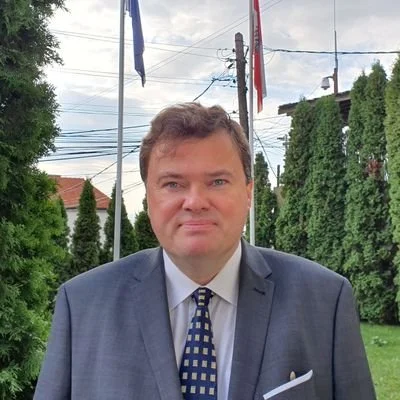
Austrian Ambassador to Kosovo: We're always with you, we'll support you for your visas.
Periskopi(6 years ago)
(6 years ago)Austria has been and remains one of the most friendly states in Kosovo. Austrian Ambassador to Kosovo Christoph Weidtinger a few weeks after the tragic attack in Vienna, has given his opinion of this crime, where one of the attackers and one of the victims were Albanians. How the attack has affected the image of the Albanian diaspora, as you see [...]
Austria has been and remains one of the most friendly states in Kosovo. Austrian Ambassador to Kosovo Christoph Weidtinger a few weeks after the tragic attack in Vienna, has given his opinion of this crime, where one of the attackers and one of the victims were Albanians.
How much the attack has affected the image of the Albanian diaspora, as Austria sees Kosovo's future, what the Austrian stance on visa liberalisation is and how they view the pandemic situation in Kosovo, Ambassador Weidinger answers in detail below.
Christoph W EIDINGER: I can only repeat what Chancellor Sebastian Kurz said right after the attack: Our common enemy is neither a certain population group nor members of a religious community; our enemies are extremism and terrorists. So and during a discussion in Austria about the attack, there's no power lines. Citizens in Vienna and Austria are aware that many of the security forces that have protected and supported people on the night of the attack and that they do so every other day are of origin from Southeast Europe. Austrians are also aware that the first person killed during the attack had the same ethnic background as the author of crime.
Indexline: What support is Austria offering to Kosovo in the fight against the COVID-19 pandemic?
Christoph W EIDINGER: Pandemia with Avid-19 presents an extraordinary challenge for the whole world. This proves to us that we are all in the same situation. Only through cooperation can we overcome this challenge. Austria has supported Kosovo since the beginning of the pandemic. Minister of Foreign Affairs. Alexander Schallenberg and Minister for Europe Mrs. Caroline Edtstadler came to Kosovo at the end of the month May to deliver Austrian aid against Coddy-19, worth 250,000 Euros. These vehicles were used to buy over 13,000 tests, making these tests a significant part in fighting pandemic. But pandemic is affecting the poorest of the needy. The Austrian National Festival, which was on October 26th, provides us with an opportunity to make a donation with food packages to the NGO „The merciful “, through which more than 100 families in the Pec region will be assisted. Austrian government has decided to offer another 12m euros for international aid initiatives against COVIDD-19 last month. Of this fund, 2 million have been earmarked for the Western Balkan region.
IndexlineDevelopments about the special court in The Hague. Several Kosovo politicians have been arrested and are already there. How should Kosovo institutions behave in the face of these developments?
Christoph W EIDINGER: Of course, we carefully follow developments and positively appreciate the willingness of the Kosovo authorities for co-operation, as well as very prudent action of the defendants, for which the presumption of innocence is worth. Rule of law, democracy and human rights are important values on the European road, which Kosovo has taken. The establishment of the Special Court proves that Kosovo is aware of these values and that it deals with them seriously. Austria, as its European partners, will support the work of the tribunal even further. I hope that so far the authority co-operation in Kosovo will continue further.
Indexline: How do you see the Kosovo-Serbia negotiation process? Serbia is insisting that the issue of “The majority Serbian Communists Association” be included in the dialogue, which Pristina rejects. What is Austria's position on this subject?
Christoph W EIDINGER: Normalising relations between Belgrade and Pristina is important for the entire region. The solution to this question is like a needle's eye, through which the entire region must pass. So both sides here have a huge responsibility beyond their borders.
We see very positive the resumption of the dialogue process. Special Envoy of the EU Mr. Miroslav Lajčac has our full support and is pleased that he has achieved some progress. More importantly, at the end of the process there is a result, which is fully carried by both dialogue partners. What the details of this agreement depend on both sides of the dialogue. Clearly, the already reached agreements must be implemented, of course, for the two dialogue partners. It also applies to both sides that they will not succeed without state vision and painful compromises.
Indexline: The November 29th elections for mayorship of the Podujevo and North Mitrovica municipality will be held. What is your message to voters of these two municipalities?
Christoph W EIDINGER: Elections are the core of a democratic process, and every citizen and citizen must exercise the right to vote. Local elections are important because local organ work directly affects people's daily lives. Of course, in the current situation with the pandemic voter security should be taken into account. Among other things, it is self-aware and important that elections be free, fair and held without incident.
Indexline: How do you see the future role of Austria and the EU in the Balkan region how long will the Austrian Army remain in Kosovo? How many soldiers do you have here? And how many Austrian civil servants are in EULEX?
Christoph W EIDINGER: Austria supports Kosovo's European perspective, as is clearly highlighted in the government programme. From Austria's point of view it is clear that Kosovo's future, like the future of the countries of the region, lies in Europe, which means full EU membership. Although much has been done so far, it has to be constantly working on reforms. Therefore, it is an important and relevant signal to implement reform programmes such as the Agency for European Reform 2 (ERA 2). Political will will will will also be needed for implementation of these reforms. The initiative to create a joint regional market, which leaders of six countries like Albania, Serbia, Northern Macedonia, Bosnia and Herzegovina, Montenegro and Kosovo have accepted is an important and very welcome step on the road towards the EU. Austria has been part of KFOR since 1999 and already has the largest number of troops, even though it is not a NATO member. EULEX is the largest civilian mission within common policies for Security and Protection (CSDP) in the EU with currently 453 employees from 21 EU member states, Great Britain and Switzerland and is naturally supported by Austria, though the number of Austrian officials differs. There are currently four officials. The mission supports Kosovo's legal/state institutions in its journey to more efficiency, stability, multiethnicity and accountability, without political interference and full compliance with the EU's best practices. So this mission makes an important contribution to Kosovo's path to the EU. Austria's participation in the above-mentioned missions is seen as an important sign, which Austria supports Kosovo on security issues and rule of law.
Indexline: The economic situation in Kosovo is difficult. What do Austrian investors need to invest in Kosovo? Is there a large Austrian investor (from giant company) that wants to invest here?
Christoph W EIDINGER: We have very good examples of successful Austrian investments in Kosovo, such as in the banking and insurance sector. Austria is one of the biggest investors in Kosovo, along with Turkey, Switzerland and Germany, with a total investment of around 235m euros. About 2,500 jobs in Kosovo are estimated to stem from Austrian direct investments. The agreement on eliminating double taxes between Kosovo and Austria has entered into force since January 1st, 2019. Kosovo has been set up for 20 countries in the World Bank report „Ease of Doing Business” in recent years, so for the World Bank, Kosovo became one of the top 10 reformers in the world. Also, the share of tax reform envisioning reliefs for international and local investors has entered into force early in 2018. So there's progress. I hope the economic relations between Austria and Kosovo deepen even more. The most important thing is further strengthening of rule of law and legal security to attract other investors. The essential factor for substantial investment is investor confidence in the stability and efficiency of the legal framework as well as institutional.
Indexline: How do you see the visa liberalisation process for Kosovo? In your opinion, what preconditions must be met for Kosovars to travel visa-free to Schengen countries?
Christoph W EIDINGER: The fact that Kosovo citizens still need visas to go to the EU is certainly uncomfortable for those who want to travel. That is even more so when it is known that Kosovo is the last country in the Western Balkan region, for which the condition exists. Austria supports Kosovo in visa liberalisation efforts, this is clearly based on the government programme. A possible decision on visa liberalisation is close to the Council of the European Union, where all EU member states are represented and we hope this council will address the issue again soon.
Indexline: What is your message to Kosovo politicians and people?
Christoph W EIDINGER: Austria and Kosovo are linked in many ways. There are a large number of historical, economic, and, above all, human relationships. Austria was a staunch supporter and Kosovo partner from the start. This will not change in the future either. Kosovo can always count on Austria as a reliable partner who will always strongly support Kosovo's European perspective. /Indesksonline/