 8 hours ago
Knowing and Association, Painful Compromise
Periskopi(6 years ago)
(6 years ago)Neither the European Union nor the international community in general have formally given signals nor clearly defined what painful “compromsis” -- which they speak of when it comes to reaching a comprehensive agreement between Kosovo and Serbia -- say connoisseurs of political developments in Kosovo, Naim Rashi and Donika [...]
Neither the European Union nor the international community in general have formally given signals nor clearly defined what painful “compromsis” -- which they speak of when it comes to reaching a comprehensive agreement between Kosovo and Serbia -- say connoisseurs of political developments in Kosovo, Naim Rashi and Donika Emin.
The necessity of a painful “compromising” to reach a peace agreement between Kosovo and Serbia, officials of the European Union, the United States, but also officials of Serbia and Kosovo have consistently spoken.
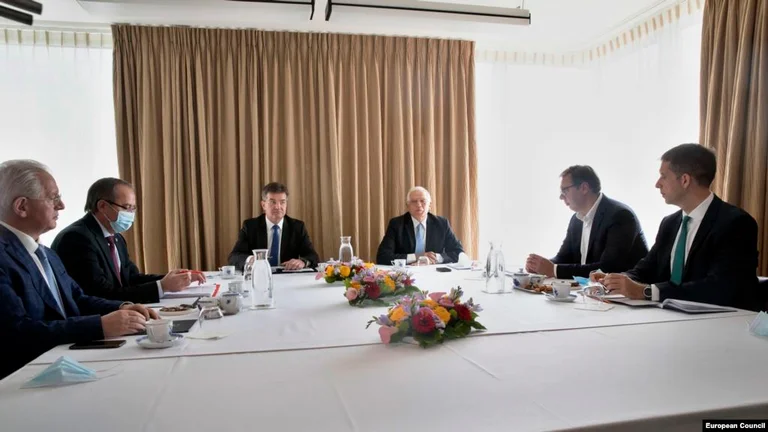
Recently, the European Union's special envoy for Kosovo-Serbia dialogue, Miroslav Lajcak, at the Belgrade Security Forum, has stated that resolving the target “will be a painful compromise”, which is possible and “worth”.
But what is this painful compromise, Lajcak has not clarified it. Other European Union officials did not clarify that statement.
“Insulated words”, without official explanation; unofficial “
Peter Stano, spokesman for the European Union (BE), competent for foreign policy, has said of Radio Free Europe that the isolated <x1-cyphylite” of European officials who have spoken at the event should never be interpreted.
He (Lajcak) spoke in a broader context and said much more than this sentence, so no interpretation or explanation is needed”, Stano declared for Radio Free Europe.
However, EU officials, under the condition of anonymity, have explained that Miroslav Lajcak, at the Belgrade Security Forum “, declassified what is clear” and that, according to them, implies a possible recognition of Kosovo's independence by the Serbian side, but also the formation of Kosovo's majority Serb municipalities.
European officials commemorate that Serbia's president, in some cases in his public presentations or interviews, has said Serbia must be ready for a painful compromise, which is, as they explained, “acceptance and eventual recognition that Kosovo will no longer be part of Serbia ♫ and therefore requires compensation”.
The same officials said that Kosovo politicians also, in some cases, have ordered that the necessary compromise is never easy “and included withdrawing from certain demands”.
In that context, European officials involved in the dialogue believe the agreement on forming the Association of Serb majority municipalities “can be seen as a painful compromise”.
The difficult <x0mes are on the table, where the will for compromise will be tested and compromise will probably be difficult for one side or the other, in light of their domestic political pressures”, European officials said, adding that compromises are worth the effort, taking into account that the final outcome will be normalisation and ultimately EU integration.
Naim Rashit, director of the Balkan Policy Group, tells Radio Free Europe that actors involved in Kosovo- Serbia has not suggested what compromise will look like, and it is hard to know.
But, according to him, what is precisely known is what the parties, Kosovo and Serbia want. As he says, Kosovo seeks recognition from Serbia and removing barriers from its path towards full international membership and European perspective.
Meanwhile, as he says, Serbia wants to resolve the Kosovo issue enough to prevent it from becoming an obstacle to EU membership.
Rashit says that in this compromise, Kosovo would offer the Ahtisaari Document, or as he calls it, “Ahtisaari plus”, the Association of Serb majority municipalities, to receive recognition from Serbia, but maintaining the unitary character of the state and its functionality.
Meanwhile, as he says, Serbia requires compromise, either territorial or a much broader status for Kosovo Serbs and the Serbian Orthodox Church, as well as other rights within Kosovo, for eventual full normalisation of relations. But, according to him, Serbia is very reluctant to put Kosovo's exclusive recognition on the table.
Now the problem lies with the mediator. He has defined this process as a painful compromise to close all open issues and eliminate all obstacles to Kosovo's progress to move towards the EU.
But he didn't give her a name. EU member states, especially Germany, already speak in an extenuating manner of mutual recognition, which before that name is recognition between the two countries. Starting with recognition between the two countries, compromise on how to accommodate this political process should be found, Rashi stressed.
Donika Emine, executive director of the CaviKos Platform, speaking of Radio Free Europe, says that throughout the Kosovo-Serbia dialogue, when the parties have returned -- whether from Brussels or Washington -- with triumphal statements they have created a perception that they are winning against each other or that they are one step ahead of each other.
Meanwhile, according to her, the parties have called for compromise, and one has been highlighted by European Union officials.
“First, Lajcak's statement that (compromis) will be painful, but the person I'm signing will be on the right side of the story, was a bit absurd. This showed that perhaps even the EU is not clear what this painful compromise is.
Okay, I see it as a strategy that at least prepare both sides for an agreement, which will be not only winners and losers. However, the EU has never been clear in sending such messages”, Amy stressed.
In spite of Rados Europe's free efforts to get a comment from Kosovo government officials, what painful “compromising” means to them, they have not been accessible.
But from the opposition Movement Vetevendosje party, Victory MP Pacolli, has told Radio Free Europe that Kosovo has made a lot of compromises, when it comes to dialogue with Serbia, and that now, it should not accept painful compromises, which would only bring damage.
“We are currently in a situation where Kosovo is unable to compromise, because they will endanger the state, challenge our right to the future”, Pacolli stressed, adding that Kosovo “has nothing more to offer Serbia”.
According to her, Kosovo has been blocked from developing as a state precisely because of Serbia's interventions, which “at any moment has pleaded not guilty to crimes it has committed”.
As Pacolli points out, the best choice would be for Serbia to recognise Kosovo as an independent state.
“Now is the time for Serbia to accept its guilt, seek forgiveness for crimes committed in Kosovo, return the bodies of missing persons, pay the damage to the war, and then accept Kosovo as an independent state, because Serbia has brought so much damage to Kosovo that it no longer has the right to ask for anything from Kosovo”, Pacolli said.
She has added that Kosovo and Serbia should go towards the EU as two independent states, along with other states in the region.
Analyst Rashit says it is difficult to define in detail the compromise, which is required by Kosovo and Serbia to conclude the conflict between them. According to him, concern remains the fact that despite the two letters US President Donald Trump has sent to the washing authorities in Kosovo and Serbia, which talk of mutual identity, both sides believe little it is within reach in the process.
Also, according to him, despite the fact that Germany and its Chancellor, Angela Merkel, have consistently said Serbia must recognise Kosovo, Serbia has made little or no progress in this direction, while Kosovo believes little or nothing that recognition from Serbia may be.
The international factor has lost the weight of its word when it talks about compromise and framework. Here is no longer the trouble of compromise and formulation, especially from Kosovo's perspective, but how this process will be completed. The international factor has been pushing this year, but next year. Now they say the same again. We have no formula for concluding this process. Of course, it is not only because of their own fault, but also because of the parties that are diverting”, Rashi says.
He added that the continuation of the blurry over the final determination of the dialogue process has also caused the confidence of politics and citizens in this process to decrease further.
But, analyst Emini estimates that political elites in Kosovo and in Serbia are totally unprepared for any epilogues of dialogue. As she says, Kosovo has no idea what it will look like as a victory and what compromise would look like, while, according to her, the Serb side, in the internal narration, insists it will not recognise Kosovo, and it does so even through media controlling its power there.
The “means, they constantly have a narrate, which for the public in Serbia underlines the message that these two countries are on the brink of war. On the other side of Kosovo, the government has statements only for public consumption, but which it no longer believes. This especially with what was signed in Washington, where there were red lines for mini- Schengen and he was signed. As of now, Prime Minister Hoti is claiming to have red lines for discussions on the association“.
However, a clear trend is seen to lead us back to this issue. Red lines in Kosovo have not been as clear as in Serbia. These red lines are very flexible because they've been moved and violated and I don't trust the prime minister himself anymore, but neither the public opin”, Amy stressed.
She added that this situation makes Kosovo weaker in negotiations, but even more unpredictable in this dialogue.
Emini added that the United States of America has brokered Kosovo and Serbia for an economic agreement, but in a political way, they have not broken down this agreement.
Dialogue between Kosovo and Serbia has started in 2011 under the European Union's mediation. This dialogue is aimed at fully normalising relations between the two countries.
Recently, the United States has intensified its efforts to bring the parties closer to normalisation of reports and, in this context, on September 4th at the White House in Washington, Kosovo and Serbia signed agreements on economic normalisation.











