 4 hours ago
U.S. elections defined for continuing dialogue
Periskopi(6 years ago)
(6 years ago)The European Union-brokered dialogue on normalisation of reports between Kosovo and Serbia has been blocked again, as the parties are disagreeing on the topic of the Serb majority municipalities' association. The latest leadership-level meeting in Brussels is held on 7 September, 3 days after the signing of the Washington Agreement. And the fact that [...]
The European Union-brokered dialogue on normalisation of reports between Kosovo and Serbia has been blocked again, as the parties are disagreeing on the topic of the Serb majority municipalities' association.
The latest leadership-level meeting in Brussels is held on 7 September, 3 days after the signing of the Washington Agreement. And the fact that who will be in charge of the White House in Washington, following the November 3rd presidential elections, is seen as determining even for continuing the Kosovo-Serbia dialogue.
Engjelshe Morina, expert in the European Council for Foreign Policy organisation (ECFR), headquartered in Berlin, estimates that dialogue will not continue until the clarification of who will win the US presidential elections.
I don't think there's going to be any movement in this process, until mid-November c.”, Morina told Radio Free Europe.
This depends greatly on the outcome of the US elections, and this result will have its role in the dynamics of the dialogue process between Kosovo and Serbia, as the US recently launched an initiative to normalise relations from the economic angle”, she added.
In Pristina, meanwhile, Life Krasniqi from the Kosovo Democratic Institute (KDI) does not expect the resumption of dialogue to depend entirely on US elections. However, it sees the full US-EU co-ordination inevitable for reaching the final agreement.
“Now the Kosovo-Serbia dialogue is at the EU table and should be seen how it can be unblocked to move forward. But a final agreement must also have US support and we are expected to have a US turnout, as without its participation we will not have an agreement that will reach mutual recognition, Kosovo's membership in the UN (United Nations Organization) and all the other ones we ask from this process<1>, Krasniqi praised Radio Free Europe.
But, she expects the EU will come up with a plan to unlock dialogue and push ahead.
Are there results from Washington's agreement on current dialogue?
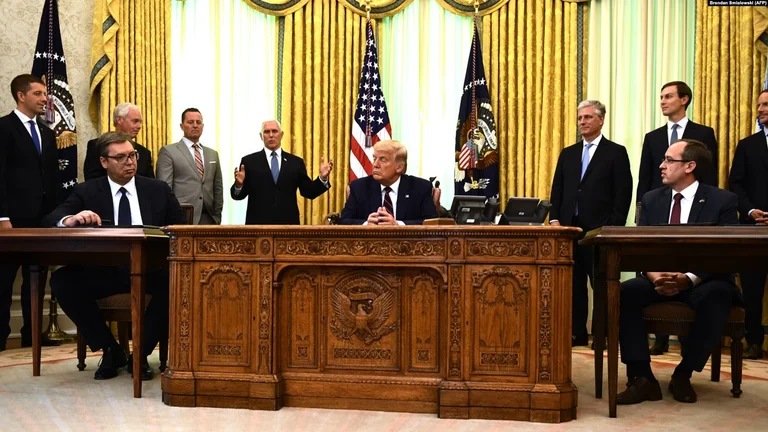
The leaders of Kosovo and Serbia signed agreements on economic normalisation in Washington in September. Engjelshe Morina says that many do not name what was signed on September 4th, but as the signature of two separate documents. Hence, she is not convinced that Washington's signatures will produce results, since, according to her, the main issues were not addressed there.
The “is hard to believe (time will show) that economic drives improve relations between Kosovo and Serbia. There are very important issues for both sides and separately for the Kosovo side, and they are not economic”, Morina said.
Political cohesion lack is undermining Kosovo
The current Kosovo government, led by Prime Minister Avdullah Hoti, is at the minimum of the parliamentary majority and is facing a strong opposition, which is not supporting it in dialogue.
Analysts say Kosovo must have political cohesion to achieve its goals.
What needs to be changed is finding a political cohesion, both in Kosovo and Serbia, to have an idea of what the parties' expectations in the dialogue are and to clarify the main principles of the” dialogue, Engdule Morina from the ECFR said.
Life Krasniqi estimates Serbia is exploiting this lack of political cohesion, as the EU itself has not clearly articulating the position that the process should bring mutual recognition.
Serbia seems to be exploiting this issue, blaming Kosovo as a barrier to dialogue. Kosovo must make it clear that it is for dialogue, but not on the condition that the entity system of the Republic be destroyed and that it emerge as a dysfunctional state”, Krasniqi said.
Dialogue at the Crossroad
The EU's special representative for the Kosovo dialogue, Serbia, Miroslav Lajcak, on his recent visits to Pristina and Belgrade (13 October 15th), did not refer to the unblocking of dialogue, but that he called on both sides to abide by the commitments.
Lajcak asked Kosovo to implement the agreement for the Association of Serb-run municipalities. On this topic, Kosovo and Serbia first reached agreement in 2013, under the first Brussels Agreement.
Also, in 2015, the parties signed additional agreements on the principles of establishment of association. But, Kosovo's Constitutional Court found that the principles are not in harmony with the Kosovo Constitution.
Meanwhile, earlier, the International Crisis Group in its latest autumn report had suggested that the European Union see the possibility of Kosovo-Serbia dialogue platforms establishing that the final agreement should include mutual recognition.
This independent organisation, which analyses conflicts in the world, however, has predicted that the final solution will include major concessions, including broad autonomy for Serbian municipalities or exchange of territories.
One of the authors of this report, Giuspe Famià, the leader of European Affairs in this organisation, in an interview for Radio Free Europe, had said that the EU should not impose restrictions on dialogue and that the United States should have a role in convincing Kosovo to revis the dialogue platform. According to him, if Kosovo agrees for broad autonomy for Serb majority municipalities, the same should apply to the Presevo Valley in Serbia.











