3 hours ago
Economic recovery, what measures North Macedonia took, Albania, Kosovo

Periskopi(6 years ago)
(6 years ago)After health, businesses are the ones most damaged by the COVID-19 pandemic. A large number of businesses have been bankrupt, and tens of thousands of workers have lost their jobs because of the difficulties that Coronavirus has caused in businesses. All states have taken concrete action with economic packages for [...]
All states have taken concrete action with economic packages to help businesses escape bankruptcy and maintain the number of employees.
A total of 4 packages for economic recovery have been adopted in northern Macedonia by the COVID-19 pandemic, including numerous measures aimed at helping the private sector and citizens of this state. Similarly, they have not held back even Albania's authority to save its economy, which has so far approved two economic packages. And on the other hand, Kosovo has only remained the most emergency package, until the second economic package has yet to be voted in the second reading.
The package of four of northern Macedonia totals 470m euros, which has 31 measures. Among the key measures involved in this package is continuing to support pay salaries by the end of the year, which will range from 14,500 to 21,776 denars. 250,000 jobs will be supported by 70m euros, the pay card of 6,000 denars for the tangible categories of citizens worth 27.6m euros.
Other measures included in this package include the three-month extra share of interest-free loans from Covid-19 through the North Macedonia Development Bank, an additional 100m euros for free loans through the North Macedonian Development Bank.
The chairman of the North-Western Macedonian Economic Ode, Nebi Hoxha, says of KosovaPress, that the measures from the first three packages have been delayed and not enough to help businesses.
For the fourth package, he says there are a large number of measures they have proposed and are involved in this package.
“In the 4th package, we have an escalating wage subsidy depending on the losses the companies suffered, which means 30 per cent to 100 per cent, depending on the loss of wage subsidies are worth 250 euros to 350 euros for each employee. Then, we've also asked for the write-off or extension of the bonding fee to profit, we've requested lowering the interest rate from commercial banks, which in some form is still not in force, and we're doing everything we can to make companies that can create economic growth and are liquids to be supported also, because they will be companies that will keep the economic balance in our country”, Hoxha said.
So there are a lot of measures that are incorporated, so once again the question of how effective they will be, we'll be the ones to observe and have the results from the ground. It's also one thing to stress, because in this situation in the 4th economic package, it's been reduced to the state budget and a budget deficit has been created some 8.5 per cent or 900m euros, which means it's a huge impact even on public debt, which has reached the value of some 60 per cent of the gross domestic product, which is a record in our country's history”, he says.
Hoxha points out that wage subsidies were the main aid provided by the government of Northern Macedonia for businesses, while stressing that the measures of this package are good, but depends on how much will be implemented.
Subventions in wages were the main aid given, then increased circulation in the country's economy has also been helped by households, students, pensioners, to have broader consumption and to create a circulation in our country. It's also to emphasize the tools that have been separated from the Bank for Development at a low interest rate, and there is also another aid shared by the Bank for Development without any interest rate for companies that have development projects and which can affect the country's economy”, he stated.
So we have enough measures to call it good, but how they're going to be implemented and implemented in the places where it's most urgent, so we need to be able to make sense to see exactly where these tools are and how they're going to be distributed so that we can be as efficient and go back to what we all aim at”, he says.
The head of the North-West Economic Office of Macedonia says that nearly 20,000 employees have lost their jobs due to pandemic, and the increase or not of this number, Hoxha says it depends on the means the government will share.
It also shows the main demands the business community has in northern Macedonia.
“The main requirements as I stressed to be liquid is number one, to keep the number of workers is number two, to create driving opportunities to increase market consumption. It is also more important, and the other aspect is the sharing of tools for companies that can contribute to economic development -- of zero interest and low interest -- and capital investments that will create new jobs and economic prosperity in our country and beyond. Also, it is more important to support companies that have economic potential for export and export absorption from”, Hoxha says.
On the other hand, the Government of Albania has approved two economic packages to help businesses and citizens affected by COVID-19.
The first package included measures as financial assistance for employees in the business sector with an annual income of up to $14,000,000 for the period following the economic end of activity due to the status of pandemic caused by COVID19. The other measure is doubling the payment for individuals who receive financial assistance, doubling the payment for individuals who receive financial aid, doubling the payment for individuals who gain income payments from unemployment.
While the second package included measures such as subsidising the outgoing and current employees in businesses with an income of 14 million dollars closed by MSHMS orders, support for layoffs in March 1st March 17th, subsidised for all employees of businesses with an income of under 14 million dollars, subsidisation of the war salary for service workers in the tourism sector.
The Albanian government in support of the private sector through an instrument of the Sovereign Guarantee in coping with the situation has approved two Sovereign Guarantee instruments for a total of 26 billion dollars.
The chairman of the Chamber of Commerce and Industry in Albania, Nikolin Jaka, says what was most important to businesses was taking over salaries of employees from the government.
What was most important was taking on the salaries of employees who because of closing activities were compensated for the so-called war pay. While within this package there was also a sovereign guarantee that was taken into the venture, which had to liquidate their employees' salaries. While after the first package we had the second package, the second package was focused more on sovereign guarantees that could receive sovereign guarantees, so it could be included in credit projects all those enterprises that felt necessary to get sovereign guarantees, and the state was guaranteed 50 per cent and 50 per cent shut down by entrepreneurs”, he says.
Jaka says that, based on statistics, in Albania over 30 per cent of small businesses have been closed, and this shows that the measures taken have not been at the right level.
As for the number of workers who have lost their jobs, Jaka says over 400,000 workers have lost their jobs as a result of the pandemic by state institutions. While, it says that small business declares a figure three times that of state institutions.
“We've requested that all small businesses that were closed in due to the pandemic be compensated for wages for all employees who leave, have a differentiality for enterprises which actually extend the deadline for the surrender of balances and income statements, we have demanded that sovereign financial guarantees be implemented without further bureaucratic obstacles<1>, he said.
“We have demanded that the transport and tourism sector be repaid for their losses, while on the other hand we have demanded that there be a new process of economic growth, which consists of some strategic reforms involving the role of producers to always empower Albanian producers, who is also the biggest employee consumer, which employs more human capital. There are other demands, and they always have to do with whether in fiscal treatment or the treatment of strategic platforms to operate in different sectors of economy”, he says.
The head of the Chamber of Commerce and Industry in Albania, Nikolin Jaka, says that since the government is in the last year of the mandate in focus, they have the establishment of the institutions of accusations against each other rather than the rescue of the economy.
He says they require nothing more than the measures North Macedonia, Bosnia and Herzegovina and several other countries in the region have taken.
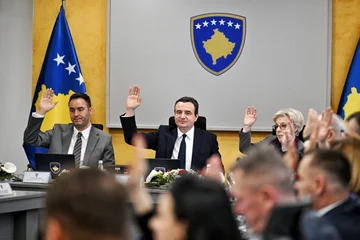
Meanwhile, Kosovo has so far adopted the emergency package, which was at the time Prime Minister Albin Kurti ruled with the country.
This emergency package included measures as double payment of social scheme value for all social and pension plan beneficiaries for April and May -- the measure worth up to 7m and 650 euros -- additional payments worth 30 euros a month for all beneficiaries of social and pension schemes that receive monthly payments worth lower than 100 euros, for April, May and June, worth up to 13m euros.
The measure of this emergency economic package was also financial support for financially troubled commercial societies as a result of the decline in their activities due to the emergency public health situation, which had included coverage of monthly salaries of employees worth 170 euros, for April and May, the measure of up to 41m euros.
In contrast, the draft economic recovery law, the current government led by Prime Minister Avdullah Hoti, has only managed to adopt it in the first reading after six attempts that had failed in the Kosovo Assembly.
This bill includes 385m euros and allows for the withdrawal of 10 percent of retirement savings. Of this, the government has made the distribution of 60m euros to businesses.
The chairman of the Kosovo Economic House, Berat Rukiqi, says the governments of the two countries -- North Macedonia and Albania -- have been more efficient in taking measures to help businesses compared to Kosovo.
“These countries have been much more efficient in the action company, have taken action at the right time. Now here to us right now this last measure that was direct support in business is a move that has been accomplished quickly and which has the direct effect on business. The other measures are not giving any very positive effect. The expectations are too high by the law on economic recovery, but it is not the problem of the nature of the masses or the type, or the amount of implementation of those measures is the problem of their implementation times”, Rukiqi has said.
We are talking about a period of seven, eight weeks and longer about installing a measure, which is too long for businesses that have a lot of needs now and in an extraordinary state of functioning of”, he says.
Rukiqi says the country's institutions have not been very efficient in supporting the private sector.
We're not measuring failure, but we're measuring efficiency. I hadn't said that right now we can only talk about an institution, that this isn't just about an institution. We are seeing that much is directly related to decision making in Parliament. I can say that the country's institutions have not been effective in supporting the private sector... for emergency is delayed and that it's lost sense, of course, that businesses have been helped but businesses have been unhappy with the whole process”
“Now for recovery are the first measures, this last 60 million measure has been welcomed, but normal expectations are much larger now by the law of recovery that particularly enables the idea to increase aggregate demand by increasing purchasing power and normally creating a better position for the liquidity of companies that relate to their access to financial”, Rukiqi says.
In Kosovo so far, there is no official record of how many businesses are bankrupt or workers who have lost their jobs as a result of COVID-19.