5 hours ago
Walker: International community must recognise Recak's truth
Periskopi(6 years ago)
(6 years ago)On the 21st anniversary of the Recak massacre, the memorial academy in which the genocide Serbia committed by Kosovo Albanians two decades ago has been celebrated. Kosovo President Hashim Thaci said the international silence against this genocide has angered Serbia to deny the crimes it committed in Recak. And the former ambassador [...]
Kosovo President Hashim Thaci said the international silence against this genocide has angered Serbia to deny the crimes it committed in Recak. While former OSCE ambassador William Walker has said the victims in Kosovo deserve justice and that the international community must know the truth that occurred in Recak.
Remember, Recaku” was the motto of activities marking the 21st anniversary of one of the worst massacres, following Srebrenica, which Slobodan Milosevic's 1999 criminal regime committed in Recak.
The responsible for the monstrous crime committed in Kosovo Albanian civilians have not yet been brought to international justice. While power in Serbia denies such a massacre, the truth of which the whole world knows.
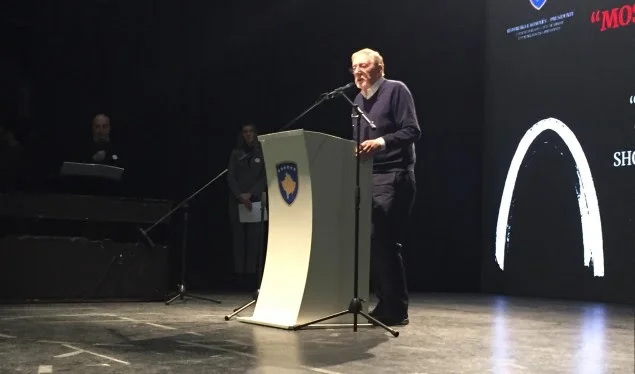
President Thaci, at the academy held in the Forum Community, said Kosovo's citizens and institutions are revolting over the lack of international justice, since he said they had full confidence in international justice authorities.
As he stressed, citizens are desperate by the international amnesty against the ethnic cleansing the state of Serbia has conducted in Kosovo.
“I want to say very openly that this international silence, and in almost one form or another, this international amnesty of Serbia's genocide committed in Kosovo encouraged and encouraged Serbia's state authorities to claim to deny even the crimes, the massacre in Recak. This has affected the people of Kosovo, hurt the feelings and wounds of any Kosovo citizen seeking justice, and this international silence has only cost Serbia its satisfaction in fact has cost the process of building peace, reconciliation and future as fast as possible for European Kosovo, European Serbia and the Western Balkans of Euro-Atlantic perspective. And of course it is time for all of us to speak the truth, and of course, the leaders who are hosters of institutions in Serbia, genocide, ethnic cleansing and other massacres in Kosovo, of violations, to stand before international justice”, Thaci said.
The head of state said Ambassador William Walker managed to keep international senbilisation alive for the massacre Serbia has committed in Kosovo.
Thaci thanked Walker for saying he never left Kosovo alone, even when internationals never visited him, stressing that for the first time, he is looking at large numbers of internationals in order to pursue the academy that commemorates the Recak massacre.
Ambassador Walker himself spoke of this, who said the commemoration of the Recak massacre does not imply hatred between the two peoples, but justice is required for victims. He said the internationals should know Recak's truth, which, as he stressed, crime against humanity occurred there, and there is no dilemma.
“I spent 43 years in the diplomatic service of the United States of America, I've had a hard time understanding where the international community is on the day when such a memorial of the macabre event took place 21 years ago. I was told, from embassies, from diplomats, who do not want to regenerate, to light the story of the Recak massacre, because in a way it would prevent the reconciliation process between Kosovo and Serbia from that war. I honestly don't understand that. This is not a meeting where we regenerate hate, I don't come here to tell you terrible stories about what happened here, I just want justice for victims of violence in Kosovo, for the victims of Recak, I believe that the international community should know the truth about what happened here”, Ambassador Walker said.
At the memorial academy on the 21st anniversary of the terrible crime Serbia exercised on Kosovo Albanians in Recak, Albania's president, Ilir Meta, said that the sacrifice of witnesses and all innocent victims is motivation for Kosovo to move forward on the path of independence and strengthening democratic institutions.
“21 years ago, we in Albania, but also all of our nation everywhere, watched with anxiety events such as those of Recak, Krush and Prekas, and everywhere goes to Kosovo, and not just that much, but 21 years ago in Albania, we waited at at least 1 million Kosovo brothers and sisters forcibly expelled thanks to a criminal project to permanently empty Kosovo from Albanians. I am happy today that these sacrifices have been worth it, and I come to an independent, democratic Kosovo today, one in Kosovo which I am sure has every opportunity to be an example of co-existence, reconciliation and construction towards a common European future in our” region, Meta said.
The Chairman of the Entrance Community, Naim Ismajli, called on the ambassadors of the QUINT states to pressure Serbia in order to bring Recak's crime responsibilities to justice.
Honored “present, and in particular you ambassadors of various states, we demand that the authority of your states and international mechanisms be exercised against Serbia to bring to justice the responsibilities of Recak crime and the responsibilities of crime in Kosovo. They may be known by name and surname, by address and exact location. Such loose criminals walk around the world, and from their walk and their freedom is threatened by our country, the Western Balkans and Serbia itself, they must bring to justice the massacres they committed in Recak and Kosovo, and in this way the region will be safe”, he said.
21 years ago, in the massacre of Recak the state of Serbia has executed over 40 innocent Albanian civilians, elderly, young and children.
William Walker, who at the time was the head of O'S verifering mission. The SEU for Kosovo, had visited the crime scene and had declared there a crime against humanity.
His statement had mobilised the international community to end ethnic cleansing in Kosovo, hosting the conference in Rambouillet in February 1999, which followed NATO bombings on Serb targets in Kosovo.