6 minutes ago
Six strange objects discovered in the center of our galaxy
Periskopi(6 years ago)
(6 years ago)Scientists have discovered very strange objects in the center of our galaxy that do not exist anywhere else on the Milky Way. In orbit around the black eyehole Archer A, Sgr A, located in the center of our galaxy, they found six objects that look nothing like the Milky Way. These objects are so [...]
In orbit around the black eyehole Archer A, Sgr A, located in the center of our galaxy, they found six objects that look nothing like the Milky Way. These objects are so unusual that they created a whole new category of space phenomena called G.
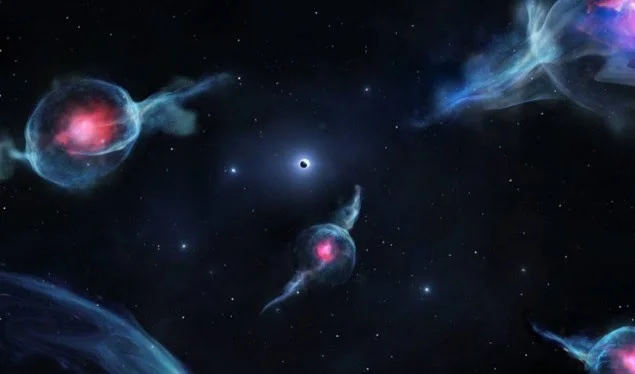
Astronomers first noticed two original objects -- G1 and G2 -- almost two decades ago. They resembled giant gas clouds, with a diameter of 100 astronomical units (an astronomical unit is roughly equal to earth's distance from the sun). As these clouds approached the black hole, they lasted, and the spectrum recorded that they consisted of dust and gas emissions.
But the problem was that G1 and G2 didn't behave like a gas cloud.
“These objects look like gas, but they act like stars,” said physicist and astronomer Andrea Ghez from the University of California (UCLA).
Ghez and her colleagues have studied our galactic center for more than 20 years. Based on their records, astronomer Anna Ciurlo i UCLA identified four other objects: G3, G4, G5 and G6.

It's still not quite clear what it is, but Ghez believes that the form G2 of 2014, when it was closer to the black hole, may offer some answers.
When it was closer to the black hole, the G2 had a really strange view”, Ghez said.
The G2 object didn't seem very unusual until it came very close to the black hole. When he was away from the black hole, he looked like a harmless compact object, and when he approached, he stretched out and twisted to begin again to return to compact”, he added.
Astronomers believe the answer lies in massive rail stars. Most of the time, these stars orbit each other, but sometimes they crash, forming a big star. When that happens, there is a huge cloud of dust and gas surrounding the new star for another million years after the crash.
“Something had to preserve the compactness of the G2 and allow it to survive a tight meeting with a black hole, showing that a star object was hidden inside,” explained Ciurlo.
What about the other five G category objects? And they can represent a merger of binary stars. Most of the stars in our galaxy center are very massive and often binary, and it is possible that extreme gravity forces around Sgr A destabilise their binary orbits.

“The black cells may be slamming the binary stars. It may be that many of the inexplicable stars we have observed are actually the latest production of rail stars. We're still learning how galaxies and black holes form. The way the binary stars interact with and with a black hole is very different from the interactions of individual stars with other stars and with a black hole, “said Ghez.