6 hours ago
Will Serbia apologise to Kosovo? Vuciq interview for renowned Albanian journalist
Periskopi(6 years ago)
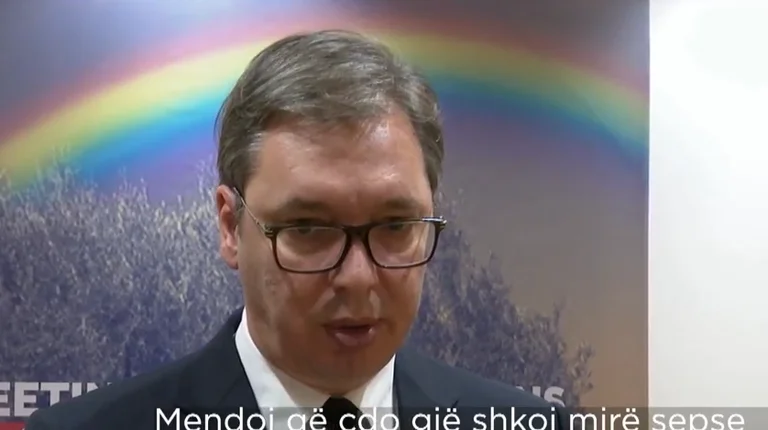
(6 years ago)Serbia's President Aleksandar Vuciq has spoken of the Recak massacre. Vuciq said he did not deny war crimes, writes Periscopi. “I have never denied war crimes, and we in Serbia, for the sake of truth, have condemned many war criminals coming from the former Yugoslavia and regardless of nationality and we have [...]
“I have never denied war crimes, and we in Serbia, for the sake of truth, have condemned many war criminals coming from the former Yugoslavia and regardless of nationality, and we have had different views of something that happened in different parts of the former Yugoslavia. That is exactly why we have to deal with this problem and why we need to build better relationships and relationships between us. You cannot force Serbs to accept all your views and ideas”, he said.
Full interview for Euronews Albania:
Euronews reporter and news director, Mrs. Albany. Ilva Tare interviewed Serbian President Aleksandar Vucic during his visit to Tirana regarding the Balkan Schengen, where he asked him about the region's main challenges and Serbia's prospects.
ILVA TARE: How did your visit to Tirana go? How do you feel when you visit Albania?
VUCH ALEXANDER: I felt real hospitality and everything went well. I think we had a productive conversation between Albania, Northern Macedonia and Serbia. I was glad that the president of Montenegro joined us on the second day of our visit. I think everything went well because we met each other and did many things for the good of our peoples and of our nations.
ILVA TARE: Mr. President Vucic, is the Western Balkans Summit a tool to create a mini European Union while the real one seems to have closed the doors to enlargement for the region?
VUCH ALEXANDER: This is a difficult question that nobody wants to answer, but I would say we do our best to improve the standard of living for people, the quality of their standard of living. We do our best to lower the operational costs of our trade and all other companies and to tell them the truth, what we need to do is facilitate the free movement of goods, capital, services and people, and that's what we're doing. In addition to that or whatever, we are on our way to the European Union, we must fulfil some important obligations, we must fulfill different agendas, yet when we speak of the European Union, we do not have everything in our hands. It is the European Union that will decide our future. But when we talk about ourselves, it's all up to us and that's why we need to increase our level of cooperation and improve the means in terms of the so-called mini-sensing initiative.
ILVA TARE: Can there be co-operation, a true co-operation among Balkan countries before we have reconciliation and peace? Because you still deny war crimes in Kosovo. Your statement on the last day of the Recak massacre, what is your position for it?
VUCH ALEXANDER: I have never denied war crimes, and we in Serbia, for the sake of truth, have condemned many war criminals coming from the former Yugoslavia and regardless of nationality, and we have had different views of something that happened in different parts of the former Yugoslavia. That is exactly why we have to deal with this problem and why we need to build better relationships and relationships between us. You cannot force Serbs to accept all your views and ideas.
ILVA TARE: No, we can ask you to accept the facts.
VUCH ALEXANDER: No, that's what you say, what you think. We think differently.
ILVA TARE: The international community has also said this, has witnessed this...
VUCH ALEXANDER: This is the fourth time you've interrupted me and yet I haven't answered your question. It's OK what a lot of people say, and when we talk about the international community, what a lot of people here say is that we should recognise Kosovo's independence and then analyse that the international community is divided. It's exactly half by half. But we put this aside. Do not condemn someone because he has different views of the past, try to make him a friend for the future. It's not just my personal advice, it's something I tell everyone as political legitimacy. We have to work together, we have to live together, we have to create an atmosphere different in which, people shouldn't be punished because of the language we speak, because of something they think or have said or said out loud and that was different from government or province officials. Leaving this aside we will create a broad space for co-operation within the region and do concrete things that we will be able to increase the level of co-operation and bring more investors to our region and bring each other closer to the future.
ILVA TARE: One last question. Serbian leaders in the past found the courage to apologise for war crimes in Bosnia and Croatia. Do you think it's time for you to apologize to Albanians for war crimes in Kosovo?
VUCH ALEXANDER: What I think is that all parties have committed a lot of crimes and I think those who committed these crimes, who committed any kind of crime, have to take responsibility and that's what I can say. I was never a man who would hide someone or who would be ashamed of something someone did. I didn't commit any crime to tell you the truth. Whoever has done this, these men must be very humble, very modest when they tell the people about whom they have done things against. I didn't participate in this. But there are many people, it doesn't matter which way, Albanians, Serbs, Croats or Bosniaks that committed crimes, and that's what we need to do, we need to get out of this time period and create a different and much better future for us.
ILVA TAREYour biggest critics say you supported those crimes, you were the propaganda machine.
VUCH ALEXANDER: I've never done this and I've never said this but if you say so, if it's easier for you, if that's enough reason to rely on some way on your conspiracy theories, I wish you the best.
ILVA TARE: As for dialogue between Pristina and Belgrade...
VUCH ALEXANDER: Your last question was two or three minutes ago.