8 minutes ago
Are there other options besides the LV coalition? V-LDK?
Periskopi(6 years ago)
(6 years ago)Determining the Vetevendosje (LVV) Movement to form the new government only with the Democratic League of Kosovo (LDK) has made other options impossible, say connoisseurs of political developments in Kosovo. Although it has already been three months since holding early parliamentary elections in Kosovo, the new government has not been created, for the fact [...]
Determining the Vetevendosje (LVV) Movement to form the new government only with the Democratic League of Kosovo (LDK) has made other options impossible, say connoisseurs of political developments in Kosovo.
Although it has already been three months since holding early parliamentary elections in Kosovo, the new government has not been created, due to the fact that the winning party, the Vetevendosje Movement and the second party, the Democratic League of Kosovo, have failed to form a coalition..
According to connoisseurs of constitutional issues in Kosovo, there are two possibilities of how to form the new government, in case the coalition between the two parties is not reached.
Justice Alban Krasniqi tells Radio Free Europe that if LVV and LDK do not agree to form the new government, it would imply that the Vetevendosje Movement would open other ways for the ruling coalition. According to him, the party led by Albin Kurti could look to finding other partners to form the new government.
“Vetevendosje Movement can see the possibility of finding another partner from the ranks of political subjects represented in the Parliament”, Krasniqi says.
In this case, according to him, the governing partnership would have to be built between the Vetevendosje Movement and one or several political subjects.
The other option, he emphasises, arises if, after receiving mandate from the president, the prime minister's mandate, there is not the majority needed to form the government. In this case, he says, the president has the discretion to appoint the second mandate.
If it is considered that we have only two options to form the government, and if this is read jointly with the relevant article of the Constitution that gives the president a kind of obligation to ensure the democratic functioning of institutions, then it may make sense that the president has some kind of disrepute, now but in the future, if he has failed to form the government in the first time, to make a sort of design of who has the greatest chance to form the” government, Krasniqi says.
The constitution, Krasniqi points out, has left open what party belongs to the mandate's appointment for the second time -- although it says correctly -- that “should be another candidate from the first mandate, because it is “the extenuation threat of Article 95 paragraph 4 of the Constitution”.
If the government's formation fails again, Krasniqi adds, then new elections should be announced.
But the new elections, according to Valmir Ismaili from the Democracy Plus organisation (D+), would be the worst possible choice to get out of the current situation.
“These two political subjects, the Vetevendosje Movement and the Democratic League of Kosovo, would need to drain all possibilities to create a government which they have promised since before holding elections and then prior to the confirmation of the election outcome”, Ismaili says.
He says that even increasing the number of ministries would be an opportunity to reach the coalition between the Vetevendosje Movement and the Democratic League of Kosovo.
“An option could be if the number of ministries were not 12, but it was 15, where the LDK would have seven and the Vetevendosje Movement five and three ministries could go for minorities. If either this option does not like either side, then it would take that both political subjects are publicly declared that no longer can a coalition between these two political subjects, Ismaili says.
According to the interpretation of the Constitutional Court of the Republic of Kosovo in 2014, in the role of initiative, the president of the Republic has a mandate, but also constitutional duty on the basis of Article 95, paragraph 1 of the Constitution, to propose the candidate for prime minister nominated by the political party or the coalition having the largest number of seats in the assembly.
This court has also stressed that the Republic's “president does not have the discretion to refuse the appointment of the candidate proposed for prime minister”.
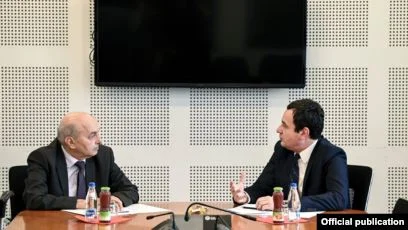
On Monday, January 6th, the first meeting between President Hashim Thaci and Vetevendosje Movement leader Albin Kurti was held, but there not nominated The warrant for the prime minister's position.