7 minutes ago
Says the Constitution: If Vetevendosje can't do Government, others can do it.
Periskopi(6 years ago)
(6 years ago)If the proposed composition of the Kurti Government does not get the majority of the necessary votes in the Kosovo Assembly, after 15 days of constitutional deadline, the president of the Republic of Kosovo, under the same procedure appoints the other candidate, but this time with the constitutional deadline only 10 days. This procedure defines the Constitution of the Republic of Kosovo and [...]
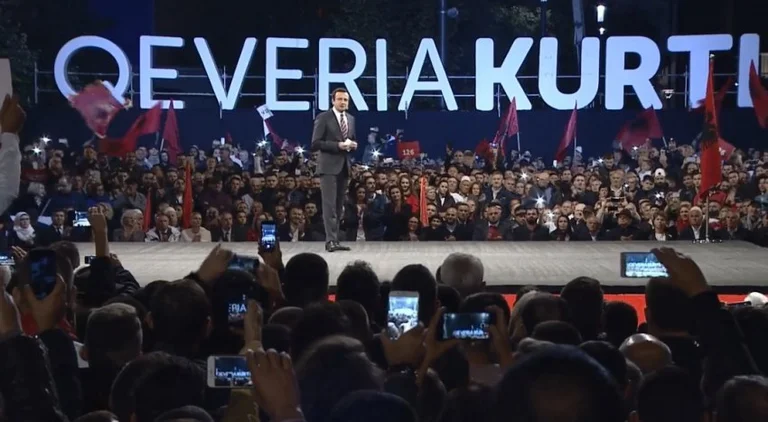
If the proposed composition of the Kurti Government does not get the majority of the necessary votes in the Kosovo Assembly, after 15 days of constitutional deadline, the president of the Republic of Kosovo, under the same procedure appoints the other candidate, but this time with the constitutional deadline only 10 days.
The Constitution of the Republic of Kosovo defines this procedure and outlines the Constitutional Court's decision, KO113/14, d. July 1, 2014, where the president can propose the mandate for forming the government twice.
The first time is self-explanatory and precise with the Constitutional Court's decision, where the president proposes the candidate for prime minister nominated by the political party or by the coalition having the largest number of seats in the Assembly and has no discrimination to refuse the appointment of this proposed candidate for prime minister.
But if the first candidate does not get enough votes, then the president has in his discretion to appoint the next candidate for prime minister.
So, in the event of the failure of the first mandate, stemming from the nominal election winner, then the president belongs according to the Constitution to mandate another candidate, which could be from any party that has passed the 5% threshold in parliamentary elections.
It is noteworthy that the Constitutional Court does not rule out the president's decision to grant the party or the first coalition the opportunity to propose the second candidate for prime minister as well.
In principle, in the second phase, about the mandate's appointment, the main burden falls on the president, because it should be objective and neutral in this race during this process.
To better understand “discretion”, the Constitutional Court has informed some elements making up this “discretion” in the interpretation of Article 95, paragraph 4 of the Constitution.
Constitutional Court says this sub “...stands silent on the question of which party or which coalition proposes the new candidate for prime minister. In the court's view, it is in the discretion of the president of the Republic that, after consultations with parties and coalitions, decide which party or which coalition will be given the mandate to propose the next candidate for prime minister,”.
In the sense of disreputed power in a decision-making, it is constitutionally exercised if it does not exceed the limits defined in the Constitution and is not contrary to all legal norms, as well as if it does not violate fundamental principles of justice or human reason.
But the Constitutional Court Act is understood in four main categories:
1. It should not be ruled out that the president of the Republic could decide to grant the same party or coalition a chance to propose the other candidate, who could be successful in forming the new government by getting the necessary votes in the Assembly.
2. The Constitutional Court considers that the president of the Republic should assess what is most likely for a political party or a coalition to propose the candidate for prime minister, who will get the necessary votes in the Assembly for forming the new government.
3. The court reiterates that Article 95, paragraph 4 of the Constitution requires that there be another candidate for prime minister, but leaves open the question of which party or coalition will be given the mandate to propose the candidate for prime minister.
4. As, according to the Constitution, the president of the Republic represents the state and the unity of the people, it is the president's responsibility to preserve the stability of the country and find the dominant criteria for forming the new government in order to avoid elections.
In the second time, all parties or coalitions (pre-elections) represented in the Assembly will be equal before the president to convince him that they are most likely to form Government.
The biggest stakes could be determined according to the dominant criteria, which would preserve the stability of the country and avoid elections.