7 minutes ago
What the Constitution can do to clarify mandate appointment
Periskopi(6 years ago)
(6 years ago)The Kosovo president's office has warned President Hashim Thaci to address with a constitutional court request to clarify constitutional and legal qualms, in the event there is delays in forming the ruling coalition between the Vetevendosje Movement and the Democratic League of Kosovo, which would form the government [...]
This has been confirmed for Radio Free Europe, the Kosovo Presidency Information Office.
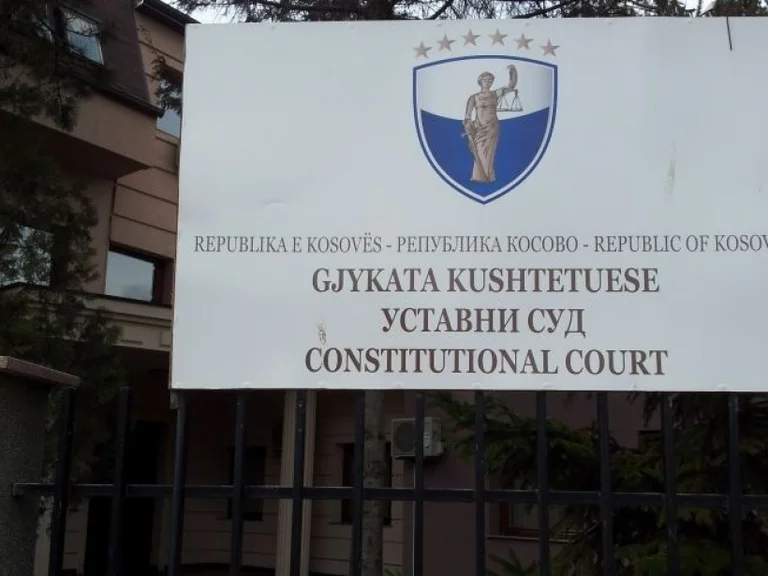
The president's constitutional responsibility is to function institutions. He is a guarantor of constitutional and democratic functioning and is obliged to take any steps necessary to fulfil his obligation, not excluding even demands to the Constitutional Court to clarify any constitutional and legal uncertainty in the service of the quick functioning of new institutions”, the Kosovo President's Office says in response. However, this office has not clarified when the country's president will address the Constitutional Court on this issue.
Florent Spahija, legal expert at the Kosovo Democratic Institute, speaking of Radio Free Europe, estimates that Kosovo's president's eventual request to ask for clarification of the Constitutional Court, as it has been said, “any constitutional and legal uncertainty in the service of functionalisation as fast as possible of the new institutions” would be in vain, because the Constitutional Court has already decided on a certain issue and has said Kosovo institutions have no right to submit questions to the same case to the court.
It is futile to run the Constitutional Court, since we have no case. So if the president wanted to address the Constitutional Court, there should be a case. But there is no case in this situation, and there is nothing to challenge in the Constitutional Court. We don't have a constitutional case yet to go further. If the candidate or political subject (the Vetevendosje) were refused to declare that it would not send the candidate name, then it could be a case. But, for now, there's no case”, Spahija said.
When Spahija says the Constitutional Court has given its opinion on a similar case, he refers to the clarification this court has given following the request that former Kosovo president, Atifete Jahjaga had addressed this supreme institution of justiceIn June 2014. Jahjaga had called for clarification of constitutional issues that concerned her responsibilities in determining the mandate for establishing the government, in line with Article 84, provisions 14, as well as Article 95 of the country's Constitution.
Constitutional Court assessment on this issue was brought in and released on July 1, 2014.
“If the candidate proposed for prime minister does not get the necessary votes, President Republic, in its discretion, according to Article 95, paragraph 4, of the Constitution, appoints the next candidate for prime minister, following consultation with parties or coalitions (registered in accordance with the Law for General Elections) that have met the aforementioned criteria, with parties or coalitions that have been registered as the electoral subject in accordance with the Law for the general election, has taken part in the election ballot, and has passed the threshold, the Constitutional Court said.
However, the Constitution does not specify any timetable for the mandated proposal for the formation of the new government by the winning election party, in the current case, by the Vetevendosje Movement.
Naim Rashit, director of the Balkan Policy Group in Kosovo, tells Radio Free Europe that already there are ideas that could soon happen the political agreement on a governing coalition between the Vetevendosje Movement and the Democratic League of Kosovo. But, according to him, it is meaningless that political agreement should necessarily occur before taking the mandate from the Vetevendosje Movement's nominee for forming new government.
“In certain cases, if there are no indicators that the winning party (the Vetevendosje Movement) and the Democratic League of Kosovo will reach an agreement, then I think there should not be left large space, if there is no political consensus, should be treated legally, and the president or anyone else will send it to the Constitutional Court, provided it does not cause new delays. But we cannot, whenever we have elections and process of forming government, establish constitutional judicial procedures, give constitutional answers. I think it has to be understood that this is right with automatism and that Vetevendosje must soon react to”, Rashi praised.
However, Spahija suggests that even if President Thaci eventually addressed the Constitutional Court at all, the latter would not consider such a requirement that he has already given her opinion, as he says in the similar situation in 2014.
I don't believe the Constitutional Court or decide on a case that it has already decided on. In such cases, then, other parties in similar cases would refer to the Constitutional Court? By the first act, or do you refer to second judgment? There is already a case, a precedent, in the way the Constitution is interpreted. It doesn't mean that it's the best interpretation, because it's had in favor and against, when that interpretation is made. But that thought can be changed only if we change the Constitution itself and have a new";x1>, Spahija said.
Vetevendosje Movement, as winner of early parliamentary elections of October 6th and the Democratic League of Kosovo, since the certificate of election results from the Central Election Commission, are making efforts to achieve a ruling coalition, which so far have resulted unsuccessful.
On January 10th, Kosovo President Hashim Thaci wrote letters to Vetevendosje Movement Chairman Albin Kurti, asking him for the name of Vetevendosje's mandate for the prime minister's post to avoid delays over the formation of the new government.
Thaci had written that he wants “to take action without delay to further, following all constitutional steps for citizens of the Republic of Kosovo to have their government” as quickly as possible.
On 13 January, Vetevendosje Movement Chairman Albin Kurti, in a written response has been addressed to Kosovo President Hashim Thaci, urging him not to put pressure on the mandater's name for future Kosovo prime minister.
He has said that Kosovo's “Constitution does not recognise the president's discretion or active role in the process of appointing the mandate, or even ensuring a parliamentary majority for electing the government to the 48x1> assembly.