4 minutes ago
After the Australia fire, something strange develops
Periskopi(6 years ago)
(6 years ago)A big fire from 2016 called "Bisha," destroyed Fort McMurray in Alberta, U.S.A. and forced 88,000 people to evacuate, burning 2,400 houses on its way. Scientists then noted that the Byisha had caused a strange phenomenon ʹ the creation of the <x0 fuel fire” capable of creating the weather [...]
Scientists then noted that the Bishaʹ had caused a strange phenomenon ) the creation of the <x0 fuel fire” capable of creating their weather.
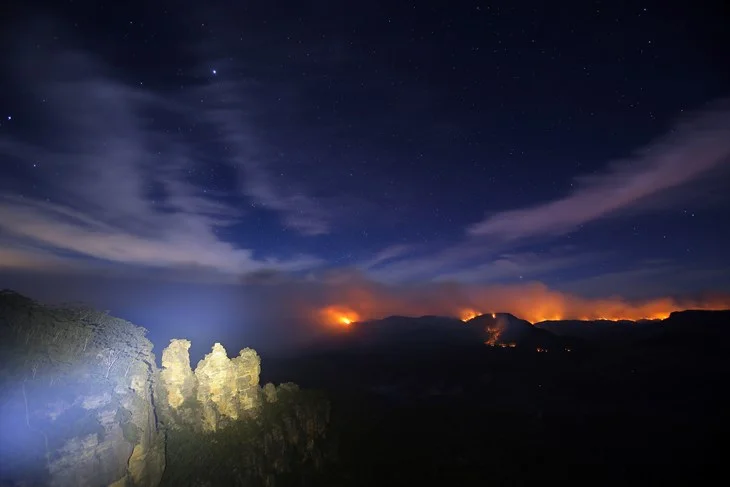
This rare weather phenomenon has occurred recently in southeastern Australia, where fires have burned nearly 10,000 square miles [110,000 sq km] of land and where 100 other fires are currently active, reports NBC News.
Scientists explain that fire clouds have been around because climate change causes fire seasons to last longer.
The cloud of fire can produce lightning, thunder and wind forces like those in a tornado to extract heat from itself by contributing to an even faster spread of fire, Kosova Prees broadcasts.
Mike Fromm, a meteorologist in Washington, has been studying this cloud for the last two decades and it's not a secret that at the beginning of his research he was in denial of what was before him.
The whole view of these clouds was completely unknown to the scientific community. In the next 10 years, we will have to face not only the existence of these clouds but also a frequent phenomenon of weather”, states Fromm.
It is estimated that some 400,000 square miles [400,000 sq km] worldwide will be burned each year because of fires, but it is not known how much of the fires affect the formation of these clouds. What is known, however, is that they are quite devastating when they are formed.
These storms are very intense, irregular, dangerous and difficult to predict. At Fort McMurray, fire clouds caused a storm in an area that included between 20 and 30 miles [20 and 30 km]”, says Mike Flannigan, director of the Association for Firing a branch of Alberta University.
How are fire clouds formed?
In February 2009, six cloud fires swept through the Australian state of Victoria, causing one of the most devastating fires on this continent.
Scientists are not sure why some fires affect the formation of fire clouds and others do not, but they do know that they need three conditions to form - heat, drought, and wind.
Sometimes high - intensity fires can cause the rise of ash, smoke, and steam, and as this warm air cools and thicks, clouds form, which are a process similar to that of the common storms.
This type of cloud has been observed in other parts of the world in South Africa, Portugal, and Argentina.
A 2018 study revealed that the amount of smoke and fog from clouds of fire entering the stratosphere is equal to the amount of smoke generated during an average volcanic eruption.
Parts of ash and other particles may cause the planet's temperature to drop, since they absorb solar radiation, reducing the amount of sunlight reaching the earth's surface.
For example, the eruption of Mount Saint Helens in 1980 helped reduce the temperature by 100 degrees Fahrenheit [0.1 ° C].