13 minutes ago
You want Enver Hoxha, you don't want George Kastriot: Writer Criticises Albin Kurti

Periskopi(7 years ago)
(7 years ago)The renowned Kosovo writer, Ndue Ukaj, has commented on several fragments of Albin Kurti's interview two days ago on a political show. Asked about the nation's three most important figures, he mentioned Sami Frashar, Fan Nolin, and Ukhshin Hoti, totally forgetting our medieval hero Gjergj Kastriot or even Adam Yasar, [...]
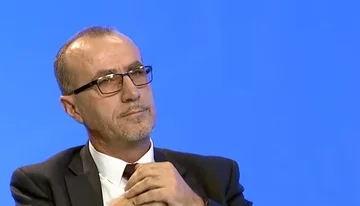
The renowned Kosovo writer, Ndue Ukaj, has commented on several fragments of Albin Kurti's interview two days ago on a political show.
Asked about the nation's three most important figures, he mentioned Sami Frashar, Fan Nolin, and Ukshin Hoti, completely forgetting our medieval hero Gjergj Kastriot or even Adam Yasar, writes Periscopi.
This appears to have been observed by Ukaj, who has criticised Kurt by attributing to him the great cultural “omanomial” and which aid in understanding his political and ideological goals.
Of course, in three of these figures, they are the weightiest in Albanian history and occupy an important place, but none can be placed at the heart of Albanian history.
For your information, Fan Noley, in the center of national history, has placed our master. writes Mr. Ukaj.
He has further criticised Kurti as well as selecting the three most negative figures in our nation, which were Esat Pasha, Nguman Morina and Hashim Thaci.
Kurti did not mention the cruel Albanian dictator Enver Hoxha, who is seen responsible for killing more than 100,000 Albanians during his four-year rule.
With these opposing stances, the VV leader, it seemed to me like a man who has a real face and some fakes.” Ukaj further comments.
In the end, he has quoted Faik Konica as saying: ““Try with all our strength to heal Albanians out of love for individuals. They must learn to love Albania, not to please this or Albanian.” (Albana, July 1898). ”
Full status:
Albin Kurti's Legal Anomalies
For me, the cultural formation of a leader is the fundamental precondition to understand its political formation, and therefore, its political goals.
Yesterday, in view of Albin Kurti's gasp, nonsense, and empty rhetoric, I have noted, among other things, some major cultural anomalies, which are not peripheral but ontological and very important to me to understand his political and ideological goals.
When asked what are the greatest national figures, he did not mention Gjergj Kastriot, the central figure of the Albanian nation, but mentioned three other figures (Sami Frasrin, Fan Nolin and Uksin Hotin). Of course, in all three of these figures are the weightiest in Albanian history and occupying an important place, but none can be placed in the center of Albanian history.
For your information, Fan Noley, in the center of national history, has placed our master.
Meanwhile, when asked who is the greatest Albanian writer, he responded to Ismail Kadare. But even here, another abnormality arises: how can you assess Kadare as the greatest Albanian writer and not place Gjergj Kastriot in the center of national history. Kadare, in his work Gjergj Kastriot, has placed it on the foundations of the Albanian nation and at the centre of Albanian cultural history. As for the memory, in the book “
X-ray Kastriot needs Albania, not as luxury, but as the cornerstone. Time had shown that without Albania he lived, while Albania could do without him.” This size and dimension of his image, we meet in Kadare's literary work but also in essayistic, so the question is rightly asked: how can you exclude Gjergj Kastriot from leading national figures and at the same time say Kadare appreciates him as the greatest Albanian writer?
With these opposing attitudes, the VV leader, it seemed to me like a man who has a real face and some fakes.
But in the next question of what, according to him, are the three most negative figures of the Albanian nation, he replied:
“Esat Pasha, Platman Morina and third is alive and you know”
In that answer, there is something frightening, and this therefore asks the question:
Did Kurt want to amnist the cobras of Communism, which his favorite writer, Kadare, wrote about?
This answer, is it a sample of his ideological orientation?
This answer, as such, conceals his ideological trap and sneezing to lift the rope. At the same time, with this response, he clearly showed that they are painted at the Communist table, which can also be seen by his attempt to nationalize everything.
So yesterday, Vetevendosje leader Albin Kurti, on the T7 show, sounded more like a disgusting commissioner to me than a serious candidate for prime minister.
Kosovo, before all else, needs leaders who can show how much they can love the country and not how much they can hate the other.
Judging and not prejudiced his political legalisation, it turns out that his political goals and the power he requires, more have ideological rather than political goals.
Kurt, using politics as a resident, is failing to make sense of his idea of power. As read, he must know that “does not have any power to have a priori meaning and value. It takes its meaning through the man who is aware of this power, who decides for it, turns it into action, thus taking responsibility”, writes German scholar and philosopher Romano Guardini, in the book “Modern Time End, Power”. Kurt, until today, hasn't shown it.
Last night, watching him speak and fill the barn with political analysts in front of him, I've been reminded of Faik Konica, the learned Conica, who has long cautioned:
Try our best to heal Albanians out of love for individuals. They must learn to love Albania, not to please this or Albanian.” (Albana, July 1898).
Yes, Kosovo Albanians, who in early October will decide on their political orientation, do not need to become naive and expect the Messiah, nor nurture love for the individual.
It is time to recover from that love.