2 minutes ago
Hoxha does not hope that there will be liberalisation either in September, means Germany's épo is tired

Periskopi(7 years ago)
(7 years ago)The decision regarding the proposal for visa liberalisation is currently being considered by the Council”. That is all said in the European Union's Council of Ministers conclusions concerning visa liberalisation for Kosovo. European Integration Minister Grant Hoxha, in an interview for EO has expressed disappointment with the Union [...]
The decision regarding the proposal for visa liberalisation is currently being considered by the Council”. That is all said in the European Union's Council of Ministers conclusions concerning visa liberalisation for Kosovo.
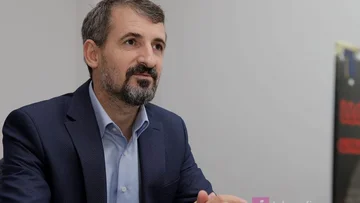
European Integration Minister Gift Hoxha, in an interview for EO has expressed disappointment with the European Union. Commenting on the EU Council of Ministers' conclusions, she says they have expected concrete dates regarding the visa liberalisation process.
We have expected a more concrete language, more concrete time terms regarding this screening process. I've stressed that we're in the final step, so the decision at the Council of Ministers actually paves the way for our citizens to move free. But this time we saw that there was nothing concrete in the Council of Ministers Conclusions. It was probably a sentence that said or confirmed what we've said several times, that the visa liberalisation issue is being considered in the Council, but it doesn't give time. And this is a bit of a worry to us, because we have completed the criteria and we know very well that despite the fact that Kosovo has had twice as much as the countries of the region we still haven't stopped and fulfilled these” criteria, she says.
Hoxha acknowledges that some EU states have already come out openly against visa liberalisation. She even mentions Germany, which, according to her, is not taking anything to convince other countries to vote for visa removal for Kosovo.
“Now we are seeing a reluctance by several member states such as France, Holland, to some extent Germany has no clear opinion, despite the fact that the Interior Minister has said that “po” visa liberalisation for Kosovo, but on the other hand at the Council of Ministers of Internal Affairs meeting, which was held on June 6th and 7th, thus preceded the Council of Ministers of Foreign Affairs meeting and nothing was discussed about Kosovo. So neither Germany, nor any of these countries opened the subject of visa liberalisation. This made us realize that without a consensus being reached among EU members, I do not see that we will have a decision on the Council of Ministers. I hope this is done as soon as possible so that our citizens can move as fast as possible, but it's all now in the hands of member states, or two three states that need to move this process forward of”, she adds.
The ministry of Integration says convinced that Kosovo has fulfilled all the criteria and conditions that come out of the guide for visa liberalisation. Fighting corruption and organised crime says it is the process that must be continued even after visa liberalisation.
For us the process is being complicated altogether. For Kosovo, there is no recognition, so right. For Kosovo the conditions are continuing, they are not additional conditions, but continue to meet the guide criteria. Guide criteria continue to be implemented, because they are things that we regularly apply, whether passport security or document security. As far as fighting and corruption criteria are concerned, or what happens to marked cases, it's something we have to continue and continue to do. It's not something that will close at the moment we get visa liberalisation”.
EU states' demands have been filed with Kosovo, Prime Minister Hoxha is weighing them unfair. He says they don't accept any more conditions. I'm worried about hesitation and delay in making a decision. None of us in Kosovo, but no one will accept additional conditions, because we cannot pay twice for something they have not yet given us. All countries with the fulfillment of the guides have received visa liberalisation. We expect the same. It is the guide's fulfillment, criteria have been fulfilled, this has been confirmed by the European Commission, confirmed twice by the European Parliament, and we expect a decision as soon as possible. Because we're and we've remained the only one isolated place and our citizens are able to move free”.
Looking at the whole situation, Minister Hoxha says sceptical that a visa liberalisation decision could occur in September. He says such a decision cannot be made without consensus between Germany and France. It even says there are the same states that are somehow keeping liberalisation blocked for Kosovo.
The “is attainable, but what we are now seeing is the hesitation of several member states, such as France, the Netherlands, are strongly opposed. Germany is not going ahead of discussion or debate to convince other countries that we have to move free. That's another fact that makes me not optimistic about September. But during the end of the year if consensus can be reached within member states then visas can be moved. However, I do not believe that Germany and France will put it on the agenda if those two first fail to reach reconciliation that they will vote for visa liberalisation. So without that consensus reached on the Council of Ministers, I don't believe it will be put into the agenda”, Hoxha says.
It does not rule out the possibility that imposing tax on Serbian products may have affected the process. It says that at every lobby meeting in EU countries, tax suspension has been required.
I cannot say that it was not required in meetings with EU members to suspend the tax. I mean, at every lobbi meeting I've been in in member states, that's what's required. But we have our reasons for the tax and dialogue. It is known that Kosovo is committed to reaching its comprehensive and comprehensive peace agreement with Serbia. But also one thing that needs to be indicated is that there must be no preconditions. So why should there be conditions to sit down and talk at the table when we're the ones who need to set conditions. I don't see these are additional conditions or obstacles, but they are being exploited by several countries”, Minister Hoxha concludes.