3 minutes ago
Kosovo continues to have obstacles to export goods to Albania

Periskopi(7 years ago)
(7 years ago)Kosovo continues to have obstacles to export goods to Albania, where some of the barriers are follow-up procedures, scan payment, analysis swimming and payments to the Nation Street. These have become known at the nationwide economic forum, which is currently held in Tirana, with the “potential and challenges of Kosovo-Albanian trade relations”. [...]
Kosovo continues to have obstacles to export goods to Albania, where some of the barriers are follow-up procedures, scan payment, analysis swimming and payments to the Nation Street.
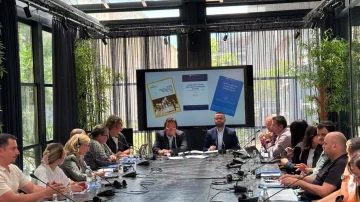
These have become known at the nationwide economic forum, which is currently held in Tirana, with the “potential and challenges of Kosovo-Albanian trade relations”.
Kosovo Deputy Prime Minister Fatmir Limaj has mentioned the problems businesses have in Kosovo Customs at the Durres Port, where he said there is no need for Kosovo goods to be scanned, as according to him the payments businesses make is a kind of “harachi”.
“At the customs point in Durres we have opened for the transitation and it is the corridor of Kosovo and there is no need for any letter or anything, any commodity that is introduced for Kosovo to be touched or controlled by Albania. It's our corridor that there were certificates, certificates, scanners. I know business from Pristina has a major share besides what the scanner and the street tax issue were told. The minister who is here today, the deputy prime minister and colleagues have been talking a long time to figure out how we can get out of this situation. We are aware that Albania's Parliament has entered several concessions, has state obligations, but we are convinced that a poor decision by the Kosovo Parliament should not suffer Tirana's business. For a poor decision by the Albanian Parliament, Kosovo's business was not to be charged. The scan for me is a strange thing, only Albania has the scanner, there is nowhere else. I know it's hard, the Albanian government is extremely difficult to review such contracts. But what we've been looking for is for Kosovo's goods not to enter the scanner, it's not stopping in Albania is coming to Kosovo. We take risk or if there's information from intelligence, from security institutions then based on those information to scan, but not every mana, we heard yesterday that in a 15-producted truck, for 15 products should be paid for by 22 euros, that's not even safe, that's what we say in Kosovo, that's not about any security”, he said.
Limaj said that in Pristina they used scanners ahead, but he said that if organs have sought to introduce a commodity into the scanner responsibility for spending the state has taken over rather than businesses.
As for this issue, Albania's Finance and Economy Minister Anila Denaj said they will engage to discuss with the company that offers the scanner service and that it will be resolved by the end of June.
It's an issue that connects us to a company that offers services, we think it's not impossible to sit down and talk to the company, discuss the part Limaj mentioned earlier. But that also means opening broader discussions between ministries, and we will be committed to doing so by the end of June. At the same time what we have very much to do earlier is risk analysis to see which tools are scand and the other equally important element of billing, which for companies is very important”, she said.
Trade and Industry Minister Andrew Shala has said Kosovo businesses are facing many barriers during their export to CEFTA countries, for political reasons.
He said the barriers to Kosovo businesses are rarely reported, but according to him, are obvious and these very barriers are the fundamental reasons for the trade balance Kosovo currently has.
Kosovo's <x0th economy, is a small economy, is a consumer economy, among the economies that have at least exports in relation to other CEFTA member states. All of this, in our opinion not because we don't have the right quality products, not because we don't have the capacity for production, but because of the barriers that are applied to Kosovo businesses potentially during the attempt to export Kosovo products to the CFTA signatory countries... primarily the barriers facing Kosovo businesses, besides Serbia and Bosnia and Herzegovina, which Kosovo has already taken reciprocity measures due to the approach these states have had with Kosovo, one of the countries with which Kosovo businesses have big barriers to do business too is the Republic of Albania. It's good that our two respective ministries quickly solve these registered barriers as soon as I can, said Minister Shala.
The head of the MTI has called on businesses from Albania to report the barriers they face, as Kosovo's stance is to respect all agreements reached and open markets for Albanian product.
Shala said she wants the same treatment for Kosovo producers who export to Albania. He said products there and around the border should not be treated by governments differently, but they should be treated indiscriminately, as Albanian products.
Minister Shala urged producers from Albania to exploit Kosovo's tax on products imported from Serbia and Bosnia and Herzegovina, as according to him they are interested in replacing all Serbian products with Albanian products.
The executive director of the entire Albanian Economic Forum, Astrit Panja, has made the presentation of the report on Kosovo-Albania trade relations, where he said that in Kosovo-Kosovo relations. Albania has improvement, but is very low compared to the potential both countries have.
He said the trade exchange in 2014 has been around 170m euros, while in 2018 it is 270m euros.
According to him, Albania has exported products worth 205m euros to Kosovo in 2018, while Kosovo in Albania is worth 65m euros.
“Penges for export, Kosovo's main problem has exports with Serbia, some 52 per cent respondents have claimed to have problems exporting with Serbia. The second place where we most face challenges is Albania, 23 percent of respondents have indicated that the second problem for exports has Albania. This should be addressed, all these obstacles must be analysed, and how to remove these obstacles, because some of the problems are also for the producers of Albania who want to export to Kosovo. The non-tariphorus barrier, the follow-up procedures, are some of the barriers that produce them. The payment of scanners, the swimming of analysis, payments on the nation's road, the payment of terminals in Kosovo by Albania's producers, all of which have costs that raise the cost of products and lower the competitiveness of Kosovo and Albania's”, he said.
Another problem, according to Panges, is what he called reckless statements by politicians who hurt businesses a lot, citing a case when a politician from Albania has hit Kosovo's quality of flour. He said it is not right for a politician to make such statements, as it is the inspection that controls the quality of products.