an hour ago
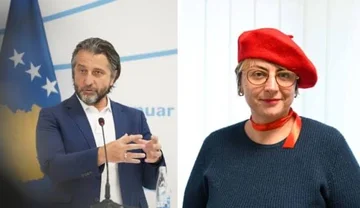
Natasha has followed: I've seen Serbian crimes myself.

Periskopi(7 years ago)
(7 years ago)Serbia's best-known human rights activist, Natasa Ka persecuted, founder of the Fund for Humanitarian Law, talks about Kosovo bombings and war. It has often been itself in Kosovo at wartime. “ast time after the start of NATO bombings, March 25th in the early hours of [...]
The next two or three hours after the start of the NATO bombing, so on March 25 in the early hours of the morning, sometime between two and three, the telephone bell” rang, recalls Natasa Ka persecuted. It was Nekibe Kelmendi. She told me the police broke into their house and brought her husband, Bajram, a very well-known lawyer, and their two sons. I don't know what to do. I tell him it's good they're working the phone lines and tomorrow morning he's gotta go to the police or the State Secret Service and ask for clarification... I will never forget this conversation. A day later, they found the lifeless bodies of Bajrami and the two boys, near a gas station, on the way out of Pristina. Police said they started investigating. But this was just covert crime, because there was no investigation, there was nothing. Nekibe Kelmendi died in 2011 and never officially understood who killed her husband and her two sons. Only her daughter remains, who is still searching for the truth. We at the Humanitarian Law Fund are also searching for the truth, but without success. ”
Natasa Ka persecuted has been one of the rare ones in Belgrade, which has justified NATO intervention in 1999 and has said so openly. It has also backed Kosovo's independence, declared in February 2008. She was the only guest from Serbia to the Parliament at the ceremony to declare independence.
Foundation for Humanitarian Law
“The Fund for Humanitarian Law was founded in 1992”, says Persecuted, “deliberately documented crimes and human rights violations in Serbia, where ethnic groups -- Albanians in Kosovo and Muslims -- live in Sandzak. ”
Natasa has persecuted her 70s degree in Belgrade philosophy faculty in sociologisty. In the Socialist Socialist Republic of Yugoslavia, she worked at the Unions' Association, while in the 1980s she was co-author of the book “Kosovo's Brandy”, in which Serbian authorities in Kosovo are sharply criticised for politics violence, following Slobodan Milosevic's coming to power. After the publication of this book, he's been persecuting the union and starting a public opinion investigation. By the end of 1992, he founded the Fund for Humanitarian Law. During the 1990s wars, the Fund has collected data on war crimes in the spaces of the former Yugoslavia. These documents have then been among the main evidence in The Hague's Tribunal processes for war crimes in the former Yugoslavia.
Kosovo active since 1996
The first „office in Pristina was opened in 1996, says he persecuted. “Aty have worked together Albanians and Serbs. Their task has been to collect information about the situation. During 1997 we have collected data on mass invitations to people in so - called informative conversations in police. During the interrogation, there have been massive threats to those committed to Kosovo's independence. They are told that this is terrorism and have been denied the right to engage with peaceful means for their political ideas. ”
Kosovo was left behind in wartime in Croatia and Bosnia and Herzegovina. The peaceful movement of Kosovo Albanians, led by Ibrahim Rugova and Fehmi Agin, has offered peaceful resistance nearly a decade. They have also organized independent parallel systems in schools and health. The parallel system has been operating for years. In 1997, the Kosovo Liberation Army <x0 was also on display, and the situation has changed radically. In 1998, armed conflicts between Serbian forces and the KLA began. The international community, which for years had ignored the peaceful movement of resistance, now tried to stop the war. In 1999, negotiations have also been held in Rambouillet, France, but the Serb side has not signed the peaceful agreement.
Beginning of the Bombings
After failing to negotiate in Rambouille, NATO launched action on shelling under the name „Operation Allied Force”, on 24 March 1999. On the third day after the launch of the bombing, I am on my way to Kosovo. I didn't know what was going on with our associates in Pristina. It has been a problem to go to Kosovo, because there have been no means of transportation. I took a cab from Belgrade to Bujanovac. But the cab had to first provide gas, because there wasn't enough in those days. We arrived in Bujanovac somehow, but did not know how to get to Pristina. I asked the taxi driver to take me there. He was very afraid, but when I told him that only Serb forces are there, he agreed. Our office was broken, our computers were robbed. I found our associates in the house, they were all too scared and didn't know what to do. I proposed to go together to Macedonia, but this proved to be a bad plan and was not realised. In Pristina it was terrible, there were no Albanians on the street. When I went to look for a Fund associate, many people gathered in front of her building. The police forced them out of the building and ordered them to head toward the railway station and then to Albania. After four days in Pristina, four Albanians and I, in a taxi, are headed for Belgrade. The taxi driver was a good man, he saw what they were doing with Albanians. He didn't talk much. I asked him if he's willing to transport four Albanians to Belgrade because we have to pass the police checks? Let's try it, he said. We passed the first check. At the second point, we were stopped. I was silent, and the cab driver asked the police where I could get gas because I don't have a point? The policeman focused on the question and didn't even check us out. We passed. ”
Lasting War
NATO strategics had planned a faster war. The Serbian military and police have not made much of a resistance to NATO bombings, but they have been well concealed and have averted major losses. The war lasted as the suffering of the people in Kosovo increased from day to day.
NATO strategics had planned a faster war. The Serbian military and police have not made much of a resistance to NATO bombings, but they have been well concealed and have averted major losses. The war lasted as the suffering of the people in Kosovo increased from day to day.
„I have gone to Kosovo almost every ten days”, recalls Natasa Ka persecuted. “Always with the same taxi driver who learned the way and knew people on the street. I went and asked for Albanian friends, I watched them still alive. I've been in Pristina to some friends when news of the ban on Fehmi Agan, his wife and their son came. I was informed that he was received, and one day later his lifeless body was found. Agan has been killed while Milosevic allowed Rugova to leave the country. Fehmi Agani has thought he too must leave Kosovo and join Rugova. Rugova's entire power was in Fehmi Agani's wisdom. Agan's death is an enormous loss not only for Albanians but for the entire region. If he had survived, positive developments would have been faster and all would have been different. ”
The Book of Memory in Kosovo
In 2015, the Fund published “Cosovske Knjige Pam~enja” (Remind Books in Kosovo). The aim of this project was to determine the exact number of victims in Kosovo. The project's co-ordinator was Natasa Ka persecuted. The number of people killed between January 1st 1998 and December 31, 2000, is 13,535. Of them 10.812 are Albanians, 2,197 Serbs, among them 526 are Roma, Bosniaks, Montenegrins and others.
Ondi for Humanity Law in Beogada and the Humanitarian Law Fund in Kosovo have published the list of people killed in 2014 as a result of NATO bombings. The bombings have killed 754 people, 454 civilians and 300 members of the armed forces. Among the civilians are 207 Serbs and Montenegrins, as well as 219 civil Albanians, 14 Roma and 14 other nationals. This source says 274 former Yugoslav soldiers and police officers and 26 KLA members have been killed. The collection of these data has started since the war.
I think almost everyone would react like me if they saw these refugee columns, the fear and horror that reigned. One day I went to buy bread at a shop in Pristina, an Albanian in order. Two other Serbs began shouting and prevented him from buying bread. I started screaming at them too... these are things you can't forget. In situations like this, she forgets her personal safety, she's no longer important”, she remembers persecution.
My travels to Kosovo have been terrible because I have seen for myself what is happening. Albanians have been initially locked up in their homes, are not allowed to take to the streets. I've seen long refugee columns, people with bags in their hand, missing and unoriented. When I asked them where are you going? Serbian police have ordered us to go to Albania. People fled to Albania, while no one helped them, there were no foreign humanitarian organisations there.
I returned to Belgrade and saw people standing in cafes, looking up into the sky, and talking about the huge injustices being committed to Serbia by bombing. No one has ever asked me what is happening in Kosovo, what is the situation there! I have been deeply angered by a letter by a group of intellectuals organised by the Open Society, with which the bombing in Serbia is required. I have been angered by this focus on myself, with no interest in what happened to others, with no interest in stopping the actions of police and army, murder, burning and destruction in Kosovo. ”
“Real<x1 national>
Following the intense diplomatic efforts of the troika led by Finnish President Martti Ahtisaari, including American and Russian diplomats Strob Talbot and Victor Chernomirdin in June 1999, Slobodan Milosevic accepted NATO conditions. On 9 June 1999, agreement on withdrawing Yugoslav troops from Kosovo and establishing a peaceful mission was signed in Kumanovo KFOR in Kosovo. Lufa ended as a large number of Serbs left Kosovo for fear of revenge. The remaining ones have lived in fear of the possibility of crime that took place a year later. Funds have also collected evidence of these crimes.
We see today that only “a real”, national truth. Another commission has been established to investigate the consequences of NATO bombings in order to prove that Serbia has been a victim. Figures that have nothing to do with facts are presented, and are largely forgotten the responsibility of the Serbian forces for a large number of people killed there”, says Katruja. “Forgets why and how it came to NATO intervention. What has preceded the intervention and what was Serbia's role in the middle. NATO's intervention has been a drastic move, but the only means to stop the Serbian military and police. ”
Natasa has been pursuing a large number of international assessments for her work. In 2003 it was also listed as 36 European heroes, published in the magazine „Time”. In 2005 an honorary citizen of Sarajevo and a person of the year in Bosnia and Herzegovina was declared, according to „magazine. Slobodna Bosna” In 2013, it was awarded the Hrant Dink Award in Turkey, while American congressmen Eliot Engel and Roger Vicker proposed Natasa had also been persecuted in 2018 for the Nobel Peace Prize.