18 minutes ago
Is President Thaci blocking the functioning of the CEC?

Periskopi(7 years ago)
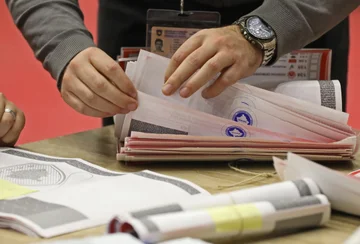
(7 years ago)The Central Election Commission continues to remain dysfunctional until a decision by Kosovo President Hashim Thaci to appoint new members who will be in the composition of this commission, assess representatives of the ruling and opposition political parties, as well as recognition of developments in Kosovo. Political parties represented in the Assembly [...]
Political parties represented in the Kosovo Assembly say they have recently submitted the names of those nominated by them to members of the CEC, but the decision to appoint them belongs to the country's president.
Basri Musmurati, secretary general of the Democratic Party of Kosovo, who is the biggest partner within the ruling coalition, tells Radio Free Europe that the issue of functionalisation of the Central Election Commission, is no longer in the hands of political parties.
However, the impasse in the CEC functionalisation, according to him, lies on the conflict that has been created over representation that political parties of the ruling coalition will have on the commission.
There is a dispute here about who should send, which party to send a name. It is between the Alliance (the Future of Kosovo) and the Initiative. Our representative as PDK has been sent. We have sent the name there, as a political subject, who should be a member of the CEC and this is no longer party work, but it is the job of the president of the country. We believe that he, very soon, will decide. We, in his decision, cannot mix”, Musmurati said.
On the other hand, Ilir Gashi, representative of the Democratic League of Kosovo in the Central Election Commission until the formation of the new composition, tells Radio Free Europe that the situation within the commission is not good. This is because the CEC currently cannot meet to carry out duties and obligations stemming from the country's laws and Constitution, not even the old composition.
It depends on the president now, that when he intends to do such a thing (the appointment of CEC members), because the Constitution gives justice only to him and no one else. But, I cannot understand why members of the ruling parties disagree to attend CEC meetings, until the commission's new composition, to carry out duties and obligations, whether with municipal advisers, MPs or even the fees that political parties should make on the part of the CEC. The CEC, in the same judicial and constitutional state, has not only carried out day-to-day obligations, but also held elections in 2013, local and general”, Gashi stressed.
Officials of the Democratic League of Kosovo, the largest opposition party, have even before raised concerns about the no appointments of CEC members, saying that President Thaci, “has blocked the Central Election Commission from March 27th-188x1> and that, with that, a dangerous precedent for the electoral system and democracy in the country has been created.
Meanwhile, despite Radio Free Europe's insistence on understanding the reasons for the delay in appointing CEC members by President Thaci, officials of the Kosovo President's Office, have declined to respond.
On the other hand, Isuf Zeynep from the non-governmental organisation Democracy Plus, speaking of Radio Free Europe, says the problem of functionalising the new CEC composition is born because President Thaci has asked the three political subjects that were part of the pre-election coalition. P AN ( The PDK, AAK and Initiative, as well as the Social Democrat Party (PSD), to propose their members for the CEC.
According to him, the problem has been artificially created and that there are no legal dilemmas regarding party representation in the CEC. In this case, as he says, the coalition The PAN belongs to two members for the CEC and not members apart from the parties of this coalition.
It is clear that Kosovo's president, in this case, is calculated with the number issue of who will be represented in the Central Election Commission. The constitution, the laws, but also the practice, are very clear, the composition in the CEC benefits by election results, which political subjects have had in the national elections. This formula would also require the new composition of the CEC. Now, because we've had a change in the composition of parliamentary groups, it doesn't mean that a political subject should lose seats or the number of members at the Central Election Commission”, Zeynep stressed.
However, he adds, with the failure to name the new CEC composition, it is currently impossible to hold elections in the four northern Kosovo municipalities, whose heads have resigned, as well as to refresh municipal assemblies, as a result of the changes they have made.
As Zeynep said, the failure of the CEC holds the issue of registering control of political parties and their finances hostage. For more, according to him, a large number of political subjects have already been left out of funding, unable to accommodate financial means, which has made their operation difficult.