23 minutes ago
How is Belgrade preventing Trepca registration as public enterprise

Periskopi(7 years ago)
(7 years ago)Serbian Trepca workers in the north refuse to register as shareholders in the company. The government in Pristina is accusing Belgrade officially. The metallurgy industrial company Trepca is not being registered as public companies with shares and workers, as Serbian workers of this company are reluctant to [...]
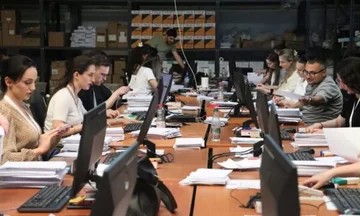
The metallural industrial company Trepca is not being registered as public companies with shares and workers, as Serbian workers of this company are reluctant to carry out registration procedures, where all Trepca workers with 20% are shareholders. They are responding to the official Belgrade call not to carry out this procedure, Prime Minister Ramush Haradinaj indicated. A month ago, the Kosovo Assembly adopted the Trepca statute, transforming this organisation from public enterprise with 80% shares owned by the state of Kosovo. Kosovo Prime Minister Ramush Haradinaj called on Trepca miners from the Serb community that “not fall prey to official Belgrade”.
“The statue is approved, now the administrative part, is under way. So what's innovation, something new and something that's deserved, miners are not only workers anymore, but they're also Trepca's owners. 20 per cent of Trepca's overall shares are of miners, Albanians and Serbs in the north as well. I call on miners of Kosovo's ethnic Serb affiliation to gain legal rights and not to fall into Belgrade's influence over their status as shareholder”, Ramush Haradinaj says.
Dimkiq: The new Trepca statue brings nothing
Serb representatives have three reserved seats in the Trepca BORD, but they do not participate in this BORD.
The “is a decision Kosovo's parliament has made both by law and by statute, and now even the registration of the assets to be made, envisions the incubation of the Serb minority aboard the Trepca, where three countries from nine are envisioned for Serbs because of the importance of the business part in the north”, Economic Development Minister Valdrin Luka has said.
The Trepca smelter management, located in the northern part of Kosovo, refuses to be included in BORD and to do responsibility, Trepca's BORD. Jovan Dimkiq, who himself calls him director general of the “Trepca” north of Mitrovica. According to official Pristina, he is with expired mandates, has told local Serbian media that the Trepca statute adopted by institutions in Pristina will produce nothing that will make workers have better perspective. The” Declarations from Pristina that with the adoption of the Trepca statute, a historic day for Kosovo has been marked, I only understand as their tendency for any political purpose. From the economic aspect, much better it would be if a plan or programme were found for development and production advancement for “Trepca” in the south, because “Trepca” in the north marks good production and financial results. The statue will not affect production, workers' income, the arrival of potential investors and anything that would make workers have better intentions”, Jovan Dimkiq was quoted as saying. Even the Independent Union of Workers of the “Three “in the north has come up with a communiqué, where it has announced that “will not implement any of the laws, nor the decisions of “Three” in the south, nor their demand to apply for the company's registration as a strategy company”.
Official Pristina criticism has also directed the chief of the office for Kosovo in Serbia's government, Marko Djuric, saying that the “authorities in Kosovo are unable to successfully manage the Trepca plant that is under their control and that it is counterproductive, while they want to bring the Trepca-veri nation into control, which is economically successful and profitable”.
Luka: Foreign Investors Interested in Trepca
Minister of Economic Development in the Kosovo government, Valdrin Luka, says he has an interest from foreign investors in Trepca. The “has a good image for Trepca, because it is known about the resource value found in Trepca. So the interest is, we've had four companies visiting mainly from Canada who have expressed interest. There are other companies from Turkey and the United States, so there's interest. Therefore, attracting investors if it is done with a good and transparent and reliable process will not be a problem for Trepca”, says Minister Luka.
Belgrade authorities consistently demand that the issue of the metallural Trepca plant be part of Kosovo-Serbia dialogue, while official Pristina flatly rejects it. The media in Serbia a month ago referring to Trepca, published a statement by EU spokeswoman Maja Kocijancic, who said that, “all outstanding issues between Kosovo and Serbia, should be resolved only through dialogue”. And that statement irritated Kosovo Prime Minister Ramush Haradinaj, who described him as a reaction to the EU against the adoption of the Trepca status assembly. “Trepca is not an open question between Kosovo and Serbia, and at any moment the people of Kosovo and its institutions will not allow the creation of false topics that clearly have the intention of partitioning Kosovo”, Prime Minister Ramush Haradinaj had reacted.
Djurd: Kosovo fails to manage nation successfully
For Serbia, meanwhile, the Trepca issue is not yet resolved, while for official Pristina this issue is over in 2016, where Kosovo's Assembly had adopted the Law on Trepca that turns it into a company with a majority state shares. Shortly after that decision, the government in Belgrade had cancelled, as Pristina's “decision and all legal actions following it” say.
Official Belgrade claims that in the ownership structure of Trepca, the biggest shareholder is the Fund for Development of the Republic of Serbia by about 57 percent, while other smaller shareholders, mainly Serbian companies and banks, as well as some foreign shareholders. And Kosovo government officials say that the Serbian investment “ ” that the government is talking about in Belgrade, “is a fund established in Milosevic's time, and therefore for the Kosovo government that fund is suspicious”.
“Every property in the Republic of Kosovo is the property of Kosovo, and this is clearly defined even with the Ahtisaari package and later with the Kosovo Constitution”, a government official told DW.
The industrial giant Trepca, after World War II, was nationalised and converted into the metalural-chemical minerals industry of lead and lynch, which at the time employed about 20,000 workers and produced about 70% of the former Yugoslavia's mineral resources. In February 1989, when Slobodan Milosevic removed Kosovo's autonomy, about 1,300 miners of Stan Targu one of the Trepca mines went on a hunger strike in support of preserving Kosovo's autonomy. After the end of the war in Kosovo and the deployment of the UN administration, UNMIK, in 2000, took over management of the Trepca reactivating process. This company, which was under the management of the Kosovo Privatisation Agency, (AKP) for all these years worked with limited capacity. Currently, Trepca consists of 41 different units, which are listed mainly in three large complexes, in the mines with flotillas, in the industrial park in Mitrovica, and in the smelter complex located in the northern part of Mitrovica/ DW.