19 minutes ago
Kosovo's difficult path towards Independence

Periskopi(7 years ago)
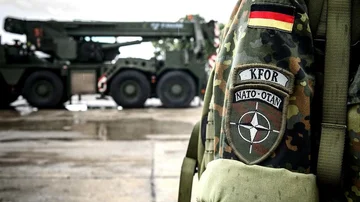
(7 years ago)For many years, until June 1999, Albanians suffered the consequences of ethnic cleansing, massacres and violations by Milosevic's military, police and paramilitary people. With the end of the war, Kosovo was liberated and international troops deployed in the country. On June 13, 1999, when Serb forces were forced to flee [...]
With the end of the war, Kosovo was liberated and international troops deployed in the country.
On June 13, 1999, when Serb forces were forced to leave Kosovo, the country was managed by the United Nations Organisation mission U n NMIC and Kosovo democratic institutions: The Assembly, the President and the government.
Although Serbia had no control over Kosovo, in Security Council Resolution 12 44, it was sometimes cited that Kosovo is a UN protectorate, but legally part of the Federal Republic of Yugoslavia.
In November 2005, the final status process was officially launched.
On February 2nd 2007, the special envoy for Kosovo's status, Martti Ahtisaari, handed over his proposal to Pristina and Belgrade for conditional independence for Kosovo, which led to the establishment of an independent state.
After several rounds of talks were held, Kosovo was declared independent on February 17th 2008.
Kosovo's February 17th 2008 declaration of independence was the crowning of a painful journey full of tears and blood for the Albanian population.
The International Civilian Office took over monitoring the implementation of independence. A few days later, a group of countries that recognised its independence founded the Steering Group, which would oversee the new state.
But the Ahtisaari Plan was never implemented in the country's north, inhabited by Serb majority, where Kosovo's symbols and institutions are not yet recognised and accepted.
On December 9, 2008, UNMIK's European Law Rule Mission took over, EULEX.
On July 22, 2010, Kosovo's independence was accepted by the International Court of Justice, which confirmed through the advisory opinion that Kosovo's independence has not violated any article in the International Law.
The Republic of Kosovo became the country guaranteeing the rights of all communities, based on the state Constitution.
By March 2011, Kosovo entered into dialogue with Serbia, talks that were called “Pristina ãograd”.
These technical talks were followed by those at the prime ministers' level, with the holding of four rounds of dialogue between Thaci and Dacic, as well as a meeting between presidents Jahjaga and Nikolic.
In Brussels, Kosovo and Serbia discussed telecom, energy, removal of the barricade over the Iber River, and other issues, but never managed to put one of the most sensitive issues on the table in post-war Kosovo, the one for the disabled.
However, signed agreements, Serbia never implemented them.
Now, a final agreement between the two countries is being talked about, a final dialogue where top leaders of the countries are standing, mediated by the European Union's chief foreign policy (BE), Federica Moghrini.
Before becoming 3 years old, the state was shocked by an international report containing claims that KLA people had committed inhumane crimes.
The author of the report was Senator Dick Marty, while in January 2011 the document was approved by the Parliamentary Assembly of the Council of Europe.
In 2015, the Assembly of Kosovo adopted constitutional changes and adopted the Law on Specialised Chambers and Specialised Prosecutor's Office, with mandates to tackle crimes against humanity, war crimes and other crimes mentioned or related to Senator Marty's report.
Recently, Serbia intensified actions for a vicious campaign against Kosovo, in terms of foreign policy.
Kosovo failed to membership in U NESTO, nor in the largest police organization, I NTERPOL.
Serbia continued the Kosovo campaign in many states.
And the Republic of Kosovo responded with the introduction of a 100% tax on goods of Serbian origin, and all that comes in from the state of Serbia.
This step, in addition to the international community's response, has made it conditional on Serbia's continuing dialogue with tax removal.
However, determined he continues to be Kosovo government chief Ramush Haradinaj, who, according to him, will remove the tax when Serbia recognises Kosovo's independence.
Kosovo failed to follow the step with which countries in the region moved towards the European Union. Currently, there is no clear European perspective since residents of the newest state have remained isolated in the Schengen area, thus being the only ones who cannot move without visas.
Kosovo is the only state in the region that formally has not started the path to membership in the European Union. It has yet to apply to obtain candidate status.
But, the country managed to mark a major achievement -- the signing of the Stabilisation and Association Agreement with the European Union -- is the first contractual relationship that Kosovo linked with the European Union.
The biggest success since independence, the Republic of Kosovo, achieved in art and sports.
The country managed to become the 210th member of the World Football Organisation, this historic decision on Kosovo. And that was ten days after he joined UEFA.
The first time she participated in a Olympics, Kosovo's representative came out with gold medals.
So far, Kosovo has recognised 116 states. Its vision of the future continues to remain membership in the EU, NATO and the UN.
While the challenge within Kosovo continues to be economic development, education and health.
The latest success, and what is being considered the greatest pride for the country's citizens, is the beginning of the process of transforming KSF into the Kosovo Army.
On eve of 11th anniversary of the country's independence, Kosovo Assembly has given it The KSF's competencies of the Kosovo Army.
The Republic of Kosovo holds two positive records in the region, that strict policies against violent extremism and terrorism, and for increased rights of non-most communities