2 hours ago
The disturbing report of U n NESCOs: 20% of Albanian children suffer from kindness or violence at school

Periskopi(7 years ago)
(7 years ago)Violence in school environments (in all its forms) is a violation of children's rights for education, health and well - being. No state can achieve a qualitative and equal education, if students experience violence or violence at school, it says in the report “after figures: End of violence in [...]
Violence in school environments (in all its forms) is a violation of children's rights for education, health and well - being. No state can achieve a qualitative and equal education, if students experience violence or violence at school, it says in the report “after figures: End of violence in schools and kindness” that has published U n NESTO in January 2019.
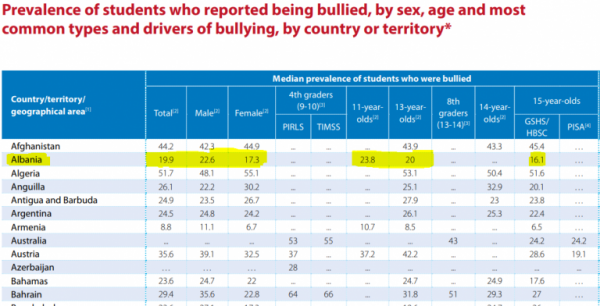
In Albania, the prevalence of students who reportedly were raped was 19.9%, about 22.6% in boys and 17.3% in girls. The figures are higher than 11-year-olds, where, according to the report, about 23.8% have admitted to having experienced lynism or violence at school in one of its forms, while the 13-year-olds where the report is 20%.
Among students aged 15 the rape rate is 16.1%.
In U report NESCO, radiation is classified into three main forms: physical violence, psychological violence/ social exclusions and sexual violence.
Bullization in schools is a global phenomenon. Nearly one out of every three students in the world has experienced the plague in the last month. Available data from all regions shows that 32% of students have been violated in one form or another by classmates in one or the last month.
Some children have experienced the plague frequently. However, the predictiveness of children who have experienced confusion and frequency varies from region to region. The percentage of students who reported violence in the region of sub-Saharan Africa is 48.2%, in North Africa 42.7% and in the Middle East about 41.1%.
Europe is among the regions with the lowest percentage of student privacy that have experienced school violence by 25%. In North America, the brevity of students who have experienced lullism is 31.7%.
Meanwhile, the report quoted sex violence as the second most common form of thunder in many regions. Some 11.2% of children who have experienced confusion report being ridiculed, sexually comment.
Among other things, report of U n NESTO, based on these findings, gives recommendations on what is to be done to end the flow in schools. First is legislation so that children's rights are protected and policies can be undertaken to stop and respond to school violence. Second, he must train teachers to prevent and respond to violence and terror in schools. Third, support should be provided for children to speak out and seek protection. One of the recommendations is to give priority and care to children who are part of vulnerable groups. /Monitor