6 hours ago
Mahmut: The Swiss institutes were not sent all the evidence in case “Dehari”

Periskopi(7 years ago)
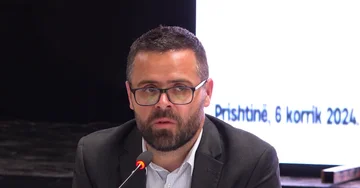
(7 years ago)Politologist Bardil Mahmut has followed up with a series of scriptures concerning manipulations he claims have become Swiss expertise for the case “Astrit Dehari”. In his most recent writing he raised questions “Who hid the pillow with the slime, which was in the crime room?” saying a very important element of [...]
In his most recent writing he raised questions “who hid the pillow with slime, who was in the Chamber of Crime? ” saying that a very important element of the crime scene was not sent to the Romande Unit of Forenical Medicine of the University Ramande Center of Legal Medicine in Lozanne, Switzerland, and that element is the slime pillow that was found on the floor in the crime room.
“on page 16 of the June 14, 2019 report describes the list of things available to Switzerland's forensic team. This list lacks the slime pillow found on the ground in a room where there was a dead man out of breath!! There is no doubt that this element would serve to spread the hypothesis even for a third mechanism used in the breathing murder of Astrit Dehar. However, this pillow can also keep track of DNA, valid to illuminate crime”, Mahmut writes.
The following publicist also raises the suspicion that this pillow has been used as a tool to hide other mechanisms of this ugly and inhuman murder.
Bardhil Mahmut's complete writing:
With the claim that it is based on the results of the autopsy of the Kosovo Legal Medicine Institute's forensic team and on the results of the Kosovo Agency's research on Forenzice, the chief prosecutor of the Constitutional Prosecutor in Prizren, Syla Hoxha, named Astrit Dehari's death as “due to the mechanical assification of the self-injudgeting”.
This conspiracy was rejected by Swiss experts who came to the conclusion that Astrit Dehar not only did he not commit suicide but, objectively, it had not been possible for him to get a breath of a round plastic bottle with no angles and smooth edges whose base was six inches [6 cm] in diameter.
In the actual case, it's not about will issues, whether Astrit Dehari wanted or did not want to put such a bottle in the airways and keep these roads blocked. This is about objectively impossible: Psychologically, blocking respiratory routes would disrupt the supply of oxygen, causing loss of consciousness and the ability of the muscles in the hands to keep the bottle on respiratory routes. This matter of medical science, which relates to the properties and function of living organs, knows every student in the primary course of medical studies who has passed a physical test. I have the full conviction that this fact of the science of physiology was known by members of the forensics team who did the Astrit Dehar autopsy report. It's a matter of why, in a concrete case, this fact has been left in silence and it hasn't been specifically said that Astrit Dehari had no chance of choking himself with that plastic bottle.
In addition, Swiss expertise exposes the major concessions made during the autopsy of Astrit Dehar. Various aspects of weaknesses and distortions contained in the Kosovo Institute of Legal Medicine autopsy report have been mentioned in my preliminary writings on the subject. Today's writing is limited to what has to do with oral injuries, which are allegedly caused by plastic bottles.
When descriptions of internal injuries caused to Astrit Dehar are described, the following point is said to be: “At the root of the tongue, parallel on both sides, about 6.5cm from the tip of the tongue are identically torn, with disorderly lip sizes: on the right side 15x10mm deep 4mm, and on the left side: 15x8mm at 6mm. These two most reliable parallel injuries are caused by the mechanical action of a solid (strong) consistency device that, by closing the mouth's vault in the deep, has encountered resistance in the strong roof, while in the land of smaller resistance, language, has caused parallel cracks on both sides”.
Such findings are dismissed by the Swiss forensic team. In Swiss expertise it is estimated that “The roots of the tongue and the right end of the tongue are the result of actions caused by a sharp item or a piercing, cutting object”. (Let's not forget that the plastic bottle was smooth, round, and round.) “The lack of bleeding in the suburbs testifies to injuries caused in the posthumous period. From where they are located and the symmetry of the wounds, they are likely caused by language extraction during autopsy. To illustrate, the same type of hurt is seen in a portion of the language autopsy published in literature (Koihara and other authors, 1992). Some cracks related to the extraction of language and pharyng up to the roof of the palate are of a similar aspect and are seen in the video and photos of autopsy. The hypothetosis proposed by legal doctors, that the cracks were caused by pressure on the tongue, after the general closure of the deep part of the mouth (strong sky) with a strong thing, we don't seem possible, because of the lack of signs of vitality around injuries, and because of the morfology of these injuries. Otherwise, in forensic literature we have not found any trace of such mechanism”.
In addition to the above-mentioned inaccuracies of Kosovo's forensic team, Swiss expertise also highlights injuries in language and roofies, which are not mentioned at all by Kosovo's forensic team. This is “a superficial gap on the side edge of the right tongue, located before the breakup described in the autopsy report” and “Purple red spots on raphemedia muco (the medical term, which defines the line that divides between the soft palate) of the soft palate and the back of the premedian right of the soft palate, which represents areas of bleeding piercing”, also viewed by external examination, but not seen by the <x1-seconds” of Kosovo!
According to Swiss expertise, “These injuries are the result of hard, unskilled shocks, and may have resulted from the lowercut. (music) in a plastic bottle in mucosa”.
Apart from differences over the wounds caused in the mouth, the Swiss forensics team disagrees with the autopsy findings about items used to choke Astrit Deharit. By autopsy, “Astrit Dehar's death has resulted from mechanical asphyxibility from blocking upper respiratory routes from a solid (strong) consistency tool”.
The Swiss expertise concludes that Mr. “Astrit Dehari is a result of asphyxibility, and the most reliable is that this is done through the sound of the spirit of the type ʹsmothering”. Meanwhile, in terms of how the catch of the spirit has been accomplished in the concrete case, they have greater diplomacy with Kosovo's forensic team.
For Kosovo's forensic team, “The blocking of upper breathing routes is made by a solid (strong) consistency tool”, that's plastic bottle. About this issue, Swiss expertise comes to another conclusion: “Sandy found in the mouth (the honey shower) may have been used to close Mr. Astrit Deharit”. But in their analysis they explain convincingly that plastic bottle could not completely close airway.
“In Mr. Dehari, the bottle was found in its mouth from its base, the diameter of which is 6cm. The anatomical measurements of the laryng conducted by groups of authors (Eckel He, Sittel C., Zoroka P. and Jerke A. and presented in the work “Dymentions of the larynge algorithm work in adults”, 1994) allow it to be estimated that the normal diameter of the human laryng hole is an average of 3.82cm (minimium 27m and a maximum of 63 mm). The proposal that this measurement is based on the distance between the clicking structures, which limit the larynx hole (the upper root of the thyroid crack), has overestimated data because they do not include soft tissues, which cover bone structures. So the base of the plastic bottle would have to be found above the epiglogue. Another argument that goes to this conclusion is the large presence of food matter in the bronze. Indeed, for an inhalation of the food materials from the bronze to occur, it is necessary that the space between the laryng walls be free”. As a result, this is an objective fact that proves that plastic bottles could not be completely choked. Besides that, there are the statements mentioned in the preceding scripture that testify that Astrit Dehari had a pulse and was breathing when it was discovered with plastic bottle in his mouth.
Other facts on which the Swiss forensic team relies on arguing that, in addition to the plastic bottle, in the hold of the Astrit Dehari spirit, other mechanisms have been used are injuries on the upper side of the forehead, on the lower right side of the face, on the right side of the neck, in the right front of the front and in the slap of the right hand, which are not superficial but parchment plates, which express internal damage to the organs or by hardy attacks. Such injuries cannot really be explained through suicide - dealing with sharp, breathing objects. The hypocrisy of injuries caused by the body's transport, of all actions to resurrect it, and of random tribulations do not explain the whole of these findings and does not seem completely convincing. On the other hand, these extracts are observed in the characteristic areas of injuries, caused during handcuffing, type “casquer of arm”, or other forms of neck violence. Because of this fact, such an injury mechanism cannot be disfellowshipped and should be mentioned”.
Of the overall injuries mentioned above, the violence caused on the neck is an inexplicable sign of the use of another mechanism to prevent Astrit Dehar's breathing routes.
The Swiss forensics team came to these conclusions based on the materials sent to them by those who have the full record of the case “Astrit Dehari”.
However, a very important element of the crime scene has not been sent to the Romand Institute of Forenzic Medicine of the Ramande University Law Medicine Centre in Lozanne, Switzerland: THE JEATH OF THE KING E WHAT YOU HAVE GIVE IN THE 12th century, IN THE CRIMINATION OF THE CRIME!
On page 16 of the June 14, 2019, report describes the list of things available to Switzerland's forensic team. There is no such list that there is no such thing as JEACT, which has been found on earth, in a room where there has been a dead man out of breath! There is no doubt that this element would serve to spread the hypothesis even for a third mechanism used in the breathing murder of Astrit Dehar. However, this pillow can also carry DNA tracks, valuable to illuminate crime.
Seeing how someone has tried to hide the evidence of crime, what is publicly contained in this context has to do with the dilemma I have, if this pillow is left intact (in the sense of genetic traces), and if it is still in the material of the Astrit Dehar file.
If the pillow really survived in trying to hide the crime and if it did not remove genetic traces, I have the full conviction that the detailed analysis of this evidence would shine, among other things, if the plastic bottle in Astrit Dehar's mouth was faked, with open arms, as witnesses describe it, was one of the mechanisms of respiratory jams, or was used as a means to conceal the other mechanisms of this ugly and inhuman murder.
I think that with a series of writing on manipulations that made Swiss expertise for the case “Astrit Dehari” I have carried out my duty as a citizen of Kosovo and as a politicologist. Swiss expertise will also refer to the scriptures I'm going to do in the future, until the full triumph of Astritis justice.