an hour ago
“Mini-Schengen”, Kosovo treated as equal to Balkan states

Periskopi(7 years ago)
(7 years ago)The so-called “Mini Schengen” initiative is in line with the Balkan countries' obligations and ambitions towards the EU. This is the institute's conclusion. EPIK, which says it followed all recent developments in front of this initiative, writes news.net. “Taking on common declaration of the three heads of state that gathered me [...]
The so-called “Mini Schengen” initiative is in line with the Balkan countries' obligations and ambitions towards the EU.
This is the institute's conclusion. EPIK, which says it followed all recent developments in front of this initiative, writes news.net.
“Taking on the joint statement of the three heads of state that gathered in Serbia's Novi Sad on 9 October 2019, the prime minister of Albania, Mr. Edi Rama, president of Serbia, Mr. Aleksandar Vučić, and the Prime Minister of Northern Macedonia, Mr. Zoran Zaev can find that the initiative is in line with the obligations and ambitions of the Western Balkan countries towards the EU”, the report said.
According to them, the declaration takes on the commitment of Western Balkan countries to the EU:
The Stabilisation and Association Agreements of six respective countries;
The Multi-year Action Plan for the Creation of the Regional Economic Zone, launched at the Trieste Summit, as part of the Berlin Process;
CEFTA Agreement;
The European Commission Communication “A reliable prospect of expanding for a further EU engagement with the Western Balkans”.
The statement rightly recognises these challenges of the Western Balkans:
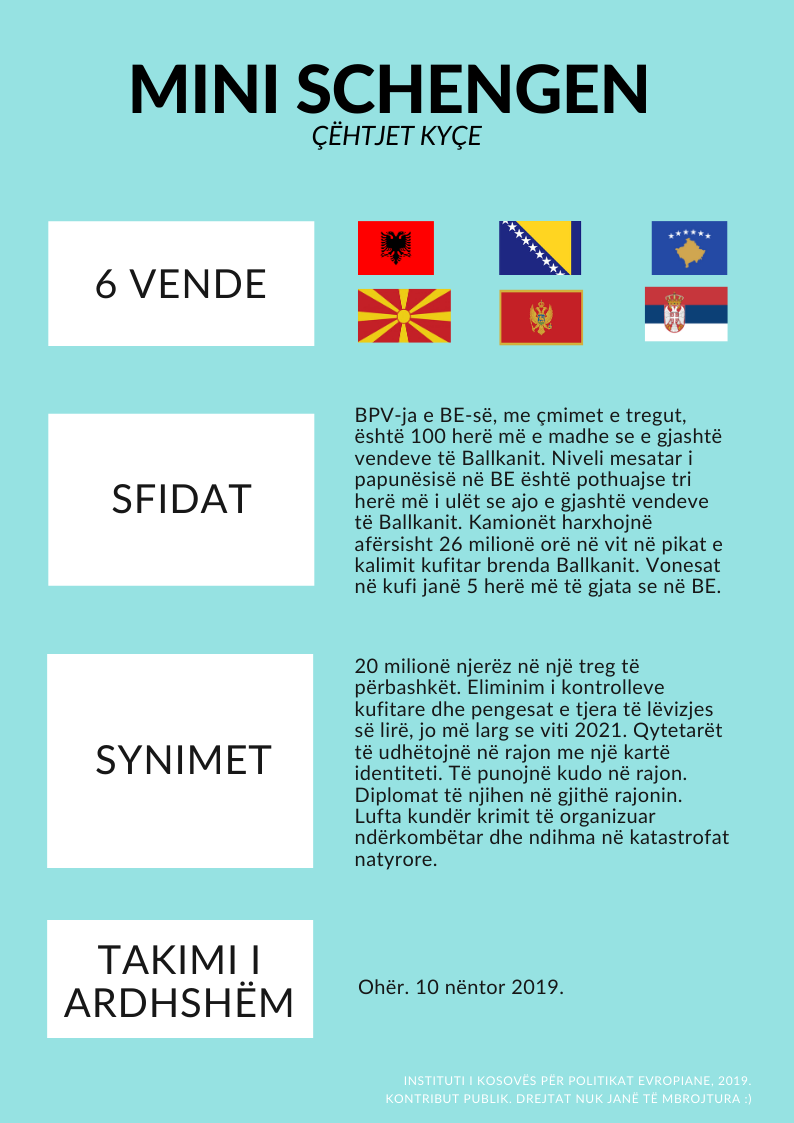
Brito-Precious Product (BPV) The EU, with market prices, is 100 times greater than the six Balkan countries;
The average unemployment rate in the EU is almost 3 times lower than in the six Balkan countries;
Trucks lose approximately 26 million hours a year at border crossings within the Balkans. Delays at the border are 5 times longer than in the EU (World Bank).
In this regard, the statement intends to arrive:
The creation of the common market of 20 million citizens;
) Eliminating border controls and other obstacles to free movement no later than in 2021;
A free movement of Balkan citizens in the region with ID cards;
) citizens' employment rights throughout the region;
Bilateral recognition of diplomas throughout the region;
The raising of co-operation in the fight against international organised crime and aid in cases of natural disasters.
It should also underline the fact that the declaration treats Kosovo at an equal level, like all other countries in the region.
In the end, EPIC makes a call and displays a scepticism:
Praising the initiative taken by three regional leaders, we call for launching regional ideas to take place every time in the spirit of including all countries in the region, thus preventing the division of Balkan countries among the countries that launch
The initiative of regional co-operation and those joining them always underlining the stated full will of all Western Balkan countries for closer co-operation with the aim of strengthening peace, equality, rule of law and prosperity for current and future generations.
We express concern about the lack of genuine political will to address the challenges identified by leaders of Western Balkan countries within the Berlin Process, which has been launched for five years now. In this regard, we demonstrate our scepticism for starting a new process outside the Berlin process, but with similar goals. In this direction, we have failed to understand how a new political initiative, but with more limited political participation than the Berlin process, better results will be achieved.