8 hours ago
Hungary continues airspace control over Kosovo

Periskopi(7 years ago)
(7 years ago)After controlling most air traffic over Kosovo since 2014, Hungary will continue to do so for “an indefinite “period since April, when the current five-year agreement expires, has confirmed NATO. Top air space over Kosovo above 3,048m from Earth's surface will [...]
The upper air space over Kosovo over 3,048m from Earth's surface will remain under the control of a Hungarian state-run company for “an indefinite” period after the current five-year agreement signed in 2014 “for the delivery of air navigation services and other relevant activities in the air space scheduled for Kosovo” expires on April 3rd.
The agreement signed between Hungary and the NATO-led peacekeeping force in Kosovo, KFOR, in April 2014, says that “will automatically be extended for an indefinite period, only in cases each side has submitted a written notice at least six months before the end of the initial period “.
“None of the parties submitted a written notice,” told BIRN an official of NATO in a written reply Monday. “Experts are taking the necessary steps to renew operational and technical agreements,” said in NATO's response.
Kosovo Air Navigation Services Agency, AshNA controls only the lowest airspace in the country, reaching about 20 percent of the country's commercial entry and exit flights. The remaining 80 percent of air traffic in upper airspace is controlled by Hungary.
A Hungarian state-owned company, HungarianControl, provides air traffic services for upper airspace under the NATO agreement.
Data from HungarianControl, from May 2018, said that activity at the <x0-space high airspace in Kosovo has increased significantly by 33.85 per cent, compared to May 2017 data.” During May 2018 alone, graphics indicate there were 11,649 operations in the upper airspace.
HungarianControl said air traffic in Hungary's airspace had increased almost tenfold, in line with global trends over the years. Until the end of 2018, the company secured safe traffic for more than a million aircraft,”, she said.
This extremely high value also includes top airspace over Kosovo,” said in a statement published on the HungarianControl website in January.
Revenues won by departures and arrivals at Pristina Airport, straight and by about 25 destinations go to Kosovo's AShNA.
Last “We earned 4m euros from this, while the upper air space should have generated around 6.7m to 7.8m euros, but we don't have accurate data on this,” ASNA Director Bahri Nuredini told BIRN.
If Kosovo had full control over its top airspace, the country could earn millions of euros annually. Kosovo could create a minimum of 100 new jobs for its citizens, while financially it would earn an additional 6m to 8m euros annually,” said.
He added that the current tariffs are determined by the Kosovo Civil Aviation Authority, which “has the right to lower or increase tariffs when assessing national policy development”.
According to AShNA, 2018 saw over 16,000 commercial operations -- a 12 per cent increase from last year.
NATO has controlled Kosovo's top air space, over 3,048m since the conflict with Serbia ended in 1999, when he handed the task to NATO member Hungary.
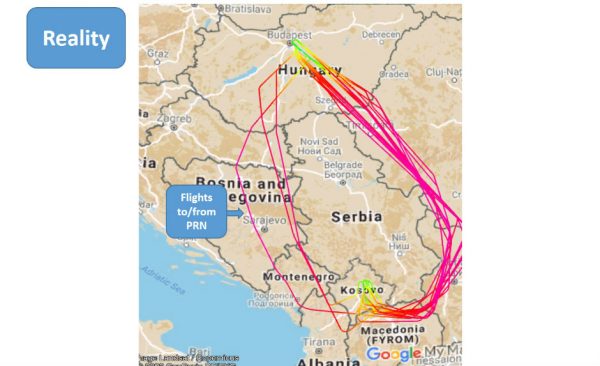
Because of Kosovo's difficult current relations with Serbia, which does not recognise it as a state, there are only two corridors open through Macedonia for commercial flights.
“Flights from Western countries coming towards Kosovo must avoid the airspace of Serbia and Montenegro,” Nuredini noted.