43 minutes ago
Hasani: Businesses besides export also have internal barriers

Periskopi(8 years ago)
(8 years ago)The economic situation in the country is not at the right level and businesses in Kosovo, except for barriers to export our businesses, have other internal barriers that make it difficult to increase the competitiveness of companies. Thus has Minister of Trade and Industry Bajram Hasani declared, at the conference on the subject “trade spaces, their importance in development [...]
The economic situation in the country is not at the right level and businesses in Kosovo, except for barriers to export our businesses, have other internal barriers that make it difficult to increase the competitiveness of companies.
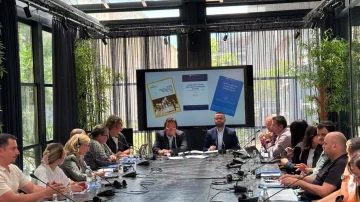
Thus has Minister of Trade and Industry Bajram Hasani declared, at the conference on the subject “, their importance in developing international trade”, organised by MTI and USAID in Kosovo.
Trade and Industry Minister Bajram Hasani has demanded from the Kosovo Parliament's Headship that the draft law on commercial societies as soon as it is processed in the Assembly, as the bill would influence the country to make progress in terms of doing business.
Hasani said that with the aim of creating facilities for the economic sector, the National Committee for ease of trade has been established, as well as the entry into force of Protocol Five will create opportunities for improving conditions for national and local trade.
The foundation of the National Trade Relief Committee is aimed at addressing the barriers our businesses face to deal with with the greatest possible seriousness. We are aware that besides barriers to export our businesses, there are other internal barriers including non-tariphorus that make it difficult to increase the competitiveness of our companies. This protocol has now entered into force and its implementation will be both national and regional, since the protocol target is not only improving conditions at the national level, but also improving conditions to trade at the regional level and CEFTA member states”, he said.
According to him, businesses in the country also face distribution of their products, as well as competitiveness from products exported to the country.
Minister Hasani said they will continue to take action under the law in effect in order to remove barriers facing local producers.
The chairman of the Kosovo Economic Ode, Safet Gerjaliu, said that along with support through funds and subsidies, the private sector also needs protection of their products.
According to him, the private sector, in addition to numerous recent challenges, is also facing a lack of labour force qualifications, and for that it required greater attention of institutions.
“The challenges are many, but I believe that dialogue is the only mechanism to find a way out of such a situation, it is not a matter of honour to Kosovo if we lose time looking for reasons for failure is the time to find reasons for failure in this direction in recent surveys that have been done with the production sector that they export to CEFTA-S countries only 16 per cent have said yes, 84 per cent do not export. One of the challenges facing the private sector and with some form being downplayed is professional education and investment in education based on the latest indicators the main problem in the private sector has been the high bank candidates, it has been the electric current believe that in the next three years the biggest problem will be the workforce”, he said.
Gerjaliu also said there is an urgent need for the commercial provision of subsidies to increase, as well as to improve the aspect of promotion of products “Made In Kosova”.
USAID Economic Development Office Director Brian Martalus said the US has helped Kosovo get better access to loans, be able to combine more efficient trade to allow Kosovo companies to be more competitive in the region and also in the EU.
According to him, the Kosovo government should work for private sector interests because without a powerful private sector, there is no real economy.
“We see a lot of potential for these exports in the future, there is a lot of work ahead to do in the Government of Kosovo and regional governments, you need to all work together, and it is also important that the private sector work together with Government and lobbie for their interests because without a strong private sector there will be no real economy, the private sector is the basis of the economy and without the voice of the private sector heard by the government, the economy will not be able to flourish”, he said.
In contrast, Bahri Berisha, the general director of Kosovo Customs, said Kosovo is at the disadvantage of exporting local products because it is not limited to any state that is an EU member, and that causes cost in a financial and time-to-face way.
Berisha said that with the aim of creating facilities for local producers, they are using better customs practices that have contributed to the reduction of financial and time costs.
<x0... Time-decuring, we have unnecessary expenses that we've eliminated from customs procedures, cut the follow-up procedure, done the digitisation of all services, but I talk so far where everything is electronic and we appreciate that all of these have contributed to the reduction of the financial and time cost”, he said.
Berisha also said Kosovo Customs is working to become part of the Joint Transit Convention, as in exchanging licenses with other border agencies, to become electronically.
The activities of institutions in the area of ease of trade were introduced at this conference, and some of them are researching the timing of the customs, authorised economic operators, tariff lists and payments that are under the additional protocol five, etc.