16 minutes ago
Kosovo visa-free thanks to Haradinaj's mood

Periskopi(8 years ago)
(8 years ago)Visa liberalism is the intriguing topic for Kosovo citizens, since it has long been promising that there will be free movement towards the states of Europe. But, since 2015 freedom of free movement is being blocked by the Demarketing Agreement with Montenegro. [...]
Visa liberalism is the intriguing topic for Kosovo citizens, since it has long been promising that there will be free movement towards the states of Europe. But, since 2015 freedom of free movement is being blocked by the Demarketing Agreement with Montenegro.
It was thought January would be the solution to the problem, but according to the pace of the Government and the Parliament's work, this deal is being neglected.
The removal of guilt from the shoulders has been made by the head of the Commission for Foreign Affairs, Diaspores and Strategic Investments, Vjosa Osmani, who says the material has been processed within the legal deadline of the Parliament's Headship.
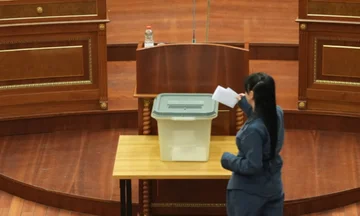
The Commission has prosecuted the material on January 16th, so within the legal deadline. It is now within the capacity to decide on the date of the plenary session, where the” agreement will be considered, Vjosa Osmani has declared.
But even though this agreement has been processed for the Parliament for two weeks, today's session is not in order.
On the issue of demarcation, visiting Kosovo for the month was also envisioned by Montenegro's prime minister.
However, it was reported that Markovic will visit Kosovo in February. Montenegro's Prime Minister, Dusko Markovic, is expected to visit Kosovo. He will stay in Pristina on 6 February.
The Montenegrin prime minister's visit to Kosovo, warned of February 6th, is not seen as a hope of giving epilogue to the border issue with Montenegro. The resolution of border demarcation is only in the hands of Kosovo Chief of Executive Ramush Haradinaj. That is how the connoisseur of political circumstances in the country and the region of Shkelzen Maliqi sees the entire situation.
The good knowledge of the political circumstances in Kosovo and the region, Shkelzen Maliqi, has commented to Gazeta Express on the news that Montenegrin prime minister has agreed to come to Kosovo at Haradinaj's invitation. But, according to him, it is unfair to expect the demarcation issue to resolve Markovik's visit, as only Kosovo's prime minister holds that job. More specifically, to resolve this issue, which presents one of the biggest obstacles to the country's integration processes, needs a change of approach by the Government of Kosovo.
On February 6th, we could clarify with Montenegro by acknowledging the ratification of the 2015 border agreement, which Montenegro has made, while the formula for domestication, of a compromise acceptable to Podgorica, would be what the deputies of the Initiative and AKR are working on these days are working on, so that the eventual corrections of the border with Montenegro can be made during the demarcation of the border line that should take place in a two-year term after it is ratified<1>, Maliqi has praised.
The 2015 agreement, which, according to him, has misinterpreted the Kosovo opposition, is in some hand an act of agreement that the two states -- Kosovo and Montenegro -- agree that the border between the two countries should be the one in 1989, under the recent currency constitution of the former Yugoslavia federation. On the other hand, Maliqi points out, the <x0-marking of the border line even in the deal is envisioned later, and during this process the two countries can set up requirements for corrections, as a legitimate process of two sovereign states”.
On the other hand, Maliqi stresses that if this proceedings are well argued before Montenegro's prime minister, he could give principled consent to that, and both sides would have enough time to analyse the problem and resolve the issue in the spirit of good neighbourlyity.
I have often recalled the opinion in Kosovo that even on the part of Montenegro -- namely, from the municipality of Plav -- there have been requirements for reforming the border line outlined in the 2015 agreement, because the western slope of the Hyles Mountains has been found to belong to Kosovo, even though the Decani municipality has a difficult approach in this area, and that for Plava is a area of great interest to forestman, tourism, economy and hunting”, Maliqi said among other things.
He has given an example where, according to him, Kosovo can show readiness for correction, demanding that the same principle be applied even in the eastern and southeastern areas of Cakir and Tower, where Kosovo claims they must meet Kosovo.
For that, I believe Montenegro's prime minister will also have consensus, but the condition is that Kosovo, ratifying the agreement, ensure the internationalisation of its northwestern limit”, has ended Shkelzen Maliqi.
While calls for the Demarket vote are constantly making internationals.
Apostolova has reiterated that the terms of demarcation and that for fighting corruption are of the same importance to visa liberalisation.
“First or second conditions. There have been 95 conditions, 93 have been met, two have not been met. I wouldn't dare tell you who's more important, since they're both equally important. Because if both conditions are not met, liberalisation cannot be proposed to member states for decision”, the chief of the EU Office in Pristina has said.
Also, Bulgarian diplomacy chief Ekaterina Zaharijeva has declared there are external factors that have a strong influence in some countries in the Western Balkans.
It has underlined that Kosovo institutions should be aware of the necessity of implementing reforms, especially in the area of the legal state, as well as the conditions they must meet.
“One of these conditions is ratification of demarcation with Montenegro”, Zaharijeva said, which has ordered that “The EU will no longer accept new members those countries that have open bilateral problems in the inter-resident”.
Call for the vote on this international agreement has also made the European Integration Minister. The gift Hoxha has said it should be in the interest of all widow, one consensus and in that form ratify the agreement with Montenegro.
Kosovo's “potential strengthens with ratification of demarcation” Hoxha has said.
She said it has been two and a half years and in this form, this is the continued law, so that it can be both a visa liberalisation condition, but not just to stop demarcation.
Among other things, he said there should be pressure by citizens as soon as visa liberalisation occurs.
There are no days that I don't accept requests from citizens, even for liberalisation, for humanity and much else”, she added.
She called for the demarcation to pass as quickly and especially on the first three months of 2018.
But this topic does not have the support of Kosovo's prime minister.
Haradinaj says the Government no longer has work to do in handling these issues, while he expressed surprise why demarcation has not been voted in pro or against in the Parliament.
There are some topics that we have homework on the executives. There are some topics that are also involved in external acts. I've done the part of the Government on both one subject and the other. I am surprised that Parliament has not yet voted, that the government has nothing more to do with it, that we have submitted the report, has parliament. Let them vote, not find arguments that lead to extremes. Two and a half years of LDK had this case in the drawer, and now they're not voting it”, Haradinaj said.
The demarcation continues to remain one of the most important issues in the country, which requires quick solutions.
The ambassadors of the most powerful countries have stated this several times, demanding that the demarcation be passed as quickly as possible, then opening the visa liberalisation route for Kosovo citizens.