4 hours ago
Government responds to Anti-corruption Agency reasons salary raises

Periskopi(8 years ago)
(8 years ago)Kosovo's government has issued several legal findings pertaining to the opinion of the Anti-Corruption Agency, as it deemed the decision illegal to raise the salaries of executive members, saying that until such a decision is in place, they would receive the determined salary. Government expresses commitment to respect [...]
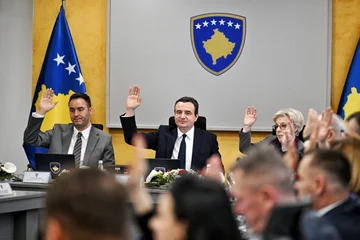
Kosovo's government has issued several legal findings pertaining to the opinion of the Anti-Corruption Agency, as it deemed the decision illegal to raise the salaries of executive members, saying that until such a decision is in place, they would receive the determined salary.
The government expresses commitment to respecting the principle of separation of state power and full rule of law under precisely constitutionally defined procedures and law.
The Prime Minister's Office's legal findings pertaining to the Anti-Corruption Agency's opinion:
Anti-Corruption Agency (in further text AKK, with its reference opinion AKK- DPS-DPKI-03-02-4227/17 concerning the Government decision of the Republic of Kosovo, No. 04/20, the date 20.12.2017, has considered that “has emerged the situation of the conflict of interest “rast in case of” in the vote (approvation) and the signing of the Government's decision no. 04/20 for increasing salaries of several positions in the government cabinet”.
The AKK's opinion is characterised not only with multiple legal inaccuracies, but also with a non-professional, potentially influential approach, in interpreting legal provisions for the conflict of interest in the exercise of constitutional and legal functions on the part of the Government of the Republic of Kosovo.
Initially, the consisting of the decision vote on the part of deputy ministers is one of the legal inaccuracies of AKK opinion. In government decisionmaking, only members of the government vote, and not even deputy ministers (see for this article 92 (1) of the Constitution of the Republic of Kosovo for the composition of the Government). This allows space to be found that the AKK's analysis has not been smoldering in precise material detail.
No declaration of the conflict of interest situation during government decision making in question has been the result of free legal and political conviction that the decision has been made on the basis of the government's constitutional competencies.
In view of this, none of the Government members have cleared up the issue of possible conflict of interest, taking on grounds, in addition to the lack of any such practice in the past.
Moreover, government decision No. The 04/20th date 20.12.2017 has also been taken because of the lack of a Law on Salaries of Government Members and in view of the current practice (see the government's previous decisions, the Parliament, the Presidency and independent institutions for the appointment of salary growth).
The government, on the basis of Article 93 (4) of the Constitution of the Republic of Kosovo, has constitutional competence, in addition, to make decisions. The Government of the Republic of Kosovo's decision is taken on the basis and in the Constitutional procedure as untenable, ex-leg competence.
On the basis of Article 92 (2) of the Constitution of the Republic of Kosovo “Kosovo's government exercises executive power in accordance with the Constitution and the law.” According to this article, it turns out government decisions have the executive title because the constitutional nature of government power is executive. In the sense of Article 92 (3) and (4) of the Constitution, the Government has the constitutional mandate to make decisions.
Therefore, the Government's decisions cannot be reconsidered in any other form, except parliamentary oversight by the Republic of Kosovo's Parliament or the review of constitutional Constitutional Court constitution under its highly-reposed constitutional mandate, as well as through judicial procedure.
The government, in accordance with Article 113. 2 (1) of the Constitution of the Republic of Kosovo, in terms of constitutionality of its judicial acts, knows only the Constitutional Court's judgments as the final authority in the Republic of Kosovo for interpreting the constitution in the sense of Article 112 and Article 4 (4) of the Constitution of the Republic of Kosovo.
The government of the Republic of Kosovo has constitutional authorisations to make the implementation of state policies, and for this it is subject to parliamentary control (see the Article 5 (4) of the Constitution of the Republic of Kosovo). As presented by the prime minister of the Republic of Kosovo on the occasion of presentation for review and approval before the other members of the Proposal Government, its purpose has been, in addition, to the leveling of salaries of members of the Government with the salaries of other branches of state government (see the pay gap between Government members, MPs and the head of the Assembly, the President's Office and other support staff in these institutions, for the most part to see the declaration of the assets of these officials).
In exercising their constitutional authorisations, and as Article 98 of the Constitution of the Republic of Kosovo defines, “Kosovo Government members enjoy immunity from prosecution, civil indictments and dismissal of actions and decisions within the scope of their responsibilities as members of the Government”. So the AKK would have to take into account the constitutional provision which guarantees functional immunity to members of the government during the exercise of its executive power.
The constitution has authorised the Government to define by law and by regulation its way of work and decision-making procedures (see for this article 99 of the Constitution of the Republic of Kosovo). Kosovo still does not have the Law for Government. But, the government in support of its constitutional authorisations, has issued the Government's Labour Rule of the Republic of Kosovo No. 09-2011.
Article 2 (2) Order No. 02/2011, the Government has determined that “issues related to the work of the Government, which have not been regulated by this regulation, are determined by decision or any other act of government, in accordance with the Constitution of the Republic of Kosovo, the law, and with that rule”.
As a result of the aforementioned constitutional and legal provisions, the organs that are authorised by the Constitution for making decisions cannot be subject to conflict of interest during the exercise of their constitutional activity, due to their constitutional authorisation is imperative, and in their exercise it is not allowed to delegate this component to any other organ in order to avoid conflict of interest. So, from this point on, the question in this case is which organ should make such a decision besides Government?
Private profit does not exist in the case of the Government's decision because we do not have private interest, but with the right to dignified wages of members of the government, which in the absence of a law that would define the salaries of members of the Government and its other supporters, there has been no other legal way of exercising their public office.
Moreover, the decision has no personal but official effect. So such a decision determines the government members' salary and part of the government's other staff, and in no provision, it does not connect with the private interests of government authorisation carriers, but with the position they hold.
Therefore, all those who are now and in the future will exercise those government authorizations, until such a decision is in effect, will receive a set salary with this Government decision.
In the Agency's opinion it has been posted, in addition, that “Government decision date No. 04/20, the 20.12.2017 date cannot be described as a conflict of interest for all who are the beneficiaries of this decision, the Conflict of Interest has been presented to officials who, by their vote, have influenced the decision to be of interest to personal benefit”.
The question in this arrangement is which other legal way would we be able to make the government the high-ranking decision? Is the AKK aware of the necessary quorum for making government decisions, as Article 15 of Ruler No. 09/2011? Furthermore, in the absence of the Law for Salaries of High Functioners, how would the salaries of MPs, members of the Government, the president, carriers of independent institutions and so on?
These questions are asked next to the AKK's presched high opinion, with which it recommends that “The decision be turned into review, using other legal ways that do not conflict with the Law for Prevention of Conflict of Interest in the Army of Public Function”.
Would the situation of the conflict of interest be averted if the salary law, including MPs' salaries, were approved by the Parliament, since MPs could have “conflicted interest quox1> after voting for their salary?
Or on the occasion of the declaration of the law adopted by the Parliament, where the declaration would be made by the president under his constitutional mandate, in which law the president's own salary would be determined? Furthermore, are the Government's decisions on salary increases at odds with the government's earlier decisions on raising salaries in the public sector and decisions on setting the minimum wage in the private sector?
These questions are asked to come to the legal conclusion that in no professional judicial interpretation, there can be no claim that the Government, on the occasion of such a vote, may be in a situation of conflict of interest for purely constitutional and legal reasons.
We estimate that the initiative of procedure by the AKK overseer (see for this Head III of Law No. 03L-159 for the Anti-Corruption Agency, the preliminary qualifications by the openly expressed oversight of our media, as well as public discours imposed on the AKK overseer's qualifications to its dependence, has created a potential situation of conflict interest.
Moreover, for the decisions of such nature, The AKK has issued no opinion about hundreds of government, presidency, Parliament and other institutions.
If we have a chance when government decisions are challenged by other administrative bodies, then the question is, does the government exercise executive power or not and what the government's actions have.
The constitution of the Republic of Kosovo in its Article 4 has defined that “Kosovo is the democratic Republic based on the principle of dividing power and controlling balance between them, as defined by this Constitution”.
Therefore, in all its meanings, the Constitution has placed the Government in constitutional obligation to exercise its executive power, considering that its power is balanced by legislative power through parliamentary supervision, and by judicial authority through the process of reviewing its decisions.
Furthermore, if the Government's decisions were rejected by other institutions, judicial security and government decision making would be violated and that ever, the government would not feel clearly convinced that its decisions are constitutional and legal.
In the end, the Government of the Republic of Kosovo is fully committed to respecting the principle of separation of state power and full rule of law under precisely constitutionally defined procedures and by law.