5 minutes ago
From Latin America to Kosovo: Thus women are trafficked for sexual services

Periskopi(5 hours ago)
(5 hours ago)In a few seconds, you can choose the city. Then nationality, age, length, weight, hair color, and even sexual preference.
A click is enough to appear dozens of women's profiles offering escort services in Kosovo.
According to Kosovo authorities, behind some of these accounts are not hidden by their own will, but victims of human trafficking.
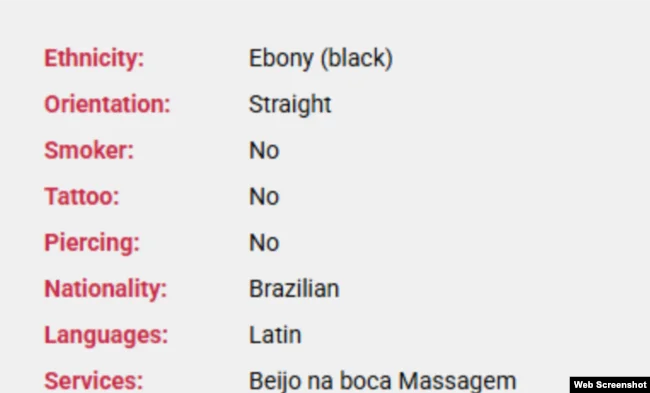
On this platform, identified by Kosovo Police for the sale of sexual services, Radio Free Europe found many women's profiles by Latin American states.
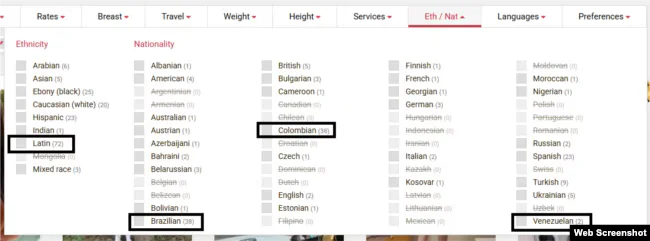
Over 70 profiles are listed as Latin women offering services in Kosovo.
Some of the profiles are said to be verified by the platform itself, which provides services across Europe.
“Those recruited from abroad, especially from Latin American states, are recruited with regular contracts. Presented as regular workers in Kosovo, with residence permits and equipped with work contracts”, says about Radio Free Europe Zana Sadiku-Sertolli from the Founding Prosecutor in Pristina.
Sadiku-Sertoll, who is co-ordinator for human trafficking criminal acts, says this form of recruiting and organisation has made prosecution of these cases difficult.
Radio Free Europe has asked the Ministry of Internal Affairs responsible for issuing work permits and residence permits for foreign nationals for policies and strategies for fighting this phenomenon, but not even after three weeks has been answered.
Regarding the platform where escort service is offered, REL has also asked the Electronic and Post Communication Regulatory Authority (ARKEP) if there has been any request to block access to this website in Kosovo, but has not been answered.
In the past, ARKEP has intervened by forcing internet providers and mobile operators to block Russian media sites sanctioned in Kosovo. While, although with services that conflict with the law, many online betting platforms operating from abroad are accessible in Kosovo.
Kosovo police have said that the REL is monitoring the suspected websites, including the one where women from Latin America are listed, but has added that “in this phase cannot provide further information”.
A report released last year by this institution says that Kosovo “continues to remain a country of origin, transitation and destination for trafficking victims” and that one of the newly identified forms is to provide sexual services via online escorts.
According to that report, victims are usually between the ages of 18 and 30 and come organised by countries like: Brazil, Venezuela, Colombia, and Peru.
Just one Perun citizen was arrested in Pristina in 2024 under suspicion of being one of the organisers of this network of traffickers.
Free Europe Radio has requested more data from the Special Prosecutor for the continuation of procedures in this case, but has not received answers.
A few months ago, the Callx medium. com reported that it had secured some of the investigative files on this case, where network organisers allegedly received over 50 percent of the profits of trafficked girls who were beaten if they did not comply with instructions.
Even in Bosnia and Herzegovina, the Prosecutor's Office told REL that during 2025 and 2026 it has identified several Brazilian citizens sexually exploited through the same platform.
According to her, an organised criminal group organised the transport and accommodation of victims, while profits were sent to organisers through cryptovalut. Europol, Interpol and Brazilian authorities are involved in the investigation.
In Kosovo, judicial co-operation with the countries of the origin of these victims has proved more complicated in cases where the country has no diplomatic relations with the victim's origin, says prosecutor Sadiku-Sertolli.
There are some states that do not know Kosovo and there must be a bilateral agreement with the state where that victim originated, as it should be estimated whether the victim should be safe to return there [or not]”, she says, adding that, however, this problem is usually solved through the Office for International Judicial Co-operation in the Ministry of Justice.
This phenomenon is not limited to the Western Balkan region.
European police agency Europol says trafficking for sexual exploitation, including women from Latin America, is part of criminal networks operating on several continents.
In June of this year, several police and security agencies -- Europol, Interpol, Frontex and Ameripol -- co-ordinated an international operation against human trafficking, attended by Kosovo authorities.
The operation ended with over 1,000 arrests and the identification of a large number of victims from Latin America.
“During the operational phase, participating countries carried out actions aimed at implementing the law, including strengthened checks on hot spots, such as borders and airports, as well as pro-active investigations into ongoing cases, requiring operational co-operation of the high level”, Europol said in response to the REL.
Kosovo is not listed among the countries where there were arrests.
Meanwhile, even in Albania, media have reported on a similar situation in Kosovo with escorts from Latin American countries, but state authorities have not answered REL questions on the subject.
While in Serbia, where the number of identified trafficking victims has increased, national rapporteur for these cases, Zoran Pashaliq, told REL that, so far, there is no record of victims from Latin America.
Unlike Serbia, statistics in Kosovo show that the number of identified trafficking victims has declined in recent years.
Although it is not specified how many have been sexually exploited, police themselves describe this as one of the most widespread forms of trafficking and acknowledge that the actual number of victims is believed to be higher.
This month, Kosovo Police held an action in massage and music-night parlors, which ended with the arrest of several people.
However, they were suspected of criminal acts of attempted prostitution rather than trafficking with human beings.
What's the difference? Prosecutor Sadiku-Sertoll says the difference lies in the person's freedom: trafficking implies that the victim is recruited, controlled, or forced into use, while access to prostitution is linked to organisation or profit from prostitution.
It shows that because traffickers make sure they do not leave material evidence, Kosovo's investigative institutions find it difficult to provide material evidence beyond the victims' statements.
Here, the next challenge is to convince the victim that he is the victim of trafficking”, Sadiku-Sertoll shows, stressing that this problem occurs especially to victims under the age of 18.
According to a Kosovo Police report, 42 victims have been identified in this age group, of which eight were ages 12 to 14. Most are said to have been employed in sex services.
But not only the lack of traces left by traffickers makes it difficult to prosecute those cases, Sadiku-Sertoll says.
She says that, despite good co-operation among institutions, the challenges remain the limited capacities of some of them, especially lack of staff in social services and police labour equipment.
According to data Radio Free Europe has received from the Kosovo Judiciary Council, human trafficking cases in the past three years have pronounced only two prison sentences.
The Penal Code envisions sentences of five to 12 years in prison for trafficking with human beings, while in the most serious cases the sentence could reach life imprisonment.
And, the U.S. State Department's report on trafficking with human beings for 2025 criticises Kosovo precisely for penal policy.
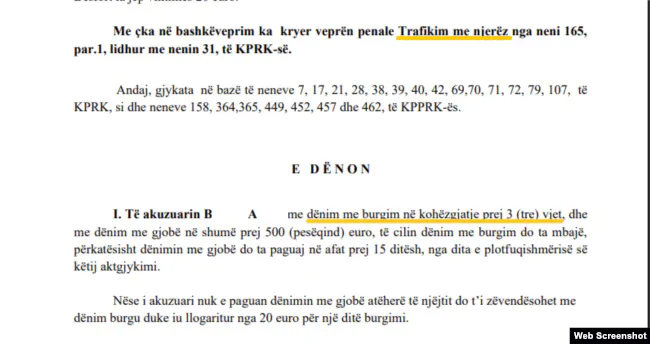
The report says that sentences below the legal minimum and “The Albanians of fines as a single punishment undermine efforts to keep traffickers responsible, weaken the preventative effect, create potential concerns about the safety of the victims, and do not reflect the seriousness of this □x1>.
One of the acts published on cases of trafficking with people, where the sentence is below the legal minimum for five years.
The same report highlights another problem, which prosecutor Sadiku-Sertoll points to: lack of training and expertise.
According to the report, most prosecutors and judges do not have sufficient training and experience, especially in cases involving emotional or psychological control of victims, which may affect the pronunciation of easier sentences or the qualifications of cases as criminal acts with sentences lower than human trafficking.
Free Europe Radio has sent questions to the Kosovo Judiciary Council about the challenges the courts face in dealing with human trafficking cases and measures being taken to strengthen judges' capacities in this area, but until the publication of this article, there is no response.