17 hours ago
It's going to be “from the big heat, but why the Germans don't have air conditioning
Periskopi(25 days ago)
(25 days ago)Unlike the US or parts of Asia, many families in Germany and northern Europe are not prepared to cope with extreme heat. But worldwide temperatures are increasing.
In countries such as the United States, Australia, and Japan, hot, wet summer months become affordable because of the cool air flow from the blistering air. In many parts of Europe, the solution is often much simpler - the closure of roles, the lighting of the fan, and the keeping close to a lot of icewater.
According to the U.S. Department of Energy, about 90 percent of people living in the United States have home conditioning. In Europe, where in some cases similar climate conditions prevail, this percentage is only about 20 percent, according to the International Energy Agency (IEA), although there are major differences between countries.
In Spain about half of all dwellings have air conditioning. In Germany, however, only about 6 percent of the dwellings are equipped with a fixed air - conditioning system, while another 13 percent use portable devices, which usually tend to slow down. The reason is clear: until recently, air conditioning was not necessary in many European countries, especially in northern ones, reports DW, broadcast Periscope.
Hot wine has had what has changed now?
Hot weather has always been part of Europe's summer. But in the meantime, extreme heat waves are becoming increasingly frequent and intense. High temperatures lasting for days or even weeks endanger human infrastructure, ecosystems, and health. The Intergovernmental Panel for Climate Change (IPCC) has shown that these extreme heat waves are increasing faster than climate patterns had predicted, especially in Western Europe.
A recent analysis by the ClimaMeter, a union of European scholars investigating extreme weather phenomena, revealed that temperatures in June 2026 were about 2 to 4 degrees Celsius (3.6 to 7.2 degrees Fahrenheit) higher than they would have been in similar conditions at the end of the 20th century. "This situation leads to an immediate increase in the demand for electricity for cooling,” explained Tommaso Alberti, an Italian researcher in ClimaMeter, in a statement.
The demand for air conditioning and cooling devices in Germany has increased by 75 percent between 2019 and 2024 years of the hottest year ever recorded. Eurovent, the heating, ventilation, air conditioning and cooling technology industry association, has registered a stable"growth” in recent years.
Despite this trend, however, resistance in Europe continues to exist against air conditioners, said Synin Renneboog, deputy secretary general of Eurovent: "In advice on how to stay fresh, circulate on social networks, I still see recommendations not to use air conditioning”, he told DW in an email. "Respect is still very often considered luxury”, writes Rennebog. Meanwhile, heat poses a serious public health hazard: "There are tens of thousands of deaths in Europe each year linked to high temperatures. ”
European homes are built for heating, not air conditioning
For most Europeans it is difficult to maintain coolness in their summer dwellings. Many houses and apartments in Germany and other parts of Central and Northern Europe are designed to keep the heat indoors during the cold months but not to ensure maximum heat cold. A recent study showed that almost half of all respondents across the EU rely on improving shade and isolation to escape heat. Yet, more and more people are also considering the use of air conditioners.
"Time when air conditioners in Europe were still a little more widespread is coming to an end,” said Helge Brinkmann, deputy director in Boston Consulting Group and green energy specialist and the environment, in an analysis September 2025.
According to analysis, however, installing a climateisation system in old European buildings often presents a challenge. Expanding renovation efforts can make it possible to establish new systems. But in European cities with historic buildings, additional administrative and aesthetic barriers must often be overcome by".
"A serious social and health policy problem”
Cost is another factor that prevents many Europeans from installing a climateization system. The rise in energy prices makes it costly to cope with heat, and 38 percent of respondents in a large EU survey said they could not afford to cool their home.
A 2020 study of how global warming is increasing the need for climateization in countries such as France, Spain, Sweden, and the Netherlands. The bottom line: Low - income populations are disproportionally affected. Synyn Renneboog from Eurovent explains that winter warming is considered a basic need, but this is not worth the same for cooling: "Maybe we should also admit that the inability to cool buildings safely during the summer is also becoming a serious social and health problem. ”
Environmental concerns so far have hampered the spread of air conditioning in Europe. Total energy consumption for cooling residential buildings and other spaces in the EU has steadily increased over the past decade, especially since 2020. Recent data from the European Statistics Office indicates that although the energy consumption of buildings in 2024 has seen a slight decline, cooling energy consumption increased by 15.3 percent compared to last year.
Are there alternatives to air conditioners?
Yes, there are more friendly alternatives to the environment to traditional air conditioners, explains Jeane Sebastien Broc from the Institute for European Energy and Climate Policy during a heat wave in July 2025: "The new facilities can be designed to limit the need for cooling, giving priority to alternatives to air conditioners. ”
These options include building design in order to allow natural air circulation in space and the use of materials that store less heat.
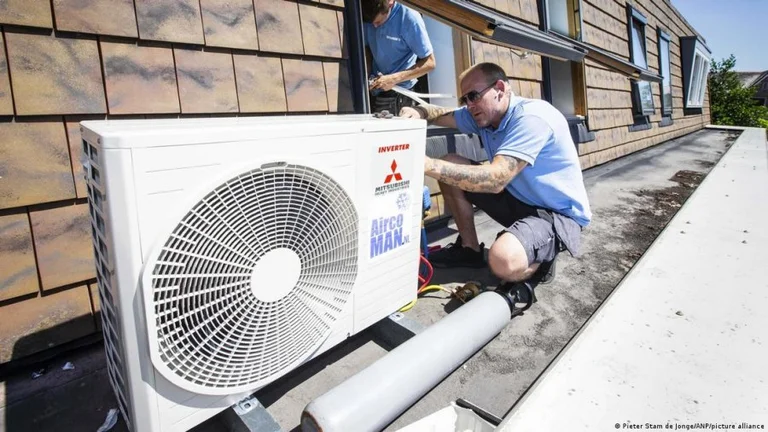
Furthermore, buildings must have improved sun protection systems, such as roles, tents, and roofing sites. Modern heat pumps already standard in some countries, while still relatively expensive in others, represent an efficient way of energy and home heating emissions. Modern versions may also include cooling function, which is useful during the summer.
Apart from measures in buildings, green spaces and water elements can also contribute to urban cooling and reducing the effect of the urban heat island; many cities are relying on common solutions such as spraying fog systems and public cooling centres. In cities like Paris, Stockholm, and Copenhagen, climateization is now centralized in a way similar to central heating through central cooling: cold water is transported through underground pipes in some buildings to cool them. /Periscope/