3 minutes ago
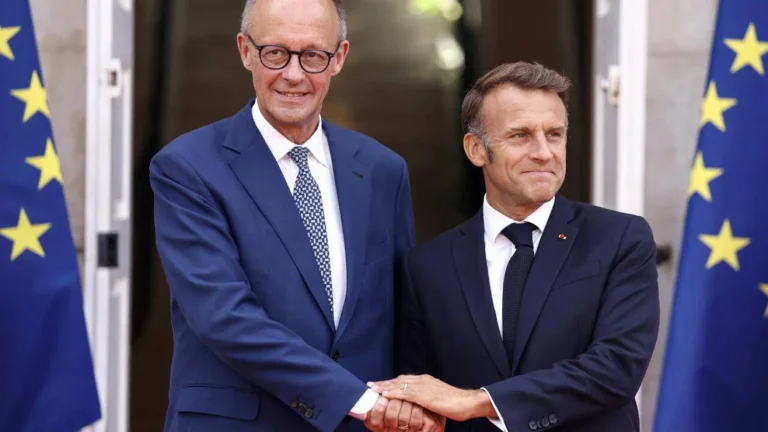
Germany and France with “non-paper” for the Western Balkans before Montenegro summit
Periskopi(21 days ago)
(21 days ago)Berlin and Paris, in an informal document, have called on the European Commission to draft proposals to facilitate the gradual integration of EU candidate countries.
This initiative envisions that countries approaching membership can benefit early from some domestic market benefits, depending on their progress in negotiations.
It is also suggested that these countries have closer ties with EU institutions during the daily decision-making process, for example by obtaining observer status at several meetings of European institutions, Telegrafi broadcast.
However, this involvement would only take place under clear conditions that preserve the independence and autonomy of the European Union's decision-making.
The enlargement policy needs a new impetus. The future tensions the European Union will host with the Western Balkans on June 5th and with Moldova on June 22nd are an opportunity not to be lost. The common goal is to complete the European Union as a truly European union. To turn this goal into reality and give a new dynamic process, additional incentives must be created within gradual integration, which must be based on merit. Likewise, it is necessary to simplify the current enlargement process so that it can become more efficient and enable faster and deeper integration into the EU, always in line with the Copenhagen criteria”, the document says.
Stressed that the goal of full EU membership remains unchanged and that gradual integration does not intend to replace full membership or extend the path towards it, reports rtcg.
Rather, the goal is to create incentives that accelerate progress on this road. In this way, gradual integration will contribute to a successful expansion of the European Union and to strengthening it as a whole”, it is further said.
The document also proposes simplifying the methodology of negotiations through a few procedural steps. The emphasis is on the job of candidate countries, the European Commission and the EU Council focusing more on the content and essence of reforms, and less on procedures.
It also points out that through structured and gradual integration, it is aimed at providing candidate countries with additional impetus to undertake and accelerate needed reforms. It is also proposed that, if certain conditions are met, two times a year will hold joint meetings between the European Commission, members of the European Parliament and representatives of Western Balkan countries and Moldova.
Also, it is envisioned that joint parliamentary committees meet more frequently in order to strengthen political and institutional co-operation.
Another element of the proposal is that representatives of candidate countries can participate in certain points of the agenda at informal meetings of the European Council and the EU Council, but only as observers and without a right to vote.
At the same time, candidate countries are offered full participation in the EU's single market on the basis of an expanded European Economic Zone model (EEA+), which means deeper economic integration without full EU membership.
This means that these countries would have, in a similar way, European Economic Zone states (Icelandic, Liechtenstein and Norway), access to the common European market.
However, this approach would be conditional on meeting some important obligations: candidate countries would have to adopt and implement EU legislation -- that is, “acquis communautaire” -- in the first five negotiating chapters.
It also requires that the relevant negotiating chapters be provisionally closed, as evidence that reforms are actually implemented and EU standards are achieved in those areas.