15 minutes ago
Xi warns about Taiwan, as Trump aims for trade progress during summit in Beijing
Periskopi(2 months ago)
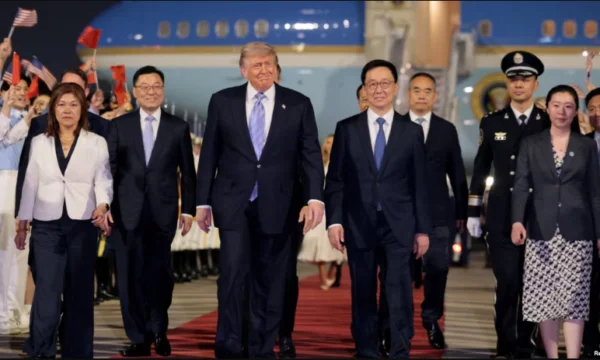
(2 months ago)US President Donald Trump, and Chinese leader Xi Jinping concluded on May 14th in Beijing high-level talks lasting more than two hours, with both sides expressing optimism for the stabilisation of reports, even though major disputes over Taiwan, trade and the war in Iran dominated the summit.
The bilateral meeting presents the first face-to-face talks between Trump and Xia since their meeting in South Korea in October 2025. Trump is expected to attend a state banquet organised for his honour in the evening, following a cultural visit to the Temple of Paradise in Beijing.
Xi used the summit's opening to call for co-operation between the two biggest economies in the world, saying that China and the United States should be <x0-partners and not opponents”, despite growing strategic rivalry and global instability. Trump called Xian <x2mic” and said that “raports between China and the US would be better than ever before”.
However, although both leaders highlighted their personal relationship and the need for closer co-operation, the talks highlighted how fragile reports between the two countries remain, as leaders face trade, technology, Taiwan and the global aftermath of the war in Iran.
“Trumpi requires stability ahead of the mesmandat elections and at the time when the US remains involved in the conflict with Iran”, Free Europe Radio Daniel Russell, associate at the Institute for Social Policy in Asia, simultaneously former US State Assistant for East Asia and Pacific Affairs. “Pejkin wants a stable external environment while facing domestic economic pressures”.
Both Washington and Beijing seem more focused on controlling tensions and preventing further escalation than on achieving any major diplomatic progress.
Despite any statements, the long-term trajectory remains strategic rivalry”, Russell said. “Most of the results will be limited, transactional and potentially returnable”.
Taiwan Warnings and Trade Signals
Taiwan emerged as one of the key points during the talks. According to a report published by Chinese state news agency Xinhua, Xi warned Trump that the wrong management of this issue could push the two countries towards a direct confrontation.
If managed properly, the two countries can maintain stability”, Xi said, according to the Chinese announcement of the talks.
If mismanaged, the two countries will crash or even get into conflict, putting the entire US-Kine relationship into an extremely dangerous” situation.
China considers the island self-government part of its territory and has pledged to bring it under control, even by force. Chinese officials have pressured Washington to reduce military and political support for Taipei, especially in the sale of American weapons to the island.
The Trump administration reportedly postponed the announcement to Congress of a planned $13 billion arms package for Taiwan before the summit in order to avoid rising tensions with Beijing. During a telephone conversation in February, Xi had asked Trump to address this matter with “extreme caution”.
“Xi Jinping wants some concessions or guarantees regarding Taiwan and what Trumpi would do if China increased pressure on the island”, Yvonne Chiu, associate at the American Enterprise Institute, told Radio Free Europe. “It also relates to a broader goal of Beijing, which is the U.S. opposition to the Indo-Peaceroom region”.
Trade and economic tensions also took an important place in the talks, though the first signals indicated limited progress.
China has approved export licenses for several hundred American massacres, enabling them to resume meat shipments to China, according to data published by China's Customs General Administration. Licenses had expired in March 2025, after President Trump imposed a tariff run against Chinese goods.
The move represents a modest gesture of goodwill ahead of broader tariff negotiations, export controls and supply chains.
The Trump has publicly highlighted trade and investments before the summit, as Beijing is seeking relief from American controls on export of advanced technology and guarantees against new tariffs.
The American president during his meeting with Xina was accompanied by several renowned business executives, including Tesla's chief executive, Elon Musk, NV chief executive IDIA, Jensen Huang, and CEO of Apple, Tim Cook.
Xi also told the US business delegation that China “will open more” for the world, even though it did not offer any formal commitments.
China's “Files on the outside world will be opened more and more”, Xi was quoted as saying during the summit, according to Chinese state media. The U.S. “companies will have even greater prospects in China”.
Rare land minerals remain a key point of influence for China in trade negotiations.
During their meeting in South Korea last year, Trump and Xi agreed to reduce tensions over a rapidly escalating trade dispute, as Beijing threatened widespread restrictions on exports of rare land minerals in response to high American tariffs. China postponed these measures for a year, and the duration of this remains one of the main issues during the summit.
A group of 17 minerals, essential to products ranging from smart phones to fighter planes, has become an important negotiating instrument for China, as competition for advanced technologies and global supply chains is intensifying. China dominates much of the world's extraction and processing capacity of these rare materials.
Iran War Increases Pressure on Talks
The Iran war and disruptions caused in shipping through the Strait of Hormuz have overshadowed meetings in Beijing.
The Trump is expected to pressure Xin to use its close ties with Tehran to encourage Iran to accept a broader peace agreement and ease restrictions affecting maritime traffic through the Strait of Hormuz, which is a strategic point through which about a fifth of global oil passes.
Before leaving Washington, however, Trump downplayed suggestions that the United States needed Beijing's help in resolving the conflict.
“ “
US Secretary of State Marco Rubio told Fox News on the trip to China that the US has presented Beijing with the argument why it should take on a more <x0active “” in resolving the Iran conflict.
We've presented the argument to the Chinese, and I hope it's convincing and they'll have a chance to do something about it at the United Nations later this week”, Rubio said.
China's reports with Tehran give Xia potential to launch emissions at a moment when power cuts and fuel price hikes are burdening the global economy and increasing political pressure on the White House.
Beijing has maintained close economic ties with Iran throughout the conflict and remains one of the largest Iranian oil buyers. A signal that Beijing and Washington were seeking common ground, senior American and Chinese officials said no country should be allowed to deploy <x0th>tariff” for navigation through the Hormuz Strait, according to a statement issued by the UN before Trump left for the summit in Beijing.
Tehran has demanded that it have the right to impose tariffs for maritime traffic as a precondition for ending the war. The United States has imposed a naval blockade on Iran, while Trump has left open the possibility of setting tariffs for maritime traffic or co-operation with Iran for collecting tariffs.
There will be many conversations behind the scenes for Iran”, Chiu said. But I don't expect these efforts to be public, in part because this brings danger to China's reputation if these efforts fail”. / REL