12 minutes ago
Germany's 6-point proposal: EU Enlargement With Western Balkan Countries
Periskopi(2 months ago)
(2 months ago)Germany proposes a six-point package for European Union enlargement and the way decisions are made within the union.
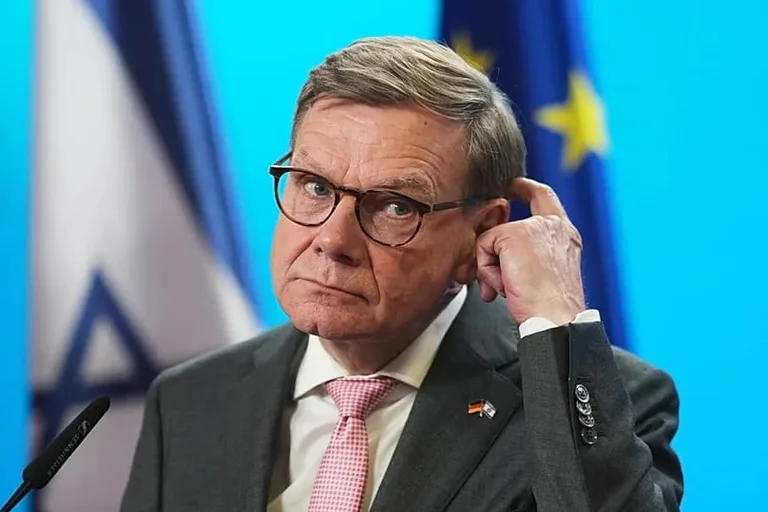
German diplomacy chief Johann Wadefhul spoke during the X Conference III of Adenauer, “The bold production of Europe's future”, regarding the admission of new members that should be a gradual process in the future.
I'd like to make it very clear here that enlargement is part of our credibility. People in the Western Balkans, for example, were given Europe's perspective decades ago. We owe them results. To that end, we finally have to make concrete progress together with countries that are willing to reform. And it is clear that an expansion to include Iceland and Norway would also be more than welcome”, said German Foreign Minister, writes TopChannel.
At the same time, he also discussed how some important decisions should be made within the European Union.
We want to get more to Brussels through expanded co-operation. This means that in the policy areas in which common progress with all 27 member states is not predictable, we will lead the way with a smaller set of states”, he added.
Part of the German foreign minister's speech
We are reliable and stable. But at the same time, we must become more efficient, flexible, and innovative. To do that, the European Union must adapt to reality. It has to change and it has to change radically.
Like Adenauer and Schumann, they sought and found answers to a new world order with conviction and courage. We want to build on that courage. Because we Europeans are in our hands.
I'd like to mention six specific points!
First, we want to achieve more in Brussels through “expanded co-operation”. This means that in the policy areas in which common progress with all 27 member states is not predictable, we will lead the way with a smaller group of states.
And implement the necessary measures in this small group in a European “ ” way. Without the need for all to participate immediately.
It has been shown that other countries often follow suit later. That would be the perfect occasion.
We want to expand this principle even in the Common Foreign and Security Policy. In fact, unity is still required for enhanced co-operation.
My proposal means that states that don't want to or may not be left out at the moment, but do not prevent those who want to lead the road.
A group of states must also be included in the KZGP can move forward more easily.
Of course, we will always try to act on the consensus of 27 ʹ because that is exactly one of the EU's strengths. However, it is important that we as the EU, even if not the 27 member states, agree 100 percent.
The blockades, especially those of recent months and years, with which the EU is known.
We could see it until last week with the release of financial resources: the deviation of some or even individuals is enough to block everyone's actions.
I say it very clearly: When it comes to security issues, the principle of unanimity can put us at risk of existence. Because it's a matter of life and death! We see this every day in Ukraine.
In the Joint Foreign and Security Policy, Europe regularly fails because of a time-launched architecture. Now conservatives are often wrongly accused of wanting to preserve old things in a challenging way. This is not the case with my foreign policy.
The conservative foreign policy is oriented towards the country's interests. It changes what needs to be changed to a changing world to protect civilization's achievements.
That brings me to my second point: voting by qualified majority.
Germany wants an EU that changes and moves. Brussels must increase its speed to this. Especially in common foreign and security policy.
The most important lesson in this is the fastest qualified decision-making. We will not give up seeking consensus as a result, but we will make it much easier by removing the possibility of deadlock. Our goal remains the greatest possible unity of twenty-seven. But the way to get there does not lead through the lowest common denominator. It leads through the courage to get started.
“The Q”, as the High Representative recently described, has the EU's potential to make it capable of action where it currently needs to stay at a stop.
By the way, we are not alone in the desire for change: under our leadership, twelve member states have already joined together to bring about this change.
And we will address all member states for that purpose, including those that are still skeptical.
Let me be very clear: it's up to us decisionmakers in the European Union to use this means of quick decision making. The legal framework is in effect, contracts already predict that. In the defence sector, we were able to show that this could be done with the established Eternal Co-operation, P ESCO. At that time, a group of people created a successful instrument of joint action.
We always have to ask ourselves: What is the real purpose of the principle of unanimity? It was once introduced to guarantee the sovereignty of the national state at its most sensitive core, foreign and defence policy. But what remains of this national sovereignty if its exercise can be blocked by a single member state? Nothing. It's not going anywhere.
It should also be a question of changing attitude: if I, as a member state, do not agree with a proposal, the answer to a 27-member community cannot be then I will block it.
Rather, it should be an issue of active finding the best tolerant solution in such a case.
Third point: a clear foreign policy profile for the EU. We need a quick decision-making capacity with concrete results in Europe.
Currently, the president of the Commission, the president of the European Council, the High Representative and the large number of responsible commissioners are doing an excellent job.
At the same time, foreign policy and security responsibilities in Brussels must be clearly adjusted and united.
To that end, the European Foreign Action Service must be closely linked to the Commission. After all, there are the sources that form foreign policy today, such as trade, development, neighbourhood, energy, climate and enforcement of sanctions. Network security needs online action.
Are we in the European Union, which should be affirmed in the world in a completely different way from 10, 15 or 20 years ago, in the right position for this? Who really believes that?
Our goal is to make Europe's external action more consistent, effective and strategic.
In the EU, it is not a static structure: Let's look at the path we've been following in recent years from the diplomatic struggle for Strategic Busule as a joint analysis of threats to concrete co-ordination of European arms shipments to Ukraine and the financing of arms projects by member states. Many things have happened in the EU. It has already demonstrated several times the innovative ability that many deny. It all happened in a few years. Because it was necessary.
Fourth: Key words rule of law.
Despite all further development, we must stop and see ourselves, the constitution of our Union. For members who knowingly violate Union values. Because rule of law is one of the highest values we Europeans have. It also shapes our image in the world.
So we want to strengthen the rule of law in concrete terms under negotiations on the future multi-year financial framework, but also strengthening Article 7 EUV. We are committed to further develop the conditioning mechanism. EU funds should not go for those who violate our common values.
Fifth, the ability to act means institutions remain able to function, even if the Union becomes larger. And it has to get bigger.
However, a Union of 33, 34 or 35 member states cannot continue to act on the same approach that has been created for a much smaller group of members.
Should we have 35 commissioners in the future? I advise against that.
The treaties already envision a better solution -- a smaller Commission that includes only two-thirds of the number of member states.
And the same applies to the European Parliament. We can already see at the national level the challenges a major parliament brings.
Therefore, we want to adapt the composition of the European Parliament and the number of commissioners to the demands of an enlarged Union. That requires decisions by the European Council. This is also an issue we need to address.
Because we want to see an EU. But it also has to function in an expanded way. And I understand the disappointment that long accession procedures bring. But first, we want to integrate new members into a strong alliance, and secondly, we also need a sustainable change in membership candidates. Enlargement is a transformation process.
And my sixth point: the enlargement process.
I propose that the path towards the accession of new members should be designed as a gradual process in the future.
The growth of gradual integration is imaginable, through preliminary stages towards full membership. Such a mechanism would also enable reducing the reserves of some members regarding full early membership. In the future, membership treaties can also contain clauses for funding conditions and further strengthen the principle of genuine co-operation.
However, I would like to make it very clear here that enlargement is part of our credibility. People in the Western Balkans, for example, were given Europe's perspective decades ago. We owe them results. To that end, we finally have to make concrete progress together with countries that are willing to reform. And it is clear that an expansion to include Iceland and Norway would also be quite welcome.
With these six proposals, I want to try to make our European Union more capable of acting. /tch