7 hours ago
Chocolate for the President's direct choice: Do not resolve the current crisis

Periskopi(4 months ago)
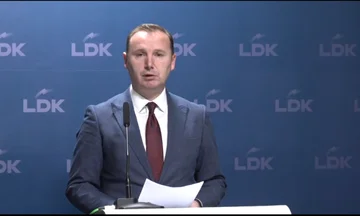
(4 months ago)Eugen Cakoli from KDI has estimated that the idea of direct election of the president can be discussed under constitutional reform, but according to him does not solve the current institutional situation in the country. He stresses that changing the Constitution requires a majority named for at least 80 votes in the Assembly, including [...]
Eugen Cakoli from KDI has estimated that the idea of direct election of the president can be discussed under constitutional reform, but according to him does not solve the current institutional situation in the country.
He emphasises that changing the Constitution requires a majority named for at least 80 votes in the Assembly, including the votes of MPs from non-most communities.
“Ide for the direct election of the president may be part of a serious debate on constitutional reform. However, both the procedure and the contents of constitutional amendments handed down by President Osmani show that it does not address the current situation and the potential crisis from the president's non-election from the Parliament”.
“First, to change the Constitution requires at least 80 votes in the Kosovo Assembly, of which at least 14 must be the votes of MPs from non-most communities. This is a very high threshold and requires broad political agreement between the majority and communities. In current parliamentary circumstances, such a majority is extremely difficult to achieve”, he said.
Cakolli also argues that even if constitutional amendments were adopted, they could not be implemented immediately, as their own text envisions the presidential election declared six months before the end of the president's regular mandate, which at this moment would practically postpone their implementation until 2031.
“S second, even if these amendments are adopted, their own text envisions that presidential elections are declared no later than six months before the end of the president's regular mandate. This rule is meant for a normal institutional situation, when the electoral calendar is predictable and the presidential mandate is approaching its end. Under current circumstances this formula cannot be implemented, so even if the amendment were to go into effect now, it would practically be implemented by 2031”.
Otherwise, the country would face a deliberate constitutional vacuum, because the six-month rule cannot be respected and a clear transitional mechanism could not be introduced to address this situation, while after the end of the term for holding elections, there would be no task manager”.
The third “, transition to a new model of election of the president, also requires the adoption of an entire legal and underground framework regulating the election process, election management, running and many other aspects. The mapping and adoption of these acts in such a short time would be virtually impossible. Moreover, the Constitutional Court itself highlighted in the recent ruling when many bills had been annulled that the procedures of “super”-proceeded to avoid regular legislative standards violate judicial security”, he wrote.
He added that under these circumstances, the president's proposal for direct elections does not provide an immediate solution to the current institutional situation.
To avoid uncertainty and institutional vacuum, Cakoli said any constitutional change “requires time, broad political consensus and a clear judicial transition”.