14 minutes ago
While new electricity bills are expected, Kosovo pays for Serbian blockade
Periskopi(5 months ago)
(5 months ago)When Kosovo pays up to 800 euros to transport a megawatts ( MWh) energy, citizens don't pay just for the current that goes to the plug. They also pay for the consequences of a political blockade, tensions with neighbours, and the weaknesses of an energy system that cannot cover the country's basic needs. That [...]
They also pay for the consequences of a political blockade, tensions with neighbours, and the weaknesses of an energy system that cannot cover the country's basic needs.
Since 2020, when Serbia blocked its transmission line with Kosovo, shorter and cheaper routes for importing energy were limited, forcing the country to use more costly options.
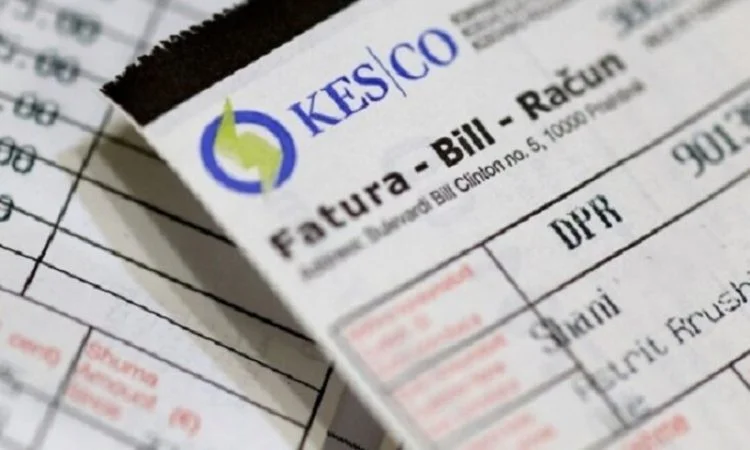
As a result, additional costs were reflected directly in energy bills for citizens and businesses.
With the proclamation of new annual tariffs expected to take place by the end of next month, uncertainty continues to remain high, as the possibility of another electricity price increase is not ruled out.
Hope for change exists, as Serbia has been forced to allow energy trade with Kosovo by 1 July, but it remains unclear whether this decision will be implemented in practice.
Why does Kosovo import energy?
The Kosovo Energy Corporation (KEK) is not enough to cope with consumers' demand for electricity, especially during the winter.
Coal thermos are old and often stop working because of decay and maintenance, while production from renewable resources remains small.
From January to November of last year alone, Kosovo spent about 250m euros on external energy purchases.
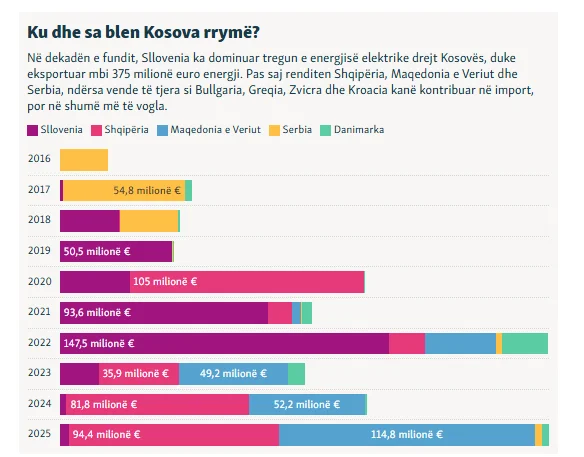
Transport reached astronomical levels of up to 800 euros per MWh per specified day during the past year, according to the Ministry of Economy.
Authorities consider blocking the transmission line from Serbia as the main factor increasing import and transport costs.
For a country of about 1.5 million people and a developing economy, these costs constitute a considerable financial burden, as increased energy spending affects not only the state budget but also the competitiveness of businesses and the rising prices for consumers.
Serbia's “as a consequence of the blockade, up to 600MW transmission capacity on the Kosovo-Serbia border is not used for commercial exchanges ) what is constantly putting pressure on other cross-border lines”, they say from the Kosovo Economy Ministry for Radio Free Europe.
Origin of the blockade
The problem began in December 2020, when Kosovo Electricity Market and Broadcasting System Operator (KOSTT) began operating independently.
Kosovo came out of the regulatory bloc with Serbia, Montenegro and Northern Macedonia and joined Albania, activating the 400kV Kosovo-Albania inter-KV, known as the “Auttostrada Kosovo-Albania”.
Since then, Serbia blocked power transmission lines in Kosovo, and the country was forced to trade across borders with Albania, northern Macedonia and Montenegro.
According to the Economy Ministry, this <x0-political deviation” has cost Kosovo millions of euros a year specifically about 150 million in 2024 alone.
Serbia does not recognise Kosovo's independence and rejects its full participation in international mechanisms, including the energy sector.
Within the dialogue on normalising relations, the two countries reached Energy Agreements in 2013 and 2015, while in June 2022 also approved the Guide for Their Implementation. But like many others, they were never fully applied.
COMM STT confirms Serbia's Elektro-economics (EMS) has not signed any capacity trade agreements with Kosovo.
“Since that period [2020] until now there has been no and continues to have no commercial electricity trade on the border with Serbia”, COST response reported.
REL urged position by Serbian operator, EMS, on this issue, received no answer.
Effects on the Energy Market
Lack of capacity at Kosovo- border Serbia has limited competitiveness, reduced alternative routes for import, and raised demand and prices at other borders.
The economy ministry says it is a factor that has partially affected the increase in tariffs for consumers, which last year were expensive for about 16%.
Last month, the three energy operators in Kosovo demanded increased electricity tariffs for this year as well.
Energy affairs expert Negotiate Zariqi explains:
It's like with land roads when the shortest road is blocked, longer roads should be used that automatically increase transport costs. Traders can manipulate prices for MWh”.
However, neither KOSTT nor the Power Regulatory Office (ZRRE) have published figures for the total value paid for these transmission lines over the past five years.
Efforts to Choose
COMM STT has raised this problem at the regional and European level, opening the case in the Energy Community.
Last December, Kosovo took the lead in this international organisation, whose goal is to support its member states' path towards EU membership through implementation of EU energy laws.
The Energy Community Ministerial Council decided at the time Serbia should allow energy trade with Kosovo at its most until July 1st, 2026.
This impasse, which has been continuing for more than five years, has caused negative direct consequences in the functioning of Kosovo's energy system, increasing the load of the network and transmission costs through alternative lines with Montenegro, Northern Macedonia and the Republic of Albania”, Energy Minister Artane Rizvanolli said last December.
Her ministry vows to monitor closely the implementation of this decision.
Despite the effort, the medium received no response from the Serbian operator, EMS, or the Energy Community Ministerial Council on measures to be taken if the lines do not open on the deadline.
If the blockade continues, Kosovo will remain obliged to import energy through longer and more expensive roads, further increasing costs for citizens and the economy.
In the long run, this situation can affect the country's energy security and its ability to attract investment.