11 minutes ago
In Serbia, 20 border points still blocked
Periskopi(6 months ago)
(6 months ago)The public company “Serbia Streets” announced on January 28th that, according to information from Serbia's Border Police Directorate, the entrances and exits from this state for heavy vehicles are blocked at 20 border points. According to the announcement, the border checkpoints are blocked with Croatia -- Batrovci, Shid, Bogojeevo, Backa Pallanka, Bezdan, Nashin; with Hungary [...]
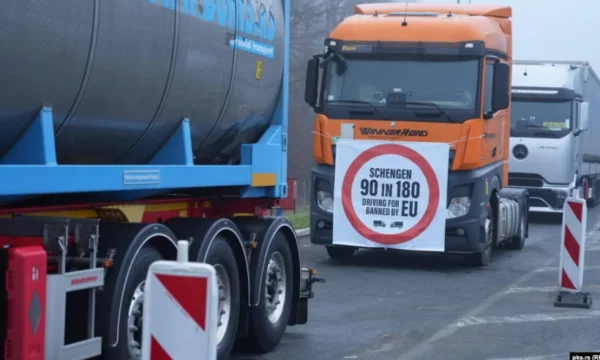
The public company “Serbia Streets” announced on January 28th that, according to information from Serbia's Border Police Directorate, the entrances and exits from this state for heavy vehicles are blocked at 20 border points.
According to the announcement, the border points are blocked with Croatia -- Batrovci, Sed, Bogojeevo, Backa Pallanka, Bezdan, Nestin; with Hungary ão Horgos, Kelebia, Backi Bregg; with Romania . Gjerdap, Srpska Crnja, Vatin, Kalugerovo; with Bulgaria Vreka Quka, Gradina, Stazirov, Ribarci, Mokranje; as well as with northern Macedonia Presevo and Prochor.
Border points with European Union countries (BE) were blocked on January 26th by truck drivers from Serbia, Bosnia and Herzegovina, Montenegro and Northern Macedonia, in protest of tough entry procedures in the Schengen Zone, which, according to them, have cut off their allowed time to stay in EU countries.
The Chambers of Western Balkans' Six Trade Investment Forum, which includes the economic rooms of Albania, Bosnia and Herzegovina, Kosovo, northern Macedonia, Montenegro and Serbia, sent a joint call on January 26th to the European Commission aimed at finding an urgent solution to drivers' difficulties.
This call said that about 60 per cent of the Western Balkan countries' foreign trade develops with the EU and that the problems of drivers at the border can turn into a serious systematic, economic and political problem for the region.
On the first day of the blockade, on January 26th, European Commission spokesman Markus Lamert declared that European institutions are working on a solution that would enable some professionals, including truck drivers, to stay in the Schengen Zone longer than the actual rules determine.
The Chambers of Commerce of Serbia and Bosnia and Herzegovina warned of multimillion losses due to blockades and of risking the stability of the supply chain.
The impact of blockades on Kosovo market
As importer of many goods through Serbia and Northern Macedonia, Kosovo is expected to feel the consequences of protests in the flow of transport vehicles.
The chairman of the Kosovo Chamber of Economics (OEK), Lulzim Rafuna, at the same time head of the Western Balkans' Economic Odays, has declared that Kosovo does not participate in protest, as the country does not yet have logistical companies that conduct regular transport with EU countries.
But he warned that its effects would also be felt in Kosovo.
Because of the border blockade, Kosovo will neither be able to export nor import goods”, Rafuna told Radio Free Europe.
The Chamber of Commerce and Industry in Kosovo sent a letter to European Union Chief Ursula von der Leyen on 27 January, urging that a solution be found so that the blockades will not continue longer and the regular circulation of goods will be allowed to improve the region's economic stability.
According to Kosovo Customs data last year, the country has imported products worth over 7 billion euros in total, or about 20m euros a day, a large amount through Serbia and Northern Macedonia.
The value of exports, meanwhile, was around 942m euros last year, or about 2.6m euros a day. / REL/