3 hours ago
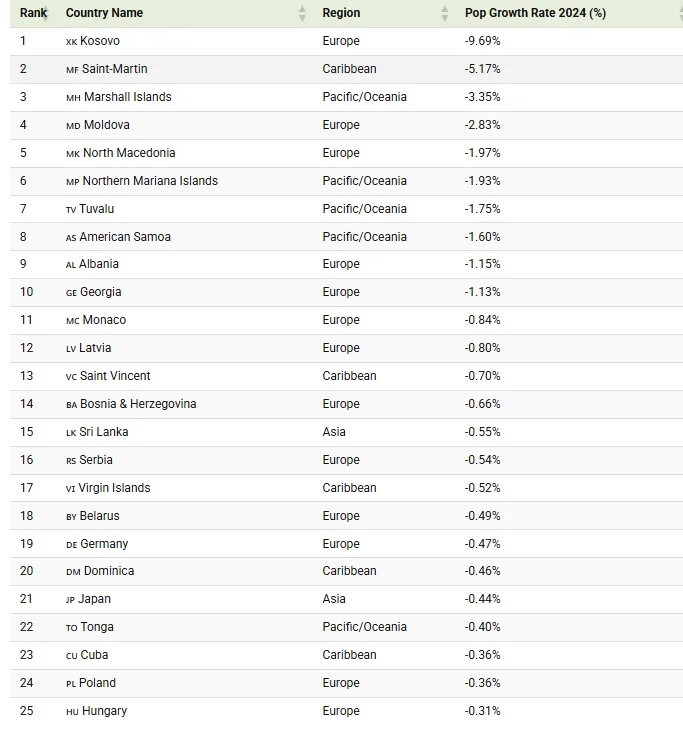
World's first Kosovo and Albania's 2024 population drop

Periskopi(9 months ago)
(9 months ago)Red alert for the population in Kosovo and Albania. The two Albanian nations are facing wave of evacuations, which are reducing local populations year after year. Population growth has long been seen as a sign of prosperity, but the world is facing a new trend: demographic decline. According to World Bank data, [...]
Red alert for the population in Kosovo and Albania. The two Albanian nations are facing wave of evacuations, which are reducing local populations year after year.
Population growth has long been seen as a sign of prosperity, but the world is facing a new trend: demographic decline. According to World Bank data, processed by Visual Capitalist, 42 countries and territories are already in contractions, some more rapidly than others.
The data is based on measuring annual population growth rates for 2024. It should be noted that the world's population as a whole continues to grow by an average of 1%.
Eastern Europe Leads to Population Fall
A significant portion of the shrinking countries are located in Eastern Europe, where Kosovo, Moldova and Northern Macedonia mark the most pronounced declines. One major reason for this trend is immigration, leaving the country of origin to move to another. Eastern Europe has experienced high levels of migration in recent decades due to the wage gap with Western Europe, as well as EU integration, which has created legitimate ways for the movement of the workforce.
Big Economics Join the List
Another interesting trend is the inclusion of major economies such as Germany, Japan, China and Italy. While their declines are more moderate, the large size of these countries means that this demographic change can have widespread global consequences.
Governments are taking steps to promote fertility rates, but it is still early to assess their efficiency.
In Japan, for example, the government has established the Agency for Children and Families, a new administrative body that oversees issues such as child welfare and nest access. Meanwhile, a national subsidy of 3,600 juans (about $500, U.S.) has been introduced in China annually for every child under the age of three.