2 hours ago
The Times: Boom and impact on Albanian Renaissance Residents Against Strategic Investors
Periskopi(9 months ago)
(9 months ago)The developers are rushing to build luxury resorts. But locals fear their way of life is at stake and anger is erupting against “strong hand tactics” The retired policeman shook the bicep and smiled. “You see those stones?
The retired policeman shook the bicep and smiled.
“see those stones? This is what we'll do if they come back. ”
Judah didn't seem to be kidding. A few months ago he helped mix an escaper sent to Trajas a village in southern Albania on behalf of the country's richest man to tear down the land we were standing on.
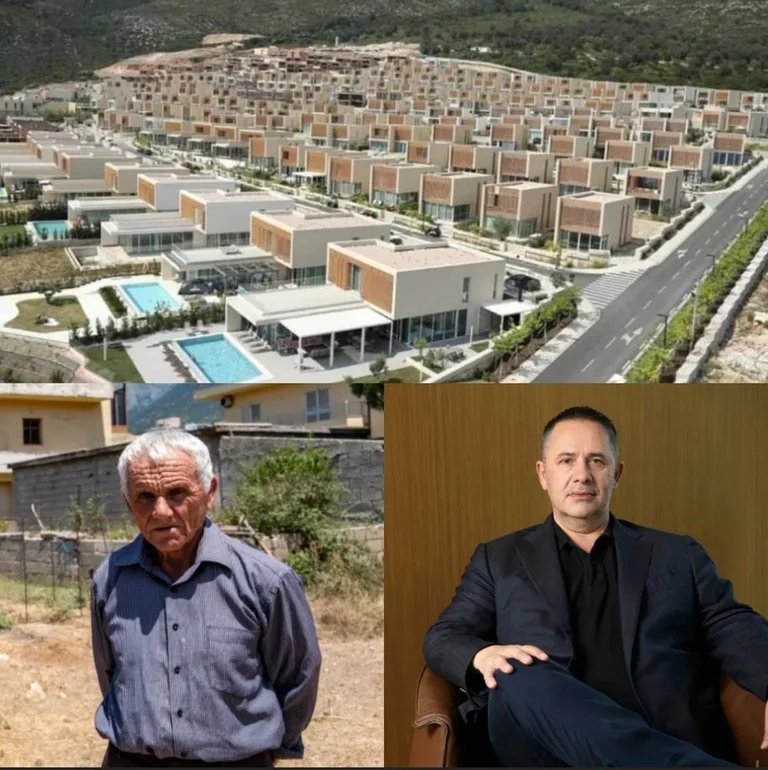
Casterilla's driver had come to start work on a tube that would bring water from the local source to Green Coast, a multibillion-euro resort complex being built by Samir Mane, a domestic equipment tank, 15 miles along the Adriatic coast.
Protesters trying to expel the fugitive to Trajasa
The source has fed the village from the time of Illyrians, neighbors of ancient Greeks. He supplies a clean crystal pool of the village and feeds wildflowers, wheat fields, and dense green grass feed cows and sheep.
Works for Green Coast started four years ago, and two of the four planned sections are now open. When completed, it will cover 90 hectares and contain luxury villas and seven five-star hotels, as well as restaurants, private beaches, police stations and ambulances, and a helipad. It is Albania's largest tourist development since the country opened for foreigners after the fall of the communist dictatorship in 1990.
His obstacle is a revolt. In March, Juveli and several hundred other men and women from Trajagi surrounded the escavetor, fighting about 50 policemen until they withdrew to the hills. No earth was touched.
The village is one of over 30 communities that have protested a network of pipelines destined to serve Green Coast and other nearby resorts that will jointly occupy an area half the size of Great London.
Villagers fear that the pipes will leave enough water to live on earth. After a long history of confronting the invaders, including as Partisans who fought alongside British officers of connection against Germans during World War II, they are not easily afraid.
Remember my word, there will be blood if this thing continues...” said Mr. Ramohitoj, the head of the village, who is the mason. “Ende has room in the village war memorial. ”
For much of the second half of the 20th century, Albania was a poor communist state, isolated from things such as holiday resorts by dictator Enver Hoxha. With nuclear bunkers and prisons in the mountains for dissidents, the country was North Korea and Europe. Now the TikTok users and the Instagram call it “Maldives of Europe” or Europe's “Thailand”.
• How this surprise country became Europe's most luxurious stay
Travel agents see a new Mediterranean gold mine, with white beaches and blue water as attractive as in Greece, Italy or Croatia. Albania now ranks as the fastest growing tourist destination in Europe, with 11.7 million government-registered visitors last year, although the figure may have been absorbed by the entrances of Turkish oil and diaspora Albanian workers counted each time they enter.
The city of Vlora has changed quickly. There is no doubt, however, about the large number of hotels and tourist developments that are emerging along the Adriatic and Joni coast at a rapid pace, especially between the southern city of Vlora and the town of Saranda, an extension promoted as the Albanian Revolution. In the 2000s, Saranda had two hotels: it now has 600.
One in five out of three million Albanians works in tourism, while southern Filipinos and Asians are coming more and more as cleaners and waiters. This summer Ryanair and other airlines have operated 44 weekly flights from Britain to Tirana, the capital. The government is building an airport in Vlora, with plans for direct flights from countries as far as the US.
Donald Trump's family is also interested in part of the action. The American president's daughter, Ivanka, and her husband, Jared Kouchner, have announced plans to build a $1.4 billion hotel in Saban, a former uninhabited military island covered in bunkers in front of Vlora.
Many of these projects are questionable. Activists accuse the government of Edi Rama, the multicolored prime minister, of providing low-priced land prices for preferred investors despite environmental impact.
The critics focus particularly on a strategy investment law introduced by Rama in 2015, two years after he took office, allowing investors to take land from the government for only 1 euros, with the state then obliged by law to provide water access, energy networks and roads. (The government has built a road tunnel through the mountain towards Green Coast.) Meanwhile, the law provides investors with protection from land claims.
Up and down the coast, people say large sums have been offered by developers for their homes, feeling they have no choice but to accept. In a 2021 report, the Covic Resistance group argued that the law serves “as a form of pressure on owners [of private property] who are forced to accept an agreement with investors, because otherwise the state will intervene to penetrate their property at a value that may be lower than market value. ”
There are thousands of controversial property cases in Albania, dating back to the collectiveisation of land under the communist regime.
Mane, a respected figure that Forbes magazine listed this year with a fortune of $1.5 billion, insists that the entire earth for Green Coast purchased for an unpublished amount thought to have been markedly more than $1.C. has been earned fairly.
Green Coast has a statue of Julius Caesar, who landed south of Albania on the road to Macedonia.
Balfin Group, his real estate company, also denies allegations that it has not consulted or compensated residents of a poor neighbourhood in Vlora that collapsed for a navy.
But I heard another story when I visited him and met a man who said he had lived for 35 years with his wife in a buffalo near what was now the shipyard. The man, very concerned about naming, said that the main entrance to his house had been destroyed seven months earlier to pave the way for the Navy.
You have laws in Britain. Here is only the law of the fittest,”, he said, claiming he was not warned of planned or compensated works. Balfin Group did not respond to a request for comment on the case.
Albania has long been identified as a money laundering hearth, and tourism boom has added, investigators say. “Hotels and restaurants have always had close ties to the criminal world and have been used for money laundering activities,” reported last month the Global Initiative Alliance Translational Crime reported. However, the industry's growing profitability has attracted major investments from illegal sources. ”
Albanian criminal mafia earns money from drug and human trafficking, as well as smuggling of migrants and weapons. Many construction companies are suspected of being facades. There is no evidence that Mane, who has gone through the sale of refrigerators and commercial-owned washing plants, a bank and many real estate enterprises in America and Canada, is involved in criminality, however.
In Albania it is difficult to know exactly who is with whom. Local investigative journalists describe the country's policy as a blood sport played among elite families, on allegations of corruption as the chosen weapon.
Tirana's former mayor, Erion Veliaj, considered a Rama protestor, is in prison facing charges of channeling public contracts to friends, as well as spending hundreds of thousands of euros on jewelry and clothes for his wife. Veliaj says his prosecutors have “built the issue on ... groundless claims to design a trumpet in the style of Wild West Sheriff. ”
Saranda prosecutor was suspended in January on charges of bribery, which he denies. His predecessor is in prison for the same reason, after being released in 2023 and imprisoned again in June.
A clear loser from the tourist boom is the environment. Nica, a professional biologist, said that 70 percent of strategic investments in tourism are in legally protected natural areas, which the government can provide without having to compensate locals. Green Coast, located on the edge of Vjo National Park, will draw water from a river there that is home to 13 globally threatened species, including frogs, fish, and birds.
Green Coast Company insists there are no water problems and that there are enough in the area for both locals and swimming pools and resort lawns. Villagers claim that old measurements are being used for the quantity of flowing water, which, according to them, are decreasing because of climate change.
Last month, Albanian singer Ledina Celo shared with a million followers in Instagram a video that seemed to show a tap that no longer drew water at her villa in the resort.
Myzafer Juveli is concerned about losing his home and living as a shepherd
Myzafer Juveli, 80, a shepherd from Trajas with a wrinkled face and a thumb finger torn from bed (“an old damage”), said he had been forced to reduce the number of sheep from 1,000 because there is less water than before. He lives right where the tube is planned.
“They want to tear down my house,” he said.
Ramohitoj, the mayor, is also concerned. If the tube is put in place, the village's <x0...
“... There's still room in the village war memorial. ”
In Callarats, another nearby village, residents armed with sticks, yogurts and knives blocked a car that, in their view, transported construction materials for a pipeline. They turned the vehicle down the street, left it destroyed, and his leader was saved only when the police intervened.
To maintain order in the region filled with luxurious holidays, the Tirana government has deployed special police and armoured units. In Vlora, the area's largest city, police distributed tear gas to a protest demanding ban on the works.
Our government is side by side with taycons” Juveli said. “We have nowhere to rely on but ourselves. ”
He and others compared this battle to a similar conflict in 1997, when the collapse of a pyramid financial scheme plunged Albania into chaos. Villages took up weapons from military depots and set up barricades against police and army.
Like then, the country is at a turning point. The economy has grown rapidly since Albania became a candidate for the European Union a decade ago, and this has been reflected in its revival. The hotel has become a billion-euro industry. Italian yachts and private planes that bring tourists from Europe and beyond are now seen on the beaches of Dhermi, Himara and Jala, where they used to rest alone.
For Manen, who has created his fortune with the chain of stores “Neptun”, this is the golden chance to place Albania on the luxury Mediterranean tourist map. He has received strong support from Prime Minister Edi Rama, who sees development as a means to attract capital and draw the country closer to the EU.
But many ordinary Albanians do not feel part of this vision. In Sarajevo, residents say they are not opposed to tourism, but against the fact that it is destroying their traditional way of life. “We don't want to become servants in their hotels,” said Ramohitoj. We want to live as we always have by working our land and drinking our water. ”
Amid this clash, Manes representatives have promised that traditional village sources will not be affected and that pipelines will be carefully managed. But trust is broken.
In Trajas Square, young people are skeptically watching every passing foreign car. Older men bear bitter memories of earlier conquests of Italian, German, Greek, Turkish. Now they feel they are facing a new invasion: money and luxury.
“We are ready to die for this water,” said Juveli, pointing again to the source of the village. We're nothing. They must know that. ”