5 hours ago
I didn't see Thaçi giving orders” - What he said yesterday was former Clark's advisor.
Periskopi(9 months ago)
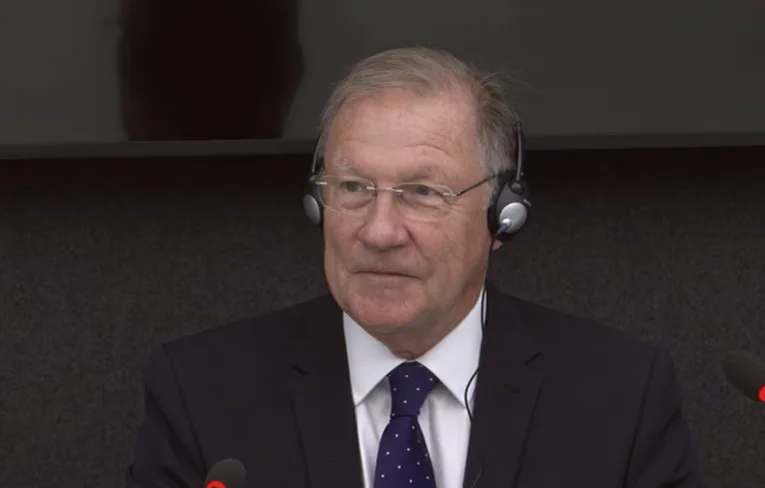
(9 months ago)John Duncan, former adviser to NATO Commander Wesley Clark, will continue his testimony at The Hague Special Court. Duncan is still being questioned by the Prosecutor and the judges, and then lawyers have additional questions. John Duncan, a career diplomat with over 35 years of experience, is Hashim's next defence witness. [...]
John Duncan, former adviser to NATO Commander Wesley Clark, will continue his testimony at The Hague Special Court.
Duncan is still being questioned by the Prosecutor and the judges, and then lawyers have additional questions.
John Duncan, a career diplomat with over 35 years of experience, is Hashim Thaci's next defence witness.
Among the most important topics he spoke of was the organisation of the Kosovo Liberation Army.
According to Duncan, The KLA had no structure, and this had made it difficult for them to work on the demilitarisation agreement.
As a rule, NATO would invite the top commanders and a deal would be made between General Clark and whoever was from the other side. We would never go to regional level. This serves to understand the hierarchical structure. So, how it worked there”, he said.
This was the difficulty we were facing there because they had no hierarchical structure. They were organized differently. The powers were different in different countries”, he said at The Hague Special Court.
Duncan stressed that in Kosovo, they could not go to talk to Thaci or Agim Ceku, and take the matter as carried out. He added that talks should be made with commanders and zones.
We couldn't just go talk to Thaci or Ceku and think we solved the problem. That's how things worked. We had to talk to persons who had powers and those who had competencies were the commanders of the” zones, the Duncan witness said further.
He reiterated that real power had the commanders of the zones.
The real movement in the KLA facility was the commanders from the regions, and this was confirmed when we met General Agim Ceku at the start of negotiating the” agreement, he said.
Duncan also spoke to Agim Ceku and what he had stated.
“That's Ceku, added that I do not do such a thing if the commanders of the” do not participate in the negotiations, Duncan said.
To that end, Thaci's defence published two videos from the demilitarisation talks.
The commanders there were seen as Ramush Haradinaj and Rrustem Mustafa, but others -- Jakup Krasniqi, Kadri Veselini, Xhavit Haliti.
“Smells war, smells like gunpowder”, the British diplomat said.
Duncan also spoke of Thaci's role.
It was unrealistic to recognise Mr. Thaci as Kosovo political leader. They had political forces that existed there like the LDK, Mr Rugova and others. They could have chosen him as leader of the Rambouillet delegation, but he was not what was called political legitimacy in a democratic society. They were not chosen by the people. He had declared an Interim Government, but we were achieved at the point that we and NATO recognised him as Kosovo prime minister. It was not realistic and did not represent reality and was not politically sustainable”, he said.
According to him, Thaci did not have full democratic legitimacy at the time, and many decisions sought the consent of the commanders of the zones; he himself “has not seen” Tell him to give orders or directives.
I've never seen him give directions, or orders, it was clear that we were dealing with two kinds of people, the first with military officer, and the second the politician. That was the impression that it was created to me”, Duncan said. He also said the KLA wanted to show itself as if they were not only guerrilla armies in the mountain.
Duncan named Serbian propaganda the claim that the KLA had strict structure and hierarchy as a regular army.
Serbian propaganda, as I understood it from the information I received. They started calling them terrorists and then looking at them as a real rowing, like a regular and disciplined army with hierarchy and operating as a regular army of”, he said.
According to him, it was a very easy “to dress some persons in uniforms and beta” to create discipline images, but this did not represent a well-organised structure.