2 hours ago
The Telegraph: Sushica pollution threatens the Vjosa River
Periskopi(9 months ago)
(9 months ago)Up in the mountains of Albania, a line segment that was once intact now resembles a construction site. A country that was supposed to be a haven for species such as otters, Egyptian triggers and Balkan belts at critical risk of extinction has now become an ugly chaos, filled with plastic, scraps of wind and concrete. [...]
Up in the mountains of Albania, a line segment that was once intact now resembles a construction site.
A country that was supposed to be a haven for species such as otters, Egyptian triggers and Balkan belts at critical risk of extinction has now become an ugly chaos, filled with plastic, scraps of wind and concrete.
White gravel beds have been eroded by heavy machinery. Big blue tubes are piled up on the side of the road, ready for deployment. Engineers are in the process of diverting millions of litres of water from the mountains towards the Adriatic coast, where a construction boom is turning the country that was recently considered the most preserved holiday secret in Europe.
The “are taking this water and sending it to the coast for tourist and luxury developments,” said Kaltrine Hyka from EcoAlbania, an environmental organisation.
You can already see there's very little water left. We've been following this case for a year and a half. The process is still under way, but in the meantime, work continues. ”
Sushica is a branch of the much larger Vyosa River, one of the last wild rivers in Europe that flows freely, with its water laden with mud, without being hampered by dams, thresholds, or other blockades.
In 2023, after a ten - and - so - long ten - year war, Vjosa 170 miles long was declared Europe's first national wildlife park, with its apparent protection, will be permanently guaranteed.
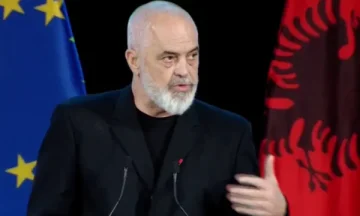
Albania's government was praised for its vision, while Prime Minister Edi Rama called it “a truly historic moment”.
But two years later, there is a huge gap between the promises then made and the current situation on the ground.
The girl, far from being an intact river paradise, is in serious danger.
Much of the damage being done to the river, which stems from the mountains of Pindi in Greece and flows into the Adriatic, is directly linked to the extraordinary tourism boom this small Balkan country has experienced in recent years.
“Uncontrolled and large-scale tourism development threatens the park's integrity,” warned a report by an environmental groups coalition in July.
Ten years ago, when Albania was still considered one of the last borders of Mediterranean tourism, about three million people visited it.
Since then, the number of visitors has increased dramatically in 2023, about 10 million tourists arrived. Last year, this small nation, with a population of only 2.4 million, hosted almost 12 million tourists.
Renowned stars, including singer I Love Lipa, Donald Trump's daughter, Ivanka, and singer Enrique Iglesias, have visited Albania. Lipa is born in London by Albanian parents and currently holds Albanian citizenship.
Mr Rama, who won a fourth historic mandate as prime minister in May, dreams of attracting up to 30 million tourists by 2030.
Mirela Godbaro, Albania's environment minister, told The Telegraph that the water loss project started in 2019, four years before the national park was declared, and that “stum independent” showed that it would not harm the biodiversity of the “river or the ecological integrity of the park”.
But drawing water is not the only threat to Vjosa at all.
Snow is being dug by escavators and used for construction, including the construction of a new giant airport at the mouth of the river, among the evils habitats of wild birds and golden hooks.
Testing flights have already been carried out, and the airport, which will be able to accept transatlantic planes, is expected to open next summer.
It is part of a strategy for the development of southern Albania, including the plans of Jared Kouchner, Donald Trump's son-in-law, to build a 1.2 billion-pound mega-resort with 10,000 rooms in an intact part of the coastline.
In other parts of the river, bitumen is extracted for use in road construction, while waste is dumped on large surfaces, just by the river.
And the river is being systematically polluted by the many oil spills coming from hundreds of wells scattered over the hills and valleys on both sides of Vjosa.
They absorb oil from the underground and pump it through cracks and leaks toward the amortized concrete bunkers.
Instead of treating the contaminated oil water that produces industries, irresponsible oil companies simply pour it into streams from where it ends directly in Vjo.
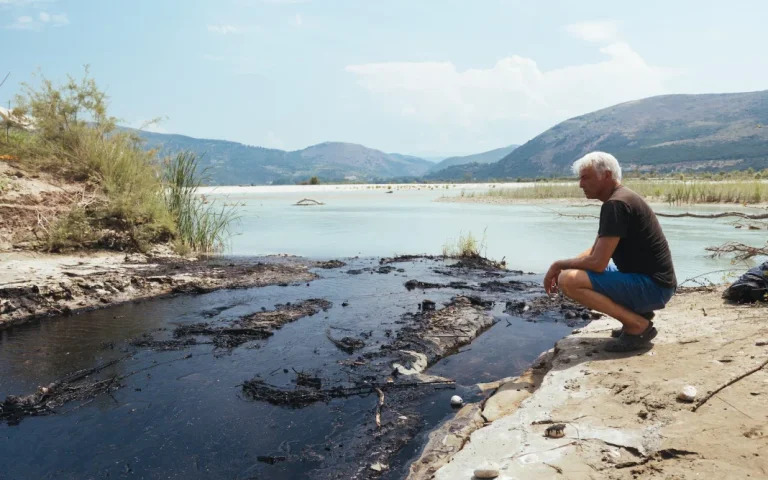
Bowed on the edge of a stream, biologist Leonard Tonight touches on a thick black and bright oil mass that is slowly entering the water.
Look at this. We're at the heart of the national park. If that happened in Yellowstone or Serengeti, people would go crazy,” said project manager from EuroNatur, a German nature conservation organisation. “National Park is being treated as a waste dump. It's incredible. ”
The bitumen has been spilled into the stream by a nearby group of oil wells. Standing on the coast of Vjosa, the smell of oil is like being in a car store.
Among the reed bushes lies an old refrigerator door, some orange plastic tubes, and discarded cigarette packages. About a hundred yards away is a small farm where Frisian cows and filthy sheep graze the grass.
An Albanian flag yellowed by the sun the two-headed black eagle over the red background waves from a wooden pole.
Oil companies collect this contaminated oil water and then release it into streams. We've been monitoring this for eight years and it happens over and over again. And that happens right in the heart of the national park,” said Olsi Nica, executive director of Eco-Albana.
The organisation fought for a decade to declare the Vjosa National Park River.
During this battle, they rejected dozens of proposals for dam construction along the river. This, at least, was a clear victory the government has pledged that no dam would ever be built.
But with authorities who seem to close their eyes to actions that deeply damage Vjosa and her entire ecosystem, the river battle has again begun with full intensity.
“Albania is no longer Europe's hidden treasure. They're building everywhere, destroying the environment. They think only for today, not tomorrow,” said Esmeralda Topi, activist from an organization to verify facts called Factoje, which holds the government responsible.
They say they're protecting the river, but you see the defense is only on paper. On the ground, the situation is quite different. ”
Albania is sold as an undiscovered green corner of Europe, with empty bays, long sandy beaches, wild mountains, and clean rivers. But rhetoric does not match reality.
At a bend of the river near the southern city of Tepelena, there is an even more shocking sight than the flow of oil.
A large garbage dump is located just on the coast of Vjosa, just a few yards from its gravel fields and measles. The ravens sting the smelly waste. The plastic flies in the wind. There's no division of materials here, no recycling, no waste management system.
They burn it over and over again to try to remove it, or they expect winter floods and waste goes into the river. It's like in Africa,” said Mr. Nica, who recently won an important award for his struggle to save Vjosa. “This is just a municipal warehouse along the river. There are many others. ”
Strangely, authorities are building a new national park centre just near the garbage dump. Environmental defenders hope that the shame of the presence of deposit will move the government to action, but at the moment there are no plans to clean up and rehabilitate the earth. The government says that all these harmful activities - exhumation, water loss, waste depots, and oil flows - will be gradually eliminated within 10 to 15 years.
Ms. Godbarko, the environment minister, says many of the problems date from the time of communism in Albania, which lasted until 1990, and years of transition to democracy that followed.
Many of these activities have been dysfunctional for years, but their environmental tracks remain,” she said, stressing that the government is doing its best to improve waste management and sewage treatment throughout Vjosa.
“We are working to eliminate inherited pollution, combining rehabilitation with new infrastructure and sustainable economic alternatives for local residents living near the Vjesa for centuries and cannot be excluded within months of activities that are vital to them,”, she told The Telegraph. Fulfilling the status conditions of the national park is “a complex and long-term” process that requires “times, capacity building, infrastructure investments and close co-operation with local communities,” she added.
But for conservationists, does the national park's 2023 proclamation seem to be an empty victory?
Mr. Ols said. We managed to stop all proposed dams and hydropower projects, which was a big success. But there is still much to do.
“We have this treasure, a raging river that flows over, one of the last in Europe, and is being treated as a waste depot. We have to pressure the Albanian government to clean up this mess. We have hope but this will not be an easy fight. ”/The Telegraph/