5 hours ago
Havenier: Kurti's statements against Constitutional Court led to suspension of Strategic Dialogue
Periskopi(9 months ago)
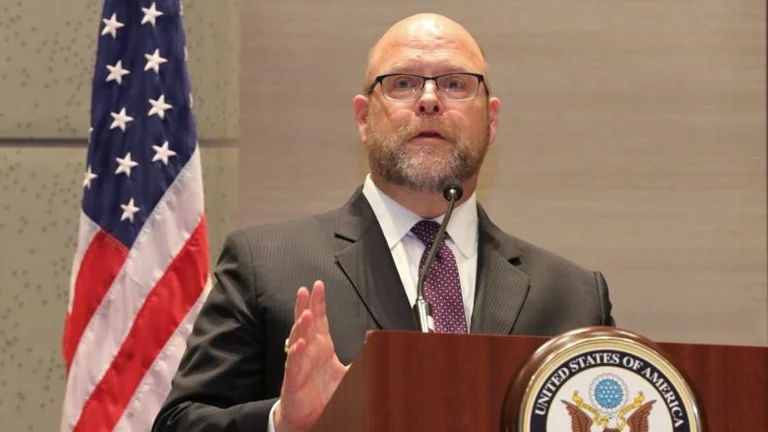
(9 months ago)Former US Ambassador to Kosovo Jeffrey Havenier explains that suspending Strategic Dialogue from the United States is the result of a gathering of frustrations to the Government of Kosovo's incumbent prime minister, Albin Kurti, where his criticism of the Constitutional Court particularly affected him. In an interview for Radio Free Europe, Havenier says suspension must be received [...]
In an interview for Radio Free Europe, Havener says the suspension should be taken seriously and named as a “potential loss” for strengthening the partnership between Kosovo and the US.
On 12 September, the US suspended the Strategic Dialogue with Kosovo, rationalising the decision with the actions of the incumbent government and increasing tensions and instability in the country.
Kosovo's incumbent government dismissed US criticisms, saying that our <x0 actions -- legitimate and constitutional -- all the time have been in service of eliminating destabilities”.
“ [Strategic Dialogue] would be an important step for Kosovo, and it is a pity it will not happen. This does not mean that continued co-operation has been suspended or damaged, but it does mean that an opportunity to increase and strengthen it, at the moment, is frozen. This should bring attention to all who worry about the power and vitality of the relationship”, says Hovier, now senior non-resident associate at the Atlantic Council Centre for Europe.
Ambassador Havenier, how serious is Washington's decision to suspend Strategic Dialogue with Kosovo?
Jeffrey HovnierI think we should take it seriously. Strategic dialogue is a diplomatic instrument the United States uses to advance bilateral relations with different countries. It includes high-level discussions on a broad agenda, defined in advance.
We have never before had formal Strategic Dialogue with Kosovo. But we are engaged in such processes with several countries in Southeast Europe: Bulgaria, Romania, Greece, Croatia, Northern Macedonia.
These include security, protection, energy security, trade, investment, cyber security, human connections. The idea is to promote stability and prosperity, greater participation or integration into European and Euro-Atlantic institutions.
[Strategic Dialogue] would be an important step for Kosovo, and it is a pity it will not happen. This does not mean that continued co-operation has been suspended or damaged, but it does mean that an opportunity to increase and strengthen it, at the moment, is frozen.
What message is the US trying to send to the Kosovo leadership with this step?
Jeffrey Hovnier: If you read the US statement, the one issued by the US Embassy in Pristina at the time of the announcement, it is clear that this decision was made by Washington authorities, as a result of their perception that the government of incumbent Prime Minister [Albin] Kurt's not co-operating enough. They consider that, despite US suggestions, suggestions and efforts, the prime minister and his government in office continue to take actions that, according to the United States, directly and negatively affect security and stability in the region.
Note, though, that this view does not seem to be just from the United States. European partners have also continued to voice genuine concerns over some of the government's political elections in office, Kurti.
If everything was fine, Strategic Dialogue would not be suspended
Could this be the lowest point in relations since independence?
Jeffrey Havenier: It's hard to say because there have been other challenges in this bilateral relationship before. But that is not a pleasant situation. This is a bad obstacle to realising the vision that the US has had since independence, and that the people of Kosovo have also had, for improved co-operation and a stronger partnership.
One thing I've noticed in social networking posts and other official statements is that some are trying to downplay it. Some say Albin Kurti and the Kosovo government still have good relations with the US, but that, simply, is not true. If everything was fine, there would have been no need for this decision to suspend the Strategic Dialogue temporarily or indefinitely.
This indicates that the Trump administration was so frustrated that it felt that it had to take action because public statements were not enough to restore the relationship as it wanted.
Why is Strategic Dialogue important for Kosovo?
Jeffrey Havenier: I think it's important for Kosovo because of the opportunities it offers. As I said earlier, the topics discussed in this dialogue are protection, security, energy security, trade, investment, economic growth, cyber security and strengthening human ties.
During my three years as ambassador to Kosovo, these were the things the people of Kosovo really wanted to see more and more.
Strategic dialogue enables greater and deeper co-operation. It works like this: delegations go to Washington, or delegations come to Pristina; The U.S. government brings people from the Department of Energy, Department of Defense, Department of Agriculture, Department of Commerce... In a way, the entire Government works to strengthen the relationship. So losing this opportunity is a huge loss.
The Point That Filled the Cup
Some argue that this is the result of the frustration gathered against the Kurti government. Not long ago, when you were in the ministry, we have seen similar situations, as you said before. What do you think is the reason for this decision now?
Jeffrey Havenier: Clearly, I don't speak for the Trump Administration, so it's hard to explain exactly its motives and decisions.
I'll give you my assessment, which may be wrong. I don't think there was one act that led to this decision. I also think it was a collection of frustrations, or, to use an American expression, that filled the cup.
I think the last act that led to this decision led people in Washington to decide that they had to take action were statements from the prime minister and others in his government that directly criticised the Constitutional Court, an independent institution founded on the Constitutions, in drafting which the US has contributed.
From the point of view of each observer, this seemed inconsistent with the principles of a good democracy, the protection of the independence of the courts, and the court's respect for the decision - making capacity.
I think that, maybe, was the main cause. But it was not just a reaction. It was a reaction after a series of efforts by American officials in this administration, including a recent visit by European Affairs Office senior official Brendan Hanrahan, to Pristina, where he met with President [Vjosa] Osmani and Prime Minister [in office] Kurt, to discuss how to improve the relationship.
I wasn't there, but I think the discussion was related to closer co-operation with the US, about how Kosovo would address the complex issues of support for the Serb community and other non-US communities.
The American government has the impression that incumbent Prime Minister Kurti's government is not listening.
Besides suspending this dialogue, what other measures could the US take to increase pressure on Kurt?
Jeffrey Havenier: I don't know the answer to that. The challenge facing the U.S. Government, as faced during my time, is that there are some priorities that often contradict each other, while a top priority remains very important.
The United States government and the American people support Kosovo. We support its journey as a European and Euro-Atlantic state, as a multiethnic democracy, as a source of stability and security in Southeast Europe, and are committed to supporting the people of Kosovo. You see this in many ways: programs, activities, commitments, people...
If you go to almost every university in Kosovo, you will find that Americans have helped with their establishment, helped with their curriculum, or are still present... So, the United States wants to continue to be one of the closest partners if not the closest partner Kosovo has.
We know the horror of the ethnic cleansing of the 1990s and are proud to help the people of Kosovo create and consolidate their state.
The administration of [former American-president, Joe] Beden and now the Trump administration have real concerns about certain actions and political decisions of Prime Minister Kurti's government. It's so simple.
This administration has reached the same conclusion as the previous administration: the best way to address the sensitive issue of supporting further integration of Kosovo and its sovereignty is to respect the rights and status of non-US communities, especially the Serb community, by respecting constitutional provisions, so that that that community can live in terms of dignity and security.
Kosovo security remains US priority
Is it possible that the current US administration will set conditions for broader co-operation, for example, in the field of security or assistance if it feels ignored?
Jeffrey Havenier: I don't know the answer. I can only say that it is an American priority for Kosovo to be safe. We are proud to be helping the Kosovo Security Force become a multiethnic force capable of working with NATO, and with the territorial defence mission. This is a very important part of security and stability.
But I would say that this administration of which I am not a part has been more willing to take actions that other administrations have not taken. Therefore, any Kosovo government should be sure to co-operate closely with the US.
I have noticed that the president [Vhosa] Osman keeps talking about the need to coordinate with the United States... and even when we don't agree as friends and partners to sit down together and find common ways to move forward. This is very important.
But some feel that US attention is now not so much in the Balkans...
Jeffrey HavenierI think that's true. The US is a global power and can follow developments and protect its interests worldwide. But, it is true that in the early 1990s and early 2000s, the Kosovo issue received direct attention from the president, Secretary of State, National Security Adviser and Secretary of Defence. It's not like that anymore, and that's something positive. It means it's getting more regular, more normal.
There are probably more people who deal with Kosovo and worry about the Kosovo issue than, say, Switzerland or Austria. But, on the other hand, there are many more people who devote time to worrying about American politics on issues like Israel-Palestina or Ukraine.
Our embassies have good people and the US government has experts who pay attention to Kosovo. Kosovo remains a US interest. We are proud of the help we have given to the people of Kosovo to consolidate and create its own state, and we want to see Kosovo succeed.
Kosovo's international success hinges on US partnership
In a hypothetical situation, what would Kosovo look like with less American influence in practice? Can Kosovo navigate without strong American support?
Jeffrey Havenier: This is a decision that belongs only to the people of Kosovo, not to the US. The US will continue to offer friendship and partnership, but the latest decision Kosovo must make.
If I were Kosovo's political leader, I'd be very careful not to do anything that would hurt or negatively affect my relationship with the United States. Almost all the successes Kosovo has achieved in the international arena have included active support from the United States.
So, if this suspension of Strategic Dialogue continues, what risk does Kosovo face, especially in view of Serbia's growing ties with Russia and China?
Jeffrey Havenier: Like I said, Strategic Dialogue is just one of many tools. [His release] represents simply a lost possibility. It doesn't represent more than that, but it's a real loss of opportunity.
Some countries in the region have Strategic Dialogue with the United States, some do not, but I think partnership and co-operation would be strengthened through Strategic Dialogue. So the effect for Kosovo is loss of opportunities and co-operation. Countries working closer to the US are more likely to benefit from greater co-operation.
What message does this decision send to EU and NATO partners for US priorities in the Balkans and especially Kosovo?
Jeffrey Havenier: I don't think they'll end up saying that Kosovo is not a priority. But they will realise that the US is showing greater concern for the lack of good co-operation and the partnership it wants from Kosovo.
Many share that view. Many have also taken action in various ways. During my time in Kosovo, we talked about EU sanctions, which also signaled concern.
US remains partner of Kosovo people
In view of America's role in building the state of Kosovo, what would you say to ordinary Kosovars who might be concerned about the decision?
Jeffrey Havenier: I'd say this: The United States has no intention of abandoning partnership with the people of Kosovo. But, we distinguish between our dedication to Kosovo state, people and institutions and any particular government. And, it is clear that the Trump administration has concerns about the quality of partnership with incumbent Prime Minister Kurti's Government.
And what would you advise Kosovo leaders now, if they wanted to restore confidence in Washington?
Jeffrey Havenier: I was not recently part of talks with the prime minister, his ministers and American counterparts, so I don't know exactly what the US government is recommending right now.
During my time, what we were looking for was closer co-operation on the difficult mechanism of abolishing the Serbian state's support for the Serb community in Kosovo, as well as not taking hasty or unilateral actions, such as closing health clinics, social security offices or other similar things.
We agreed that they should be integrated into the structures of the state of Kosovo, but this should be done in a agreed manner through dialogue [for normalisation of relations with Serbia].
[EU envoy] Peter Sorensen is a very good negotiator. Finding a way forward, to be acceptable to both sides, I believe it continues to be what this administration requires. But, like I said, I haven't been part of these talks since late December.